Question
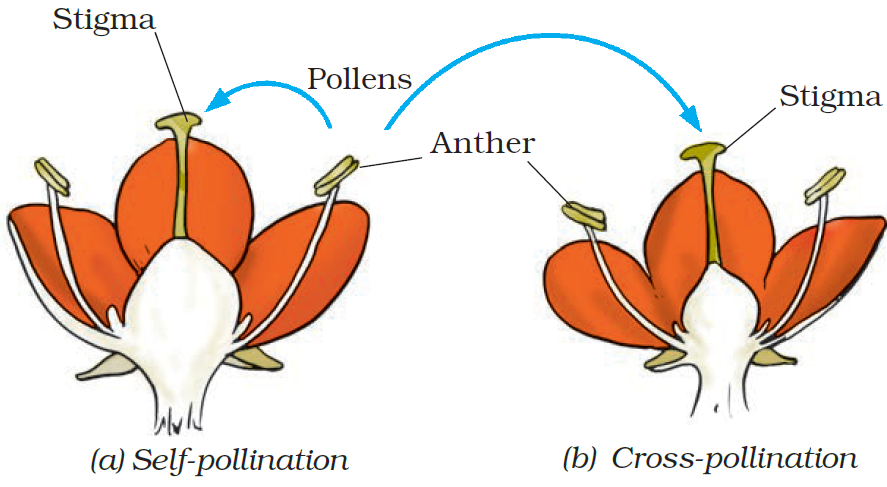
Show self-pollination and cross pollination via a labelled diagram.
Answer


Self pollination: Refers to the transfer of pollen from the anther (male reproductive part) of a particular flower to the stigma (female reproductive part) of the same flower.
Cross pollination: Refers to the transfer of pollen from the anther (male reproductive part) of one flower to the stigma (female reproductive part) of the another flower of a different plant (of same or different species), with the help of an external agent.

Need a full question paper?

Generate a complete, print-ready paper with questions like this in minutes — across 16+ boards, with answer keys.
Start Generating Free

Similar questions

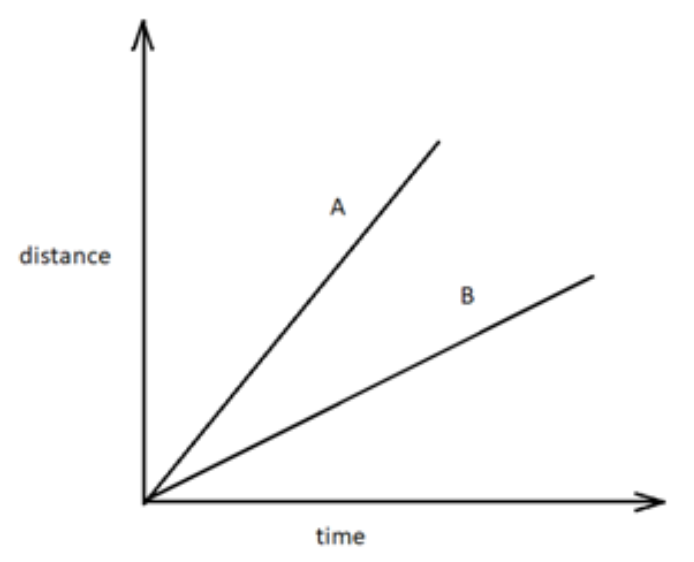
Figure shows the distance-time graph for the motion of two vehicles A and B. Which one of them is moving faster?

Image

Figure: Distance-time graph for the motion of two cars

Name the animals which shows these adaptations.
Write in detail about the adaptations in different animals living in tropical rainforests.
Differentiate between a convex and a concave lens.
Describe the functioning of excretory system.
State similarities and differences between the laboratory thermometer and the clinical thermometer.
Priya’s grandfather was taken to the hospital as he was unable to perform excretory processes. Priya heard a nurse talking to her father that her grandfather’s has kidney failure and needs to undergo dialysis. Priya later asked her father as to what is dialysis process and why does grandpa needs it. Her father smiles and tells her all the facts associated with this process.
  1. What do you mean by dialysis?
  2. Why is there a need for dialysis in some people?
  3. Excretion is an important life process. How?
  4. Which is the major excretory organ in humans?
  5. What values do you observe in Priya?
Does transpiration serve any useful function in the plants? Explain.
Study the following statements about ozone.
I. It is essential for breathing of living organisms.
II. It is used to disinfect water.
III. It absorbs ultraviolet rays.
IV. Its proportion in air is about 3%.
Which of these statements are correct?
(a) I, II and III
(b) II and III
(c) I and IV
(d) All of the above
Match the organs in Column $I$ with the words listed in Column $II.$
  Column I   Column II
$(a)$ Rectum $(i)$ Mucous
$(b)$ Gell bladder $(ii)$ Villi
$(c)$ Stomach $(iii)$ Taste buds
$(d)$ Tongue $(iv)$ Faeces
$(e)$ Small intestine $(v)$ Bile juice