Question
Show that $(a - b)^2, (a^2 + b^2)$ and $(a + b)^2​​​​​​​$​​​​​​​ are in AP.

Answer

The given number are $(a - b)^2, (a^2 + b^2)$ and $(a + b)^2​​​​​​​$​​​​​​​.
Now,
$(a^2 + b^2) - (a - b)^2 = a^2 + b^2 - (a^2 - 2ab + b^2) = a^2 + b^2 - a^2 + 2ab - b^2 = 2ab$
$(a + b)^2 - (a^2+ b^2) = a^2 + 2ab + b^2 - a^2 - b^2 = 2ab$
So, $(a^2 + b^2) - (a - b)^2 = (a + b)^2 - (a^2 + b^2) = 2ab$ (Constant)
Since each term differs from its preceding term by a constant, therefore, the given numbers are in AP.

Need a full question paper?

Generate a complete, print-ready paper with questions like this in minutes — across 16+ boards, with answer keys.
Start Generating Free

Similar questions

The height of a right circular cone is 20cm. A small cone is cut off at the top by a plane parallel to the base. If its volume be $\frac{1}{8}$ of the volume of the given cone, then at what height above the base is the section made?
Solve for x and y:
71x + 37y = 253,
37x + 71y = 287
$\triangle PQR \sim \triangle ABC , PQ =3 cm, QR =4 cm, PR =5 cm$ $A (\triangle PQR ): A (\triangle ABC )=1: 4$. Construct both triangles
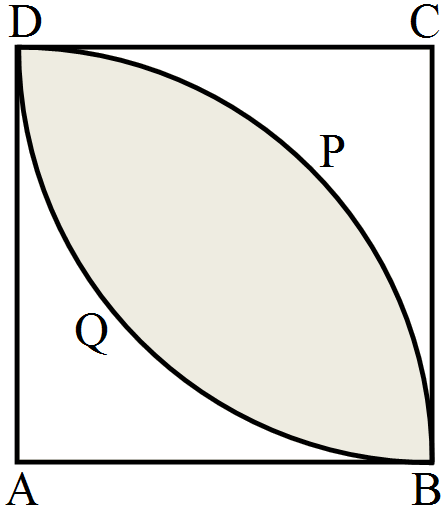
In the given figure, ABCD is a square of side 7cm, DPBA and DQBC are quadrants of circles each of the radius 7cm. Find the area of shaded region.
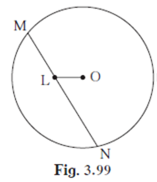
In figure 3.99, seg MN is a chord of a circle with centre O. MN = 25,L is a point on chord MN such that ML = 9 and d(O,L) = 5.
Find the radius of the circle.
Find the HCF and LCM of $\frac{8}{9},\frac{10}{27}$ and $\frac{16}{81}.$
Points $P, Q, R$ and $S$ divides the line segment joining $A(1, 2)$ and $B(6, 7)$ in $5$ equal parts. Find the coordinates of the points $P, Q$ and $R$.
Solve the following equations by using the method of completing the square:
$x^2 + 8x - 2 = 0$
A rocket is in the form of a circular cylinder closed at the lower end and a cone of the same radius is attached to the top. The radius fo the cylinder is 2.5m, its height is 21m and the slant height of the cone is 8m. Calculate the total surface area of rocket.
Solve the following system of equations by the method of cross-multiplication:
$\frac{57}{\text{x}+\text{y}}+\frac{6}{\text{x}-\text{y}}=5,$
$\frac{38}{\text{x}+\text{y}}+\frac{21}{\text{x}-\text{y}}=9.$