Question
Show that a diagonal divides a parallelogram into two triangles of equal area.
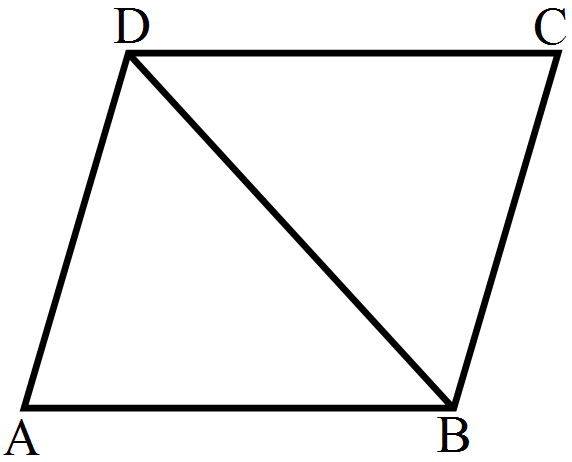 Let ABCD be a parallelogram and BD be its diagonal. To prove:$\text{ar}(\triangle\text{ABD})=\text{ar}(\triangle\text{CDB})$
Generate a complete, print-ready paper with questions like this in minutes — across 16+ boards, with answer keys.
 $\text{ar}(\triangle\text{FED})=\frac{1}{8}\text{ar}(\triangle\text{AFC})$
|
Profits per shop:
|
0-50
|
50-100
|
100-150
|
150-200
|
200-250
|
250-300
|
|
No. of shops:
|
12
|
18
|
27
|
20
|
17
|
6
|