Question
Show that:

$\Big[\Big\{\frac{\text{x}^{\text{a}(\text{a}-\text{b})}}{\text{x}^{\text{a}(\text{a}+\text{b})}}\Big\}\div\Big\{\frac{\text{x}^{\text{b}(\text{b}-\text{a})}}{\text{x}^{\text{b}(\text{b}+\text{a})}}\Big\}\Big]^{\text{a}+\text{b}}=-\frac{3}{2}$

Answer

$\Big[\Big\{\frac{\text{x}^{\text{a}(\text{a}-\text{b})}}{\text{x}^{\text{a}(\text{a}+\text{b})}}\Big\}\div\Big\{\frac{\text{x}^{\text{b}(\text{b}-\text{a})}}{\text{x}^{\text{b}(\text{b}+\text{a})}}\Big\}\Big]^{\text{a}+\text{b}}=1$

$\text{LHS}=\Big[\Big\{\frac{\text{x}^{\text{a}(\text{a}-\text{b})}}{\text{x}^{\text{a}(\text{a}+\text{b})}}\Big\}\div\Big\{\frac{\text{x}^{\text{b}(\text{b}-\text{a})}}{\text{x}^{\text{b}(\text{b}+\text{a})}}\Big\}\Big]^{\text{a}+\text{b}}$

$\Big[\frac{\text{x}^{\text{a}(\text{a}-\text{b})}}{\text{x}^{\text{a}(\text{a}+\text{b})}}\times\frac{\text{x}^{\text{b}(\text{b}-\text{a})}}{\text{x}^{\text{b}(\text{b}+\text{a})}}\Big]^{\text{a}+\text{b}}$

$=\Big[\frac{\text{x}^{\text{a}^2-\text{ab}}}{\text{x}^{\text{a}^2-\text{ab}}}\times\frac{\text{x}^{\text{b}^2+\text{ab}}}{\text{x}^{\text{b}^2-\text{ab}}}\Big]^{\text{a}+\text{b}}$

$=\Big[\frac{\text{x}^{\text{a}^2-\text{ab}+\text{b}^2+\text{ab}}}{\text{x}^{\text{a}^2+\text{ab}+\text{b}^2-\text{ab}}}\Big]^{\text{a}+\text{b}}$

$=\Big[\frac{\text{x}^{\text{a}^2+\text{b}^2}}{\text{x}^{\text{a}^2+\text{b}^2}}\Big]^{\text{a}+\text{b}}$

$=[1]^{\text{a}+\text{b}}$

$=1$

$=\text{RHS}.$
Need a full question paper?

Generate a complete, print-ready paper with questions like this in minutes — across 16+ boards, with answer keys.

Start Generating Free

Similar questions

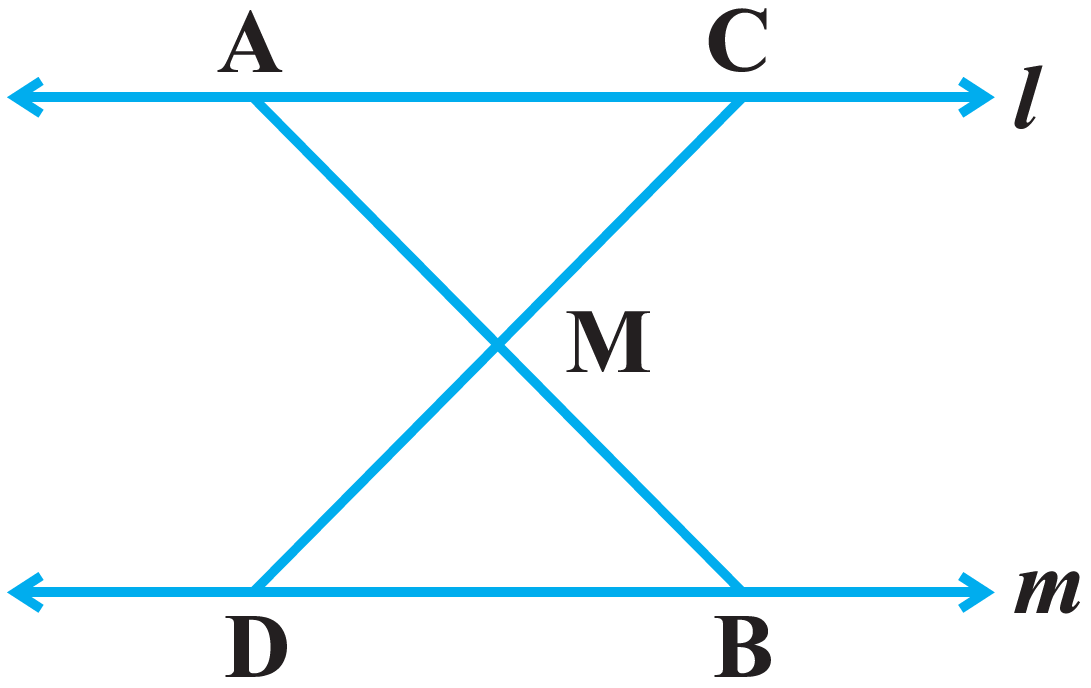
In given $\text{l}\ ||\ \text{m}$ and M is the mid-point of a line segment AB. Show that M is also the mid-point of any line segment CD, having its end points on l and m, respectively.
In each of the following determine rational numbers a and b:
$\frac{\sqrt3-1}{\sqrt3+1}=\text{a}-\text{b}\sqrt3$
From a solid right circular cylinder with height 10cm and radius of the base 6cm, a right circular cone of the same height and base is removed. Find the volume of the remaining solid. $\big(\text{Take}\ \pi=3.14\big).$
A rectangular container, whose base is a square of side 5cm, stands on a horizontal table, and holds water up to 1cm from the top. When a solid cube is placed in the water it is completely submerged, the water rises to the top and 2 cubic cm of water overflows. Calculate the volume of the cube and also the length of its edge.
Factorize:
4(x - y)2 - 12(x - y)(x + y) + 9(x + y)2
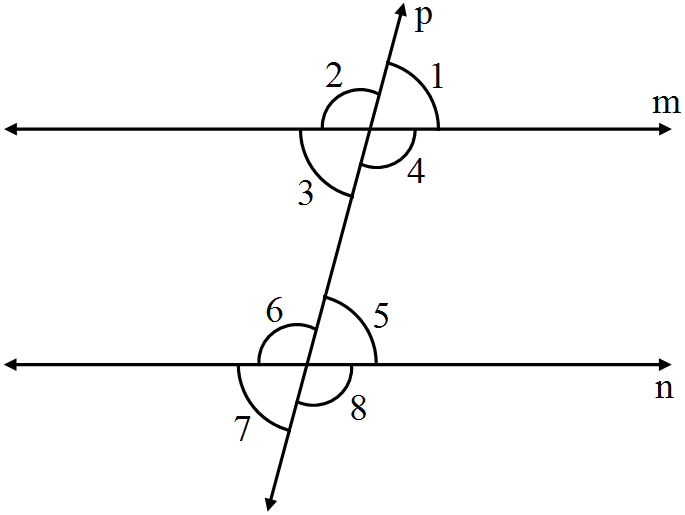
In figure transversal l intersects two lines m and n, $\angle{4}=110^\circ$ and $\angle{7}=65^\circ.$ Is m || n?

In the following, use factor theorem to find whether polynomial g(x) is a factor of polynomial f(x) or, not:
f(x) = 2x3 - 9x2 + x + 12, g(x) = 3 - 2x
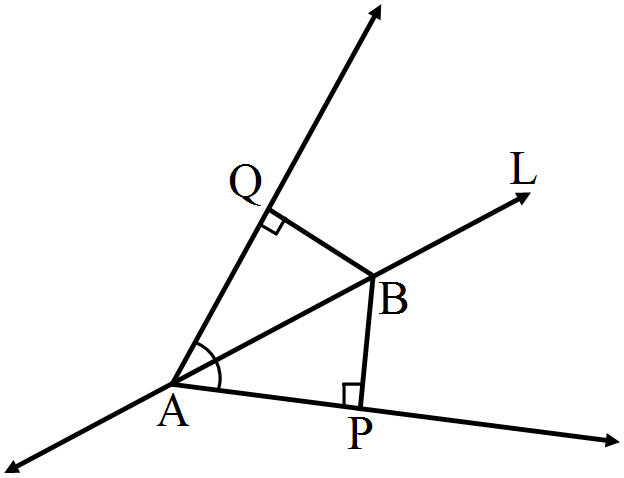
In the given figure, line l is the bisector of an angle $\angle\text{A}$ and B is any point on l. If BP and BQ are perpendiculars from B to the arms of $\angle\text{A},$
Show that:
  1. $\triangle\text{APB}\cong\triangle\text{AQB}$
  2. BP = BQ, i.e., B is equidistant from the arms of $\angle\text{A}.$

Find the following products:
(2a - 3b - 2c)(4a2 + 9b2 + 4c2 + 6ab - 6bc + 4ca)
The lateral surface area of a cylinder is 94.2cm2 and its height is 5cm $\big(\text{Take}\ \pi=3.14\big)$. Find:
  1. The radius of its base.
  2. Its volume.