Question
Show that currents in two long, straight, parallel wires exert forces on each other. Derive the expression for the force.###Derive an expression for the force per unit length between two infinitely long parallel conductors carrying current and hence define the ampere.
Answer

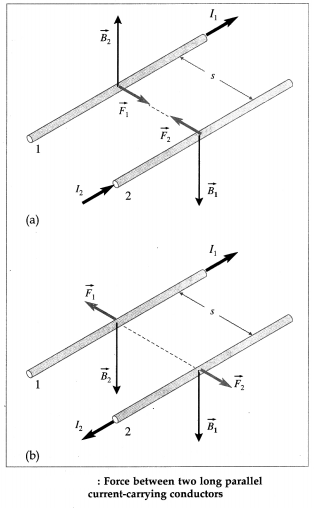
When two currents pass in adjacent parallel straight conductors, we may think of each of the currents as being situated in the magnetic field caused by the other current. This results in a force on each conductor.
Image
Consider two infinitely long, straight, parallel wires, each of length ; a distance s apart in vacuum, as shown in figure (a). The magnetic field around the wire 1 , carrying a current $l_1$ has an induction of magnitude
$
B _1=\left(\frac{\mu_0}{4 \pi}\right) \frac{2 I_1}{s}
$
Wire 2 , with a current $I_2$ in the same direction as $l_1$, is situated in this field. The direction of the field
with induction $\overrightarrow{B_1}$ at the position of wire 2, given by the right hand Igripi rule, is
perpendicular to the plane of the two conductors, as shown. Hence, the force $\overrightarrow{F_2}$ on wire 2
has a magnitude
$
F _2= I _2 \mid B _1=\left(\frac{\mu_0}{4 \pi}\right) \frac{2 I_1 I_2 l}{s}
$
and is, by Fleming's left hand rule, towards wire 1. Similarly, the magnetic induction $\overrightarrow{B_2}$ at the position of wire 1 has a magnitude
$
B _2=\left(\frac{\mu_0}{4 \pi}\right) \frac{2 I_2}{s}
$
and is also directed perpendicular to the plane of the wires. Hence, the force on wire 1 has a magnitude
$F _1=I_1 \mid B _2=\left(\frac{\mu_0}{4 \pi}\right) \frac{2 I_1 I_2 l}{s}$
directed towards wire 2 . Thus, the two currents attract each other. $\vec{F}_1=-\vec{F}_2$, i.e, they are equal in magnitude and opposite in direction.
Ampere found that the wires attracted each other when the currents in them were in the same direction [from figure (a)], and repelled each other when they were in the opposite directions [from figure (b)].
From the Eq. (2), the force per unit length acting on each wire is $\frac{F}{l}=\left(\frac{\mu_0}{4 \pi}\right) \frac{2 I_1 I_2}{s}$
Using SI units, $\mu_0 / 4 \pi=10^{-7} N / A ^2$ and, if $I _1= I _2=1 A$ and $s =1 m$, then $\frac{F}{l}=2 \times 10^{-7} N / m$
In $SI$, this equation is the defining relation for the ampere.
Definition: The ampere is that constant current which if maintained in two infinitely long straight parallel wires, and placed one metre apart in vacuum, would cause each conductor to experience a force per unit length of $2 \times 10^{-7}$ newton per metre. [Note : $1 Wb / A \cdot m =1$ $T \cdot m / A =\mid N / A ^2$.]

Need a full question paper?

Generate a complete, print-ready paper with questions like this in minutes — across 16+ boards, with answer keys.

Start Generating Free

Similar questions

Two wires, each $1 m$ long and of the same diameter, have densities $8 \times 10^3 kg / m ^3$ and $2 \times$ $10^3 kg / m ^3$ and are stretched by tensions $196 N$ and $49 N$, respectively. Compare their fundamental frequencies.
What is Brewster’s law? Derive the formula for Brewster angle.
A wheel of diameter $40 \mathrm{~cm}$ starts from rest and attains a speed of $240 \mathrm{rpm}$ in 4 minutes. Calculate its angular displacement in this time interval.
Obtain an expression for the electric field intensity at a point outside an infinitely long charged cylindrical conductor.
Derive an expression for the angular speed of the bob of a conical pendulum.
OR
Derive an expression for the frequency of revolution of the bob of a corical pendulum.
The threshold wavelength of tungsten is $2.76 \times 10^{-5} cm$. (a) Explain why no photoelectrons are emitted when the wavelength is more than $2.76 \times 10^{-5} cm$.(b) What will be the maximum kinetic energy of electrons ejected in each of the following cases
(i) if ultraviolet radiation of wavelength $\lambda=1.80 \times 10^{-5} cm$ and
(ii) radiation of frequency $4 \times 10^{15} Hz$ is made incident on the tungsten surface.
Using Ampere’s law, derive an expression for the magnetic induction inside an ideal solenoid carrying a steady current.
The width of a plane incident wavefront is found to be doubled in a denser medium if it makes an angle of 70° with the surface. Calculate the refractive index for the denser medium.
State the causes of induced current and explain them on the basis of Lena's law.
Explain the reduction of electric field inside a polarized dielectric.
OR
Explain the behaviour of a dielectric slab which is subjected to an external electric field.