Question
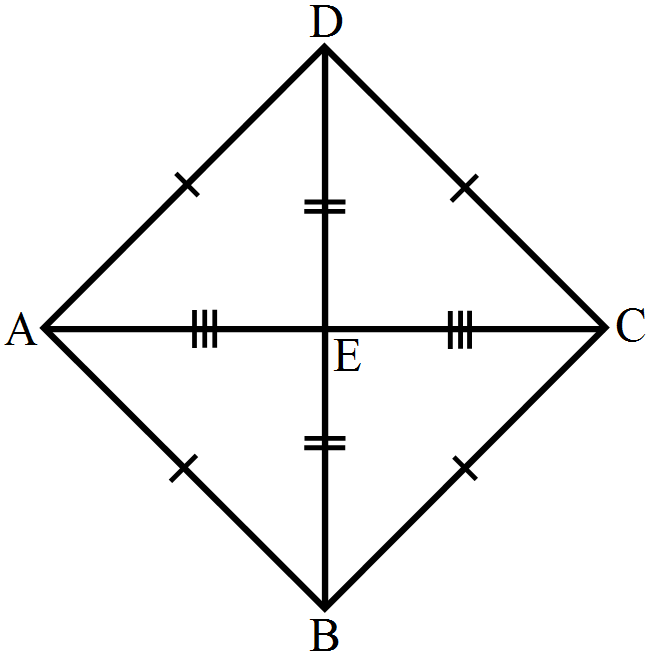
Show that each diagonal of a rhombus bisects the angle through which it passes.
Answer


In $\triangle\text{AED}$ and $\triangle\text{DEC}$:
$\text{AE}=\text{EC}$ (diagonals bisect each other)
$\text{AD}=\text{DC}$ (sides are equal)
$\text{DE}=\text{DE}$ (common)
By SSS congruence:
$\triangle\text{AED}\cong\triangle\text{CED}$
$\angle\text{ADE}=\angle\text{CDE}$ (c.p.c.t)
Similarly,
we can prove $\triangle\text{AEB}$ and $\triangle\text{BEC}$,
$\triangle\text{BEC}$ and $\triangle\text{DEC}$,
$\triangle\text{AED}$ and $\triangle\text{AEB}$ are congruent to each other.
Hence, diagonal of a rhombus bisects the angle through which it passes.

Need a full question paper?

Generate a complete, print-ready paper with questions like this in minutes — across 16+ boards, with answer keys.

Start Generating Free

Similar questions

Solve the following equation and also check your result in case: $\frac{6\text{x}+1}{2}+1=\frac{7\text{x}-3}{3}$
State true or false. Explain your reasoning.
(i) The cube of any odd number is even.
(ii) There is no perfect cube that ends with 8.
(iii) The cube of a 2-digit number may be a 3-digit number.
(iv) The cube of a 2-digit number may have seven or more digits.
(v) Cube numbers have an odd number of factors.
With the decrease in prices of tea by $15%$ Tonu, the chaiwallah, was able to buy $2\ kg$ more of tea with the same $Rs. 45$ that he spent each month on buying tea leaves for his chai shop. What was the reduced price of tea? What was the original price of tea?Assessment Report for $2009-2010$
Class: 9B Name: Vidit Atrey Date: $31$ March $2010$
Subject Internal assessment Examination Total Final%
English Literature $\frac{20}{25}$ $\frac{82}{100}$ $\frac{102}{125}$  
English Language $\frac{22}{25}$ $\frac{91}{100}$ $\frac{113}{125}$  
Hindi Literature $\frac{18}{25}$ $\frac{67}{75}$ $\frac{85}{100}$  
Hindi Language $\frac{16}{25}$ $\frac{68}{75}$ $\frac{84}{100}$  
Mathematics $\frac{42}{50}$ $\frac{88}{100}$ $\frac{130}{150}$  
Sanskrit $\frac{14}{20}$ $\frac{75}{100}$ $\frac{99}{120}$  
Physics $\frac{45}{50}$ $\frac{90}{100}$ $\frac{135}{150}$  
Chemistry $\frac{41}{50}$ $\frac{82}{100}$ $\frac{123}{150}$  
Biology $\frac{43}{50}$ $\frac{87}{100}$ $\frac{130}{150}$  
History and Civics $\frac{19}{25}$ $\frac{68}{75}$ $\frac{87}{100}$  
Geography $\frac{17}{20}$ $\frac{71.5}{80}$ $\frac{88.5}{100}$  
The volume of a cube is $9261000\ m3$. Find the side of the cube.
Simplify and express the result in power notation with positive exponent.
(i) $(-4)^5+(-4)^8$ $\qquad$ (ii) $\left(\frac{1}{2^3}\right)^2$ $\qquad$
(iii) $(-3)^4 \times\left(\frac{5}{3}\right)^4$ $\qquad$ (iv) $\left(3^{-7}+3^{-10}\right) \times 3^{-5}$ $\qquad$
(v) $2^{-3} \times(-7)^{-3}$
Solve:
$x^2+ 12x + 20$
Replace $A, B, C$ by suitable numerals.
$ \ \ \ \ \ \ \ \ \ \ \ \text{A B}\\\underline{ \ \ \ \ \ \ \times\text{B A}}\\\underline{\text{(B+1)}\text{C B}}$
The count of bacteria in a culture grows by $10\%$ in the first hour, decreases by $8\%$ in the second hour and again increases by $12\%$ in the third hour. If the count of bacteria in the sample is $13125000$, what will be the count of bacteria after $3$ hours?
How many cubic metres of earth must be dug out to sink a well which is $20\ m$ deep and has a diameter of $7$ metres? If the earth so dug out is spread over a rectangular plot $28\ m$ by $11\ m$, what is the height of the platform so formed?
Verify the property: $x \times (y \times z) = (x \times y) \times z$ by taking:
$\text{x}=\frac{1}{2},\text{y}=\frac{5}{-4},\text{z}=\frac{-7}{5}$