Question
Show that every positive odd integer is of the form $(4 q+1)$ or $(4 q+3)$ for some integer $q$.

Answer

Let 'a' be a given positive od integer.
On dividing ' $a$ ' by $4$ , let $q$ be the quotient and $r$ be the remainder.
Then, by euclid's algorithm, we have
$a = 4q + r$, where $0 ≤ r < 4$
$⇒ a = 4q + r$, where$ r = 0, 1, 2, 3$
$⇒ a = 4q$ or$ a = 4q + 1$ or $a = 4q + 2$ or $a = 4q + 3$
But, $a=4 q$ and $a=4 q+2=2(2 q+1)$ are clearly even.
Thus, when ' $a$ ' is odd, it is of the form:
$a=(4 q+1) \text { or }(4 q+3) \text { for some integer } q$But, $a=4 q$ and $a=4 q+2=2(2 q+1)$ are clearly even.
Thus, when ' $a$ ' is odd, it is of the form:
$a=(4 q+1) \text { or }(4 q+3) \text { for some integer } q$

Need a full question paper?

Generate a complete, print-ready paper with questions like this in minutes — across 16+ boards, with answer keys.
Start Generating Free

Similar questions

Solve for $x$ and $y$
$\frac{9}{\text{x}}-\frac{4}{\text{y}}=8,$
$\frac{13}{\text{x}}+\frac{7}{\text{y}}=\text{101}$ $(\text{x}\neq0,\ \text{y}\neq0).$
Short-Answer Question:
If $\alpha$ and $\beta$ are the zeroes of a polynomial $f(x) = 6x^2+ x - 2,$ find the value of $\Big(\frac{\alpha}{\beta}+\frac{\beta}{\alpha}\Big).$
The diagonals of quadrilateral $ABCD$ intersect at $O$. Prove that $\frac{\text{ar}(\triangle\text{ACB})}{\text{ar}(\triangle\text{ACD})}=\frac{\text{BO}}{\text{DO}}.$
If $5\text{A}=\text{cosec }(\text{A}-36^\circ)$ and $5\text{A}$ is an acute angle, show that $\text{A}=21^\circ.$
In a right triangle $ABC$ in which $\angle\text{B}=90^{\circ},$ a circle is drawn with $AB$ as diameter intersecting the hypotenuse $AC$ at $P.$ Prove that the tangent to the circle at $P$ bisects
$BC.$
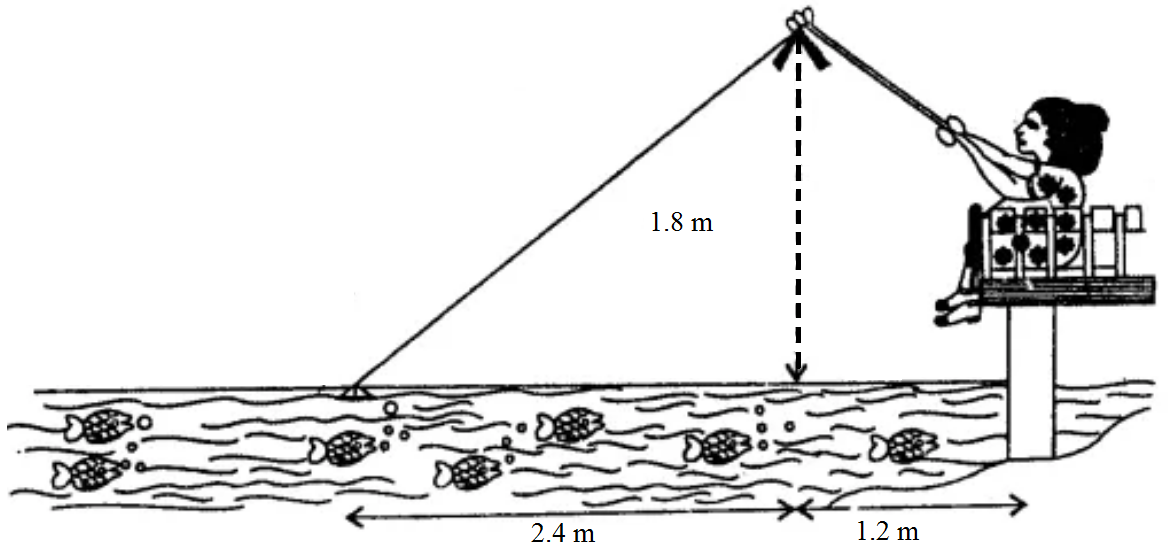
Nazima is fly Ashing in a stream. The tip of her Ashing rod is $1.8\ m$ above the surface of the water and the fly at the end of the string rests on the water $3.6\ m$ away and $2.4\ m$ from a point directly under the tip of the rod. Assuming that her string (from the tip of her rod to the fly) is taut, how much string does she have out? If she pulls the string at the rate of $5\ cm$ per second, what will the horizontal distance of the fly from her after $12$ seconds.
Find the roots of the following quadratic equation (if they exist) by the method of completing the square.
$\text{x}^2-4\sqrt{2\text{x}}+6=0$
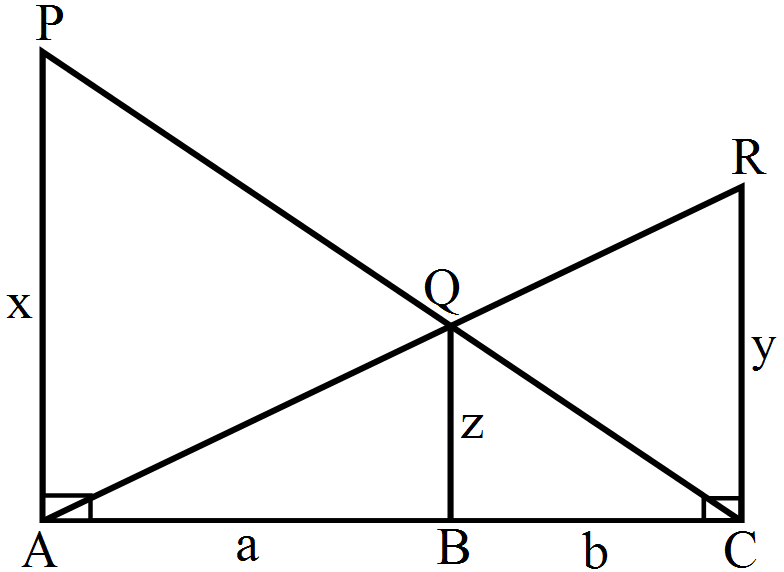
In the given figure, each one of $P A, Q B$ and $R C$ is perpendicular to $A C$. If $A P=x, Q B=z, R C=y, A B=a$ and $B C=b$, show that $\frac{1}{x}+\frac{1}{y}=\frac{1}{z}$.
If $Q(0,1)$ is equidistant from $P(5,-3)$ and $R(x, 6)$, find the values of $x$. Also, find the distances $Q R$ and $P R$.
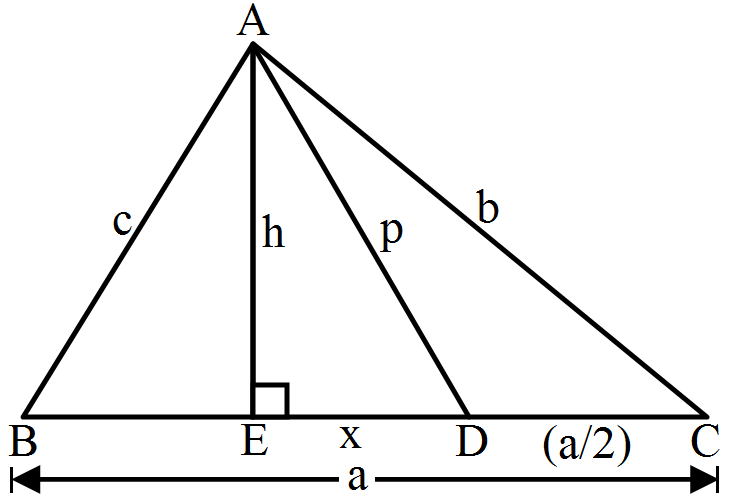
In the given figure, $D$ is the midpoint of side $B C$ and $A E \perp B C$. If $B C=a, A C=b, A B=c, E D=x, A D=p$ and $A E=h$, prove that.

$\text{c}^2=\text{p}^2-\text{ax}+\frac{\text{a}^2}{4}$