Question
Show that for $\text{a}\geq1,\text{ f(x)}=\sqrt{3}\sin\text{x}-\cos\text{x}-2\text{ax}+\text{b}$ is decreasing in R.

Answer

We have,$\text{ f(x)}=\sqrt{3}\sin\text{x}-\cos\text{x}-2\text{ax}+\text{b}$
$\Rightarrow\ \text{f(x)}=\sqrt{3}\cos\text{x}-(-\sin\text{x})-2\text{a}$
$=\sqrt{3}\cos\text{x}+\sin\text{x}-2\text{a}$
$=2\Big[\frac{\sqrt{3}}{2}\cdot\cos\text{x}+\frac{1}{2}\cdot\sin\text{x}\Big]-2\text{a}$
$=2\Big[\cos\frac{\pi}{6}\cdot\cos\text{x}+\sin\frac{\pi}{6}\cdot\sin\text{x}\Big]-2\text{a}$
$=2\cos\Big(\frac{\pi}{6}-\text{x}\Big)-2\text{a}$ $\big[\therefore\cos(\text{A}-\text{B})=\cos\text{A}\cdot\text{B}+\sin\text{A}\cdot\sin\text{B}\big]$
$=2\Big[\cos\Big(\frac{\pi}{6}-\text{x}\Big)-\text{a}\Big]$
Since, $\cos\text{x}\in[-1,1]\text{ and a}\geq1$
$\therefore\ 2\Big[\cos\Big(\frac{\pi}{6}-\text{a}\Big)-\text{a}\Big]\leq0$
We know tha if $\text{f(x)}\leq0,$ then f(x) is a decreasing function.
Thus, f(x) is a decreasing function in R.

Need a full question paper?

Generate a complete, print-ready paper with questions like this in minutes — across 16+ boards, with answer keys.
Start Generating Free

Similar questions

In pre-board examination of class XII, commerce stream with Economics and Mathematics of a particular school, 50% of the students failed in Economics, 35% failed in Mathematics and 25% failed in both Economics and Mathematics. A student is selected at random from the class.

Based on the above information, answer the following questions.

  1. The probability that the selected student has failed in Economics, if it is known that he has failed in Mathematics, is:
  1. $\frac{3}{10}$

  2. $\frac{12}{25}$

  3. $\frac{1}{4}$

  4. $\frac{5}{7}$
  1. The probability that the selected student has failed in Mathematics, if it is known that he has failed in Economics, is:
  1. $\frac{22}{25}$

  2. $\frac{12}{25}$

  3. $\frac{1}{2}$

  4. $\frac{3}{25}$
  1. The probability that the selected student has passed in at least one of the two subjects, is:
  1. $\frac{1}{4}$

  2. $\frac{1}{2}$

  3. $\frac{3}{4}$

  4. None of these.

  1. The probability that the selected student has failed in at least one of the two subjects, is:
  1. $\frac{3}{5}$

  2. $\frac{22}{25}$

  3. $\frac{2}{5}$

  4. $\frac{43}{100}$

  1. The probability that the selected student has passed in Mathematics, if it is known that he has failed in Economics, is:
  1. $\frac{2}{5}$

  2. $\frac{3}{4}$

  3. $\frac{1}{3}$

  4. $\frac{1}{2}$ 

If the equation is of the form $\frac{\text{dy}}{\text{dx}}=\frac{\text{f(x, y)}}{\text{g(x, y)}}$or $\frac{\text{dy}}{\text{dx}}=\text{F}\Big(\frac{\text{y}}{\text{x}}\Big),$ where f(x, y), g(x, y) are homogeneous functions of the same degree in x and y, then put y = vx and $\frac{\text{dy}}{\text{dx}}=\text{v+x}\Big(\frac{\text{dv}}{\text{dx}}\Big),$ so that the dependent variable y is changed to another variable v and then apply variable separable method.
Based on the above information, answer the following questions.
  1. The general solution of $\text{x}^2\frac{\text{dy}}{\text{dx}}=\text{x}^2+\text{xy}+\text{y}^2$ is:
  1. $\tan^{-1}\frac{\text{x}}{\text{y}}=\log|\text{x}|+\text{c}$
  2. $\tan^{-1}\frac{\text{y}}{\text{x}}=\log|\text{x}|+\text{c}$
  3. $\text{y}=\text{x}\log|\text{x}|+\text{c}$
  4. $\text{x}=\text{y}\log|\text{y}|+\text{c}$
  1. Solution of the differential equation $2\text{xy}\frac{\text{dy}}{\text{dx}}=\text{x}^2+3\text{y}^2$ is:
  1. x3 + y2 = cx2
  2. $\frac{\text{x}^2}{2}+\frac{\text{y}^3}{3}=\text{y}^2+\text{c}$
  3. x2 + y3 = cx2
  4. x2 + y2 = cx3
  1. General solution of the differential equation (x2 + 3xy + y2) dx - x2 dy = 0 is:
  1. $\frac{\text{x+y}}{\text{y}}-\log\text{x = c}$
  2. $\frac{\text{x+y}}{\text{y}}+\log\text{x = c}$
  3. $\frac{\text{x}}{\text{x+y}}-\log\text{x = c}$
  4. $\frac{\text{x}}{\text{x+y}}+\log\text{x = c}$
  1. General solution of the differential equation $\frac{\text{dy}}{\text{dx}}=\frac{\text{y}}{\text{x}}\bigg\{\log\Big(\frac{\text{y}}{\text{x}}\Big)+1\bigg\}$ is:
  1. $\log(\text{xy})=\text{c}$
  2. $\log\text{y}=\text{cx}$
  3. $\log\frac{\text{y}}{\text{x}}=\text{cx}$
  4. $\log\text{x}=\text{cy}$
  1. Solution of the differential equation $\Big(\text{x}\frac{\text{dy}}{\text{dx}}-\text{y}\Big)\text{e}^\frac{\text{y}}{\text{x}}=\text{x}^2\ \cos\text{x}$ is:
  1. $\text{e}^\frac{\text{y}}{\text{x}}-\sin\text{x = c}$
  2. $\text{e}^\frac{\text{y}}{\text{x}}+\sin\text{x = c}$
  3. $\text{e}^\frac{\text{-y}}{\text{x}}-\sin\text{x = c}$
  4. $\text{e}^\frac{\text{-y}}{\text{x}}+\sin\text{x = c}$
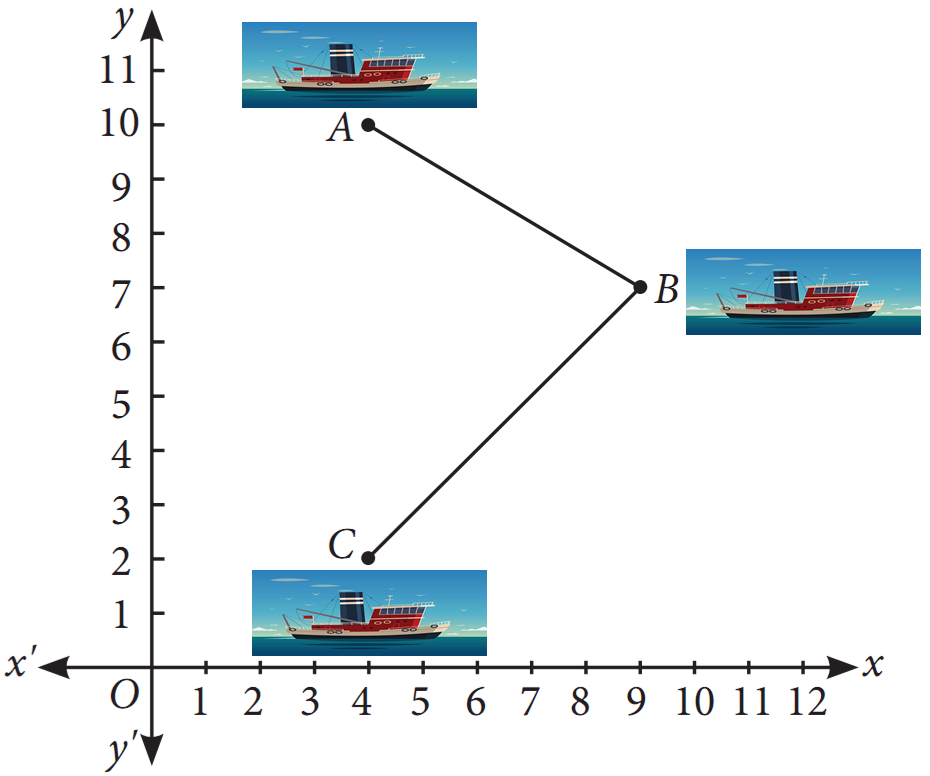
A barge is pulled into harbour by two tug boats as shown in the figure.

Based on the above information, answer the following questions.

  1. Position vector of A is:
  1. $4\hat{\text{i}}+2\hat{\text{j}}$

  2. $4\hat{\text{i}}+10\hat{\text{j}}$

  3. $4\hat{\text{i}}-10\hat{\text{j}}$

  4. $4\hat{\text{i}}-2\hat{\text{j}}$

  1. Position vector of B is:
  1. $4\hat{\text{i}}+4\hat{\text{j}}$

  2. $6\hat{\text{i}}+6\hat{\text{j}}$

  3. $9\hat{\text{i}}+7\hat{\text{j}}$

  4. $3\hat{\text{i}}+3\hat{\text{j}}$

  1. Find the vector $\overline{\text{AC}}$ in terms of $\hat{\text{i}},\hat{\text{j}}.$
  1. $8\hat{\text{j}}$

  2. $-8\hat{\text{j}}$

  3. $8\hat{\text{i}}$

  4. None of these
  1. If $\vec{\text{A}}=\hat{\text{i}}+2\hat{\text{j}}+3\hat{\text{k}},$ then its unit vector is:
  1. $\frac{\hat{\text{i}}}{\sqrt{14}}+\frac{2\hat{\text{j}}}{\sqrt{14}}+\frac{3\hat{\text{k}}}{\sqrt{14}}$

  2. $\frac{3\hat{\text{i}}}{\sqrt{14}}+\frac{2\hat{\text{j}}}{\sqrt{14}}+\frac{\hat{\text{k}}}{\sqrt{14}}$

  3. $\frac{2\hat{\text{i}}}{\sqrt{14}}+\frac{3\hat{\text{j}}}{\sqrt{14}}+\frac{\hat{\text{k}}}{\sqrt{14}}$

  4. None of these
  1. If $\vec{\text{A}}=4\hat{\text{i}}+3\hat{\text{j}}$ and $\vec{\text{B}}=3\hat{\text{i}}+4\hat{\text{j}},$ then $|\vec{\text{A}}|+|\vec{\text{B}}|=$
  1. 12
  2. 13
  3. 14
  4. 10
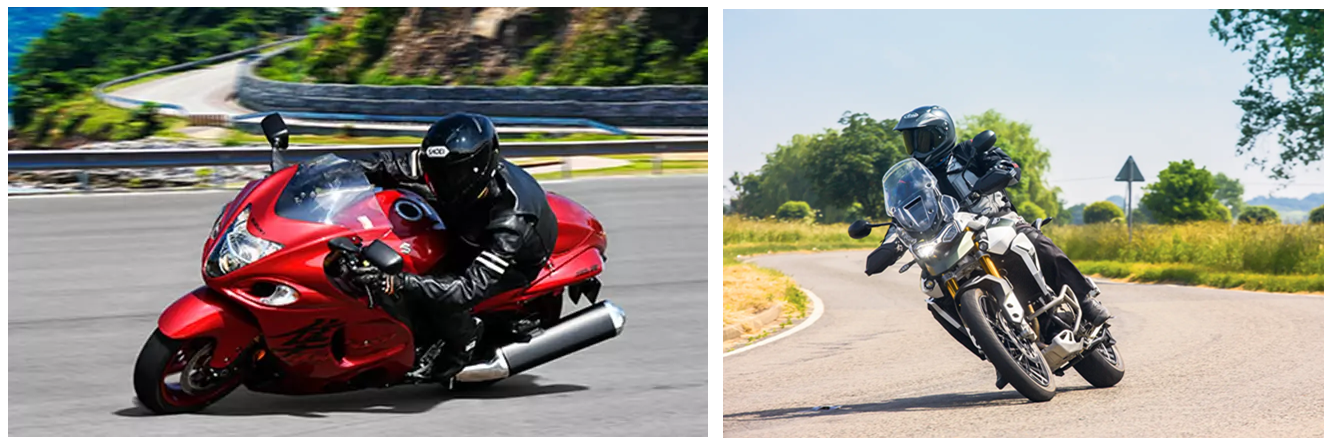
Two motorcycles A and Bare running at the speed more than allowed speed on the road along the lines $\vec{\text{r}}=\lambda(\hat{\text{i}}+2\hat{\text{j}}-\hat{\text{k}})$ and $\vec{\text{r}}=3\hat{\text{i}}+3\hat{\text{j}}+\mu(2\hat{\text{i}+\hat{\text{j}}+\hat{\text{k}}}),$ respectively.

Based on the above information, answer the following questions.

  1. The cartesian equation of the line along which motorcycle A is running is:
  1. $\frac{\text{x}+1}{1}=\frac{\text{y}+1}{2}=\frac{\text{z}-1}{-1}$

  2. $\frac{\text{x}}{1}=\frac{\text{y}}{2}=\frac{\text{z}}{-1}$

  3. $\frac{\text{x}}{1}=\frac{\text{y}}{2}=\frac{\text{z}}{1}$

  4. None of these
  1. The direction cosines of line along which motorcycle A is running, are:
  1. < 1, -2, 1 >
  2. < I, 2, -1 >
  3. $<\frac{1}{\sqrt{6}},\frac{-2}{\sqrt{6}},\frac{1}{\sqrt{6}}>$

  4. $<\frac{1}{\sqrt{6}},\frac{2}{\sqrt{6}},\frac{-1}{\sqrt{6}}>$

  1. The direction ratios of line along which motorcycle Bis running, are:
  1. < 1, 0, 2 >
  2. < 2, 1, 0 >
  3. < 1, 1, 2 >
  4. < 2, 1, 1 >
  1. The shortest distance between the gives lines is:
  1. 4 units
  2. $2\sqrt{3}\text{ units}$

  3. $3\sqrt{2}\text{ units}$

  4. 0 units
  1. The motorcycles will meet with an accident at the point:
  1. (-1, 1, 2)
  2. (2, 1, -1)
  3. (1, 2, -1)
  4. Does not exist
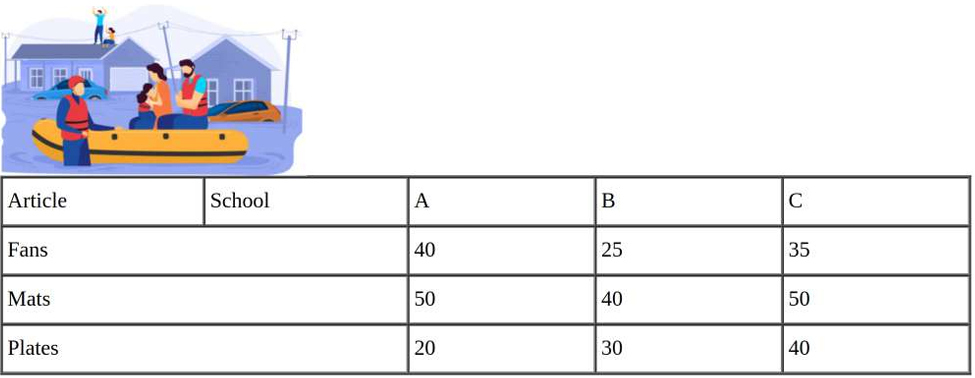
Three schools A, B and C organized a mela for collecting funds for helping the rehabilitation of flood victims. They sold handmade fans, mats, and plates from recycled material at a cost of ₹ 25 , ₹ 100 and ₹ 50 each. The number of articles sold by school A, B, C are given below.

Image

(i) Represent the sale of handmade fans, mats and plates by three schools A, B and C and the sale prices (in ₹) of given products per unit, in matrix form.

(ii) Find the funds collected by school A, B and C by selling the given articles.

(iii) If they increase the cost price of each unit by $20 \%$, then write the matrix representing new price.

OR

Find the total funds collected for the required purpose after $20 \%$ hike in price.
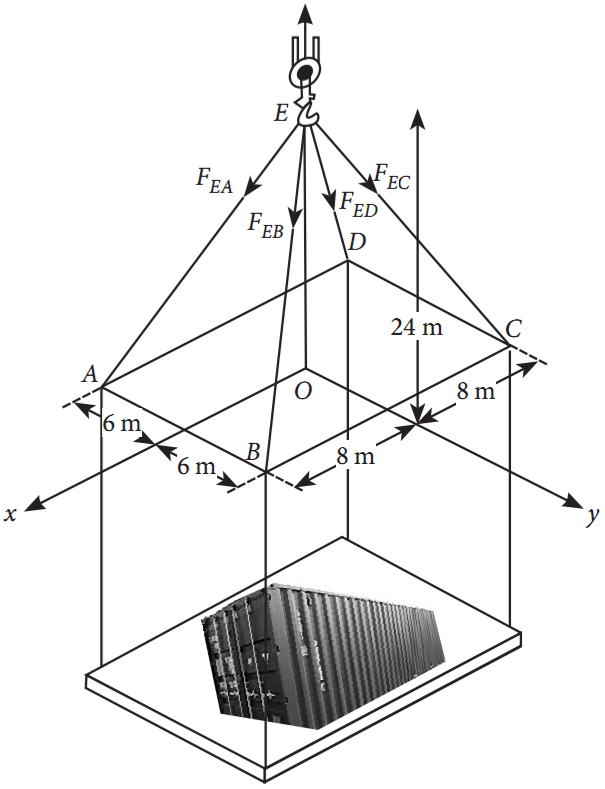
Consider the following diagram, where the forces in the cable are given.

Based on the above information, answer the following questions.

  1. The cartesian equation of line along EA is:
  1. $\frac{\text{x}}{-4}=\frac{\text{y}}{3}=\frac{\text{z}}{12}$

  2. $\frac{\text{x}}{-4}=\frac{\text{y}}{3}=\frac{\text{z}-24}{12}$

  3. $\frac{\text{x}}{-3}=\frac{\text{y}}{3}=\frac{\text{z}-12}{12}$

  4. $\frac{\text{x}}{3}=\frac{\text{y}}{4}=\frac{\text{z}-24}{12}$

  1. The vector $\overline{\text{ED}}$ is:
  1. $8\hat{\text{i}}-6\hat{\text{j}}+24\hat{\text{k}}$

  2. $-8\hat{\text{i}}-6\hat{\text{j}}+24\hat{\text{k}}$

  3. $-8\hat{\text{i}}-6\hat{\text{j}}-24\hat{\text{k}}$

  4. $8\hat{\text{i}}+6\hat{\text{j}}+24\hat{\text{k}}$

  1. The length of the cable EB is:
  1. 24 units
  2. 26 units
  3. 27 units
  4. 25 units
  1. The length of cable EC is equal to the length of:
  1. EA
  2. EB
  3. ED
  4. All of these
  1. The sum of all vectors along the cables is:
  1. $96\hat{\text{i}}$

  2. $96\hat{\text{j}}$

  3. $-96\hat{\text{k}}$

  4. $96\hat{\text{k}}$

Consider the mapping f: A → B is defined by f(x) = x - 1 such that f is a bijection.
Based on the above information, answer the following questions.
  1. Domain of f is:
  1. R - {2}
  2. R
  3. R - {1, 2}
  4. R - {0}
  1. Range of f is:
  1. R
  2. R - {2}
  3. R - {0}
  4. R - {1, 2}
  1. If g: R - {2} → R - {1} is defined by g(x) = 2f(x) - 1, then g(x) in terms of x is:
  1. $\frac{\text{x}+2}{\text{x}}$
  2. $\frac{\text{x}+1}{\text{x}-2}$
  3. $\frac{\text{x}-2}{\text{x}}$
  4. $\frac{\text{x}}{\text{x}-2}$
  1. The function g defined above, is:
  1. One-one
  2. Many-one
  3. into
  4. None of these
  1. A function f(x) is said to be one-one iff.
  1. f(x1) = f(x2) ⇒ -x= x2
  2. f(-x1) = f(-x2) ⇒ -x1 = x2
  3. f(x1) = f(x2) ⇒ x1 = x2
  4. None of these
Western music concert is organised every year in the stadium that can hold 36000 spectators. With ticket price of ₹ 10, the average attendance has been 24000. Some financial expert estimated that price of a ticket should be determined by the function.
$\text{p}(\text{x})=15-\frac{\text{x}}{3000}$ where x is the number of tickets sold.

Based on the above information, answer the following questions.
  1. The revenue, R as a function of x can be represented as.
  1. $15\text{x}-\frac{\text{x}^2}{3000}$
  2. $15-\frac{\text{x}^2}{3000}$
  3. $15\text{x}-\frac{1}{3000}$
  4. $15\text{x}-\frac{\text{x}}{3000}$
  1. The range of x is.
  1. [24000, 36000]
  2. [0, 24000]
  3. [0, 36000]
  4. None of these
  1. The value of x for which revenue is maximum, is.
  1. 20000
  2. 21000
  3. 22500
  4. 25000
  1. When the revenue is maximum, the price of the ticket is.
  1. ₹ 5
  2. ₹ 5.5
  3. ₹ 7
  4. ₹ 7.5
  1. How many spectators should be present to maximize the revenue?
  1. 21500
  2. 21000
  3. 22000
  4. 22500
If the area of a circle increases at a uniform rate, then prove that perimeter varies inversely as the radius.
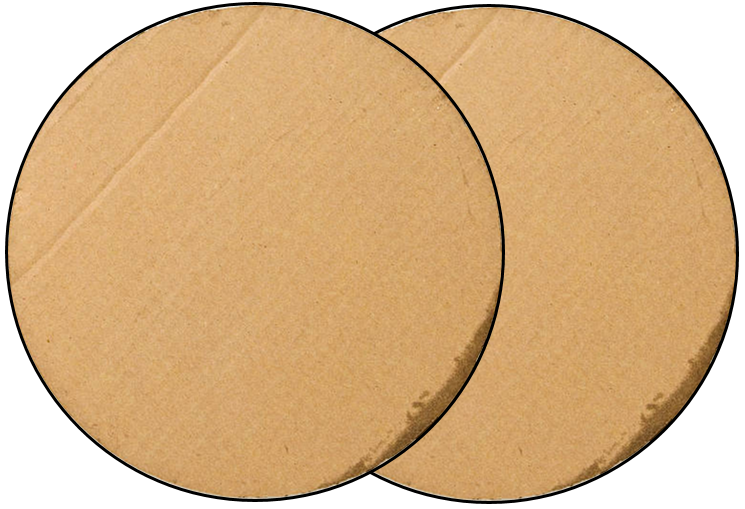
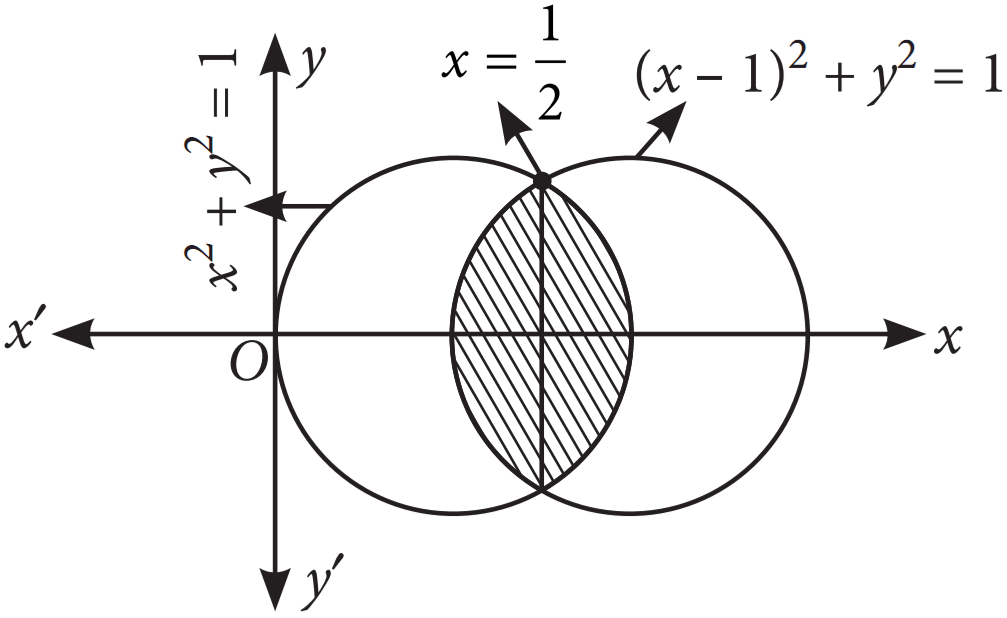
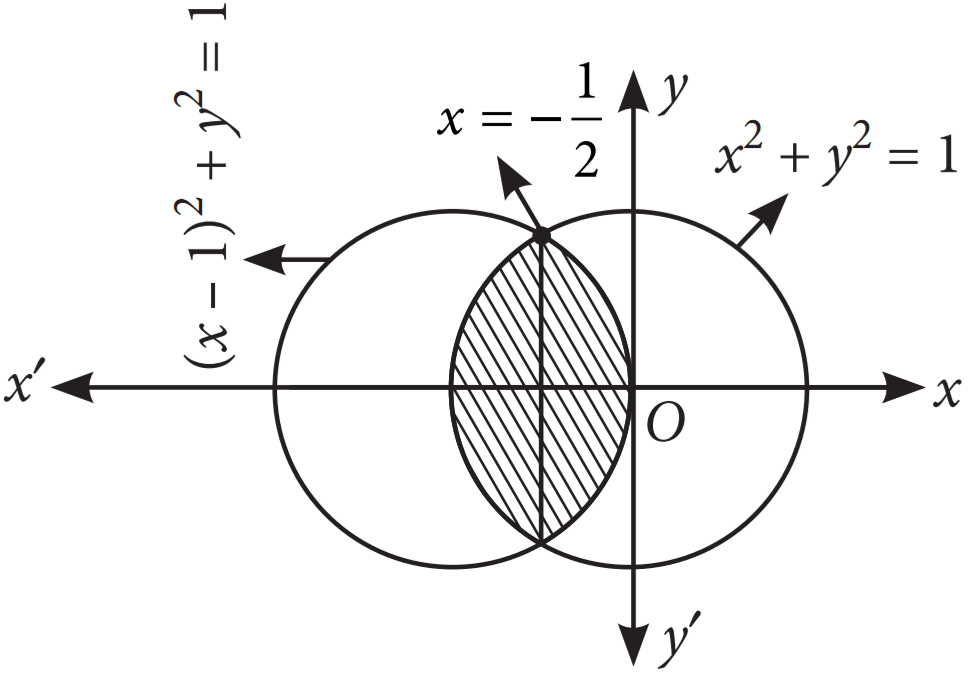
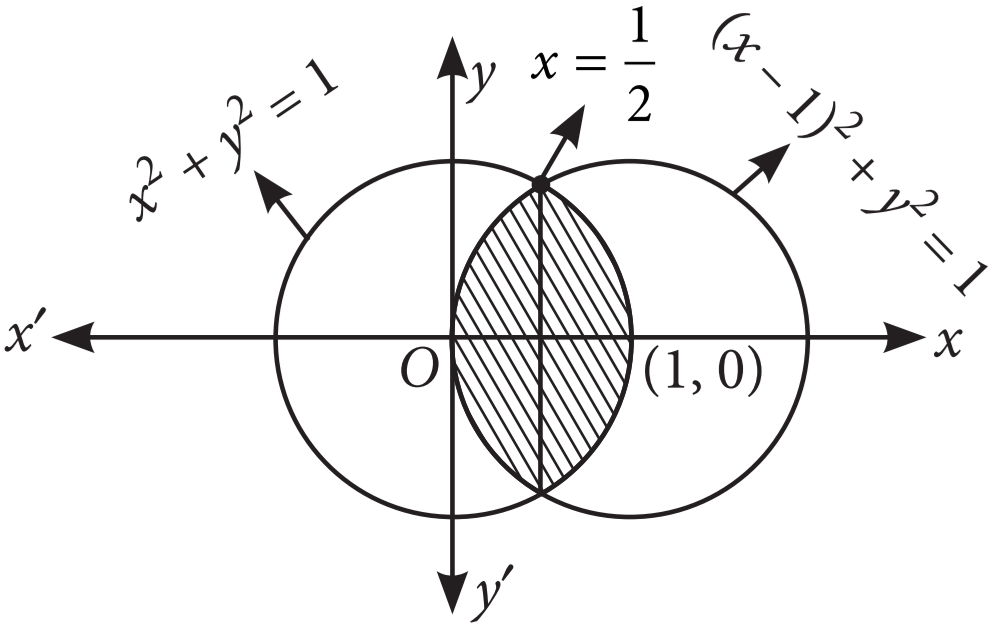
Ajay cut two circular pieces of cardboard and placed one upon other as shown in figure. One of the circle represents the equation (x - 1)2 + y2 = 1, while other circle represents the equation x2 + y2 = 1.

Based on the above information, answer the following questions.
  1. Both the circular pieces of cardboard meet each other at
  1. $\text{x}=1$
  2. $\text{x}=\frac{1}{2}$
  3. $\text{x}=\frac{1}{3}$
  4. $\text{x}=\frac{1}{4}$
  1. Graph of given two curves can be drawn as.
  1. None of these
  1. Value of $\int\limits_{0}^{\frac{1}{2}}\sqrt{1-(\text{x}-1)^2}\text{dx}$ is.
  1. $\frac{\pi}{6}-\frac{\sqrt{3}}{8}$
  2. $\frac{\pi}{6}+\frac{\sqrt{3}}{8}$
  3. $\frac{\pi}{2}+\frac{\sqrt{3}}{4}$
  4. $\frac{\pi}{2}-\frac{\sqrt{3}}{4}$
  1. Value of $\int\limits_{\frac{1}{2}}^{1}\sqrt{1-\text{x}^2}\text{dx}$ is.
  1. $\frac{\pi}{6}+\frac{\sqrt{3}}{4}$
  2. $\frac{\pi}{6}+\frac{\sqrt{3}}{8}$
  3. $\frac{\pi}{6}-\frac{\sqrt{3}}{8}$
  4. $\frac{\pi}{2}-\frac{\sqrt{3}}{4}$
  1. Area of hidden portion of lower circle is.
  1. $\bigg(\frac{2\pi}{3}+\frac{\sqrt{3}}{2}\bigg)\text{ sq.units}$
  2. $\bigg(\frac{\pi}{3}-\frac{\sqrt{3}}{8}\bigg)\text{ sq.units}$
  3. $\bigg(\frac{\pi}{3}+\frac{\sqrt{3}}{8}\bigg)\text{ sq.units}$
  4. $\bigg(\frac{2\pi}{3}-\frac{\sqrt{3}}{2}\bigg)\text{ sq.units}$