Question
Show that $\text{f(x)}=\tan^{-1}(\sin\text{x}+\cos\text{x})$ is an increasing function in $\Big(0,\frac{\pi}{4}\Big).$

Answer

We have, $\text{f(x)}=\tan^{-1}(\sin\text{x}+\cos\text{x})$
$\therefore\ \text{f}'(\text{x})=\frac{1}{1+(\sin\text{x}+\cos\text{x})^2}\cdot(\cos\text{x}-\sin\text{x})$
$=\frac{1}{1+\sin^2\text{x}+\cos^2\text{x}+2\sin\text{x}.\cos\text{x}}(\cos\text{x}-\sin\text{x})$
$=\frac{1}{(2+\sin2\text{x})}(\cos\text{x}-\sin\text{x})$
$\big[\because\sin2\text{x}=2\sin\text{x}\cos\text{x and }\sin^2\text{x}+\cos^2\text{x}=1\big]$
For $\text{f}'(\text{x})\geq0.$
$\frac{1}{(2+\sin2\text{x})}\cdot(\cos\text{x}-\sin\text{x})\geq0$
$\Rightarrow\ \cos\text{x}-\sin\text{x}\geq0$ $\Big[\because(2+\sin2\text{x})\geq0\text{ in }\Big(0,\frac{\pi}{4}\Big)\Big]$
$\Rightarrow\ \cos\text{x}\geq\sin\text{x}$
Which is true, if $\text{x}\in\Big(0,\frac{\pi}{4}\Big)$
Hence, f(x) is an increasing function in $\Big(0,\frac{\pi}{4}\Big).$

Need a full question paper?

Generate a complete, print-ready paper with questions like this in minutes — across 16+ boards, with answer keys.

Start Generating Free

Similar questions

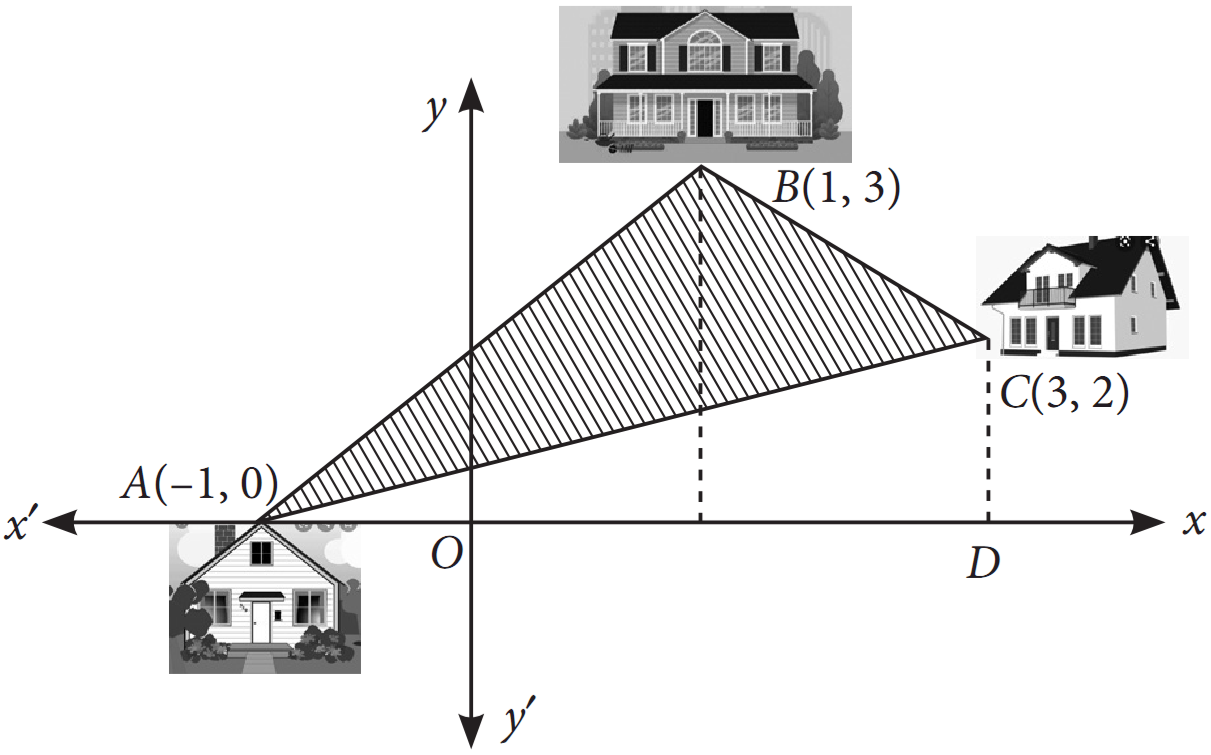
Location of three houses of a society is represented by the points A(-1, 0), B(1, 3) and C(3, 2) as shown in figure.

Based on the above information, answer the following questions
  1. Equation of line AB is.
    1. $\text{y}=\frac{3}{2}(\text{x}+1)$
    2. $\text{y}=\frac{3}{2}(\text{x}-1)$
    3. $\text{y}=\frac{1}{2}(\text{x}+1)$
    4. $\text{y}=\frac{1}{2}(\text{x}-1)$
  2. Equation of line BC is.
    1. $\text{y}=\frac{1}{2}\text{x}-\frac{7}{2}$
    2. $\text{y}=\frac{3}{2}\text{x}-\frac{7}{2}$
    3. $\text{y}=\frac{-1}{2}\text{x}+\frac{7}{2}$
    4. $\text{y}=\frac{3}{2}\text{x}+\frac{7}{2}$
  3. Area of region ABCD is.
  1. 2 sq. units
  2. 4 sq. units
  3. 6 sq. units
  4. 8 sq. units
  1. Area of $\triangle\text{ADC}$ is,
  1. 4 sq. units
  2. 8 sq. units
  3. 16 sq. units
  4. 32 sq. units
  1. Area of $\triangle\text{ABC}$ is.
  1. 3 sq. units
  2. 4 sq. units
  3. 5 sq. units
  4. 6 sq. units
Megha wants to prepare a handmade gift box for her friend's birthday at home. For making lower part of box, she takes a square piece of cardboard of side $20\ cm.$

Based on the above information, answer the following questions.

  1. If $x \ cm$ be the length of each side of the square cardboard which is to be cut off from corners of the square piece of side $20\ cm,$ then possible value of $x$ will be given by the interval.
  1. $[0, 20]$
  2. $(0, 10)$
  3. $(0, 3)$
  4. None of these
  1. Volume of the open box formed by folding up the cutting corner can be expressed as.
  1. $\text{V}=\text{x}(20-2\text{x})(20-2\text{x)}$
  2. $\text{V}=\frac{\text{x}}{2}(20+\text{x})(20-\text{x})$
  3. $\text{V}=\frac{\text{x}}{3}(20-\text{x})(20+\text{x})$
  4. $\text{V}=\text{x}(20-2\text{x})(20-\text{x)}$
  1. The values of $x$ for which $\frac{\text{dV}}{\text{dX}}=0$, are.
  1. $3, 4$
  2. $0,\frac{10}{3}$
  3. $0, 10$
  4. $10,\frac{10}{3}$
  1. Megha is interested in maximizing the volume of the box. So, what should be the side of the square to be cut off so that the volume of the box is maximum?
  1. $12\ cm$
  2. $8\ cm$
  3. $\frac{10}{3}\text{cm}$
  4. $2\ cm$
  1. The maximum value of the volume is.
  1. $\frac{17000}{27}\text{cm}^3$
  2. $\frac{11000}{27}\text{cm}^3$
  3. $\frac{8000}{27}\text{cm}^3$
  4. $\frac{16000}{27}\text{cm}^3$
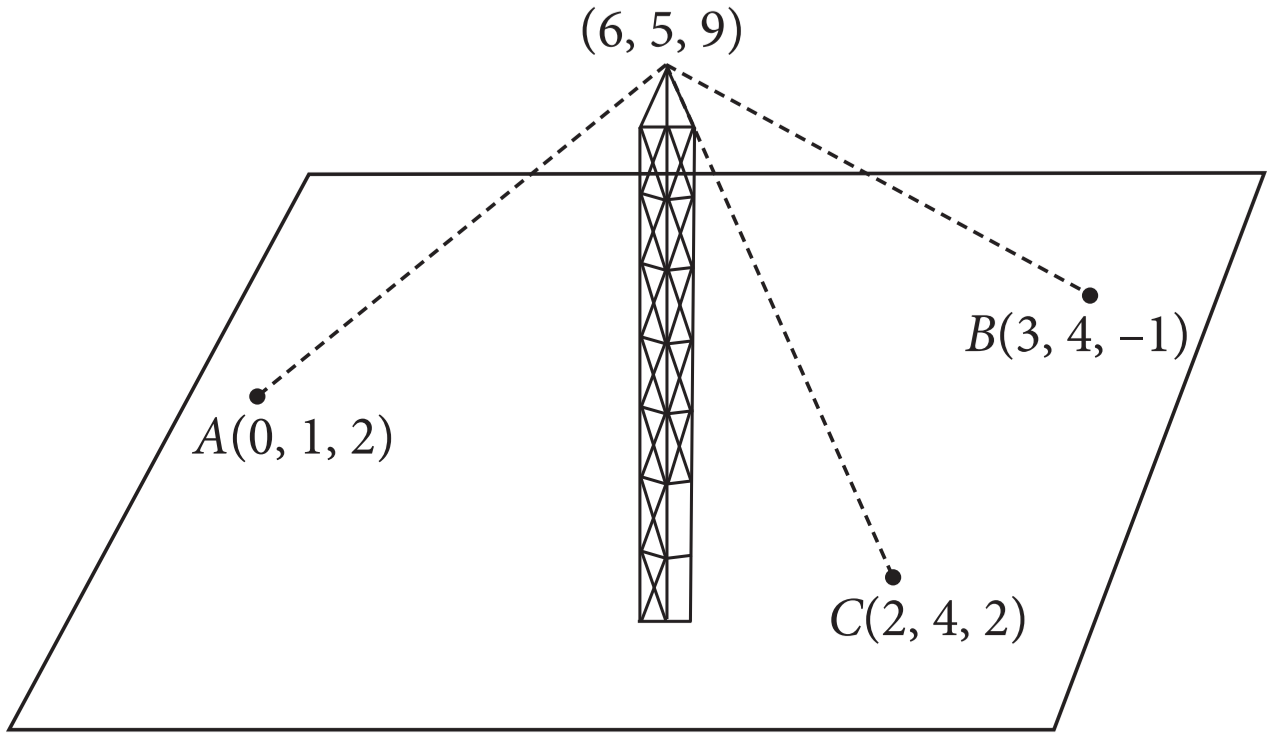
A mobile tower stands at the top of a hill. Consider the surface on which tower stand as a plane having points A(0, 1, 2), B(3, 4, -1), and C(2, 4, 2) on it. The mobile tower is tied with 3 cables from the point A, Band C such that it stand vertically on the ground. The peak of the tower is at the point ( 6, 5, 9), as shown in the figure. Based on the above information, answer the following questions.
  1. The equation of plane passing through the points A, Band C is:
  1. 3x - 4y + z = 0
  2. 3x - 2y + z = 0
  3. 3x - 2y + z = 0
  4. 4x - 3y + 3z = 0
  1. The height of the tower from the ground is:
  1. 6 units
  2. 5 units
  3. $\frac{17}{\sqrt{14}}\text{units}$
  4. $\frac{5}{\sqrt{14}}\text{units}$
  1. The equation of line of perpendicular drawn from the peak of tower to the ground is:
  1. $\frac{\text{x}-6}{3}=\frac{\text{y}-4}{-2}=\frac{\text{z}-9}{1}$
  2. $\frac{\text{x}-6}{3}=\frac{\text{y}-5}{-2}=\frac{\text{z}-9}{1}$
  3. $\frac{\text{x}-6}{3}=\frac{\text{y}-4}{2}=\frac{\text{z}-9}{1}$
  4. $\frac{\text{x}-6}{3}=\frac{\text{y}-5}{2}=\frac{\text{z}-9}{1}$
  1. The coordinates of foot of perpendicular drawn from the peak of tower to the ground are:
  1. $\Big(\frac{33}{14},\frac{104}{14},\frac{109}{14}\Big)$
  2. $\Big(\frac{33}{14},\frac{109}{14},\frac{104}{14}\Big)$
  3. $\Big(\frac{33}{14},\frac{105}{14},\frac{109}{14}\Big)$
  4. None of these
  1. The area of $\triangle\text{ABC}$ is:
  1. $\frac{1}{2}\sqrt{14}\text{sq}.\text{units}$
  2. $\frac{3}{2}\sqrt{14}\text{sq}.\text{units}$
  3. $\sqrt{14}\text{sq}.\text{units}$
  4. $2\sqrt{14}\text{sq}.\text{units}$
Three friends Ravi, Raju and Rohit were doing buying and selling of stationery items in a market. The price of per dozen of pen, notebooks and toys are Rupees $\mathrm{x}, \mathrm{y}$ and $\mathrm{z}$ respectively.Ravi purchases $4$ dozen of notebooks and sells $2$ dozen of pens and $5$ dozen of toys. Raju purchases $2$ dozen of toy and sells $3$ dozen of pens and $1$ dozen of notebooks. Rohit purchases one dozen of pens and sells $3$ dozen of notebooks and one dozen of toys.
In the process, Ravi, Raju and Rohit earn $₹\ 1500, ₹\ 10$0 and $₹ \ 400$ respectively.
Image
$(i)$ Write the above information in terms of matrix Algebra.
$(ii)$ What is the total price of one dozen of pens and one dozen of notebooks?
$(iii)$ What is the sale amount of Ravi?
$OR$
What is the amount of purchases and sales made by all three friends?
Read the following text carefully and answer the questions that follow:
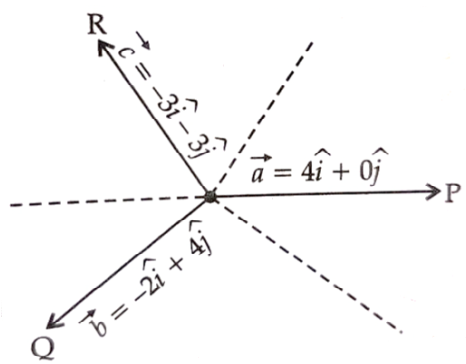
Team $\text{P, Q, R}$ went for playing a tug of war game. .
Teams $\text{P, Q, R}$ have attached a rope to a metal ring and is trying to pull the ring into their own areas $($team areas when in the given figure below$)$.
Team $P$ pulls with force$F _1=4 \hat{i}+0 \hat{j} KN$
Team $Q$ pull with force $F _2=-2 \hat{i}+4 \hat{j} KN$
Team $R$ pulls with force $F _3=-3 \hat{i}-3 \hat{j} KN$
Image
$i.$ What is the magnitude of the teams combined force? $(1)$
$ii.$ Find the magnitude of Team $B. (1)$
$iii.$ Which team will win the game? $(2)$​​​​​​​
$OR$
Find the probability that she gets grade $A$ in at least one subject. $(2)$
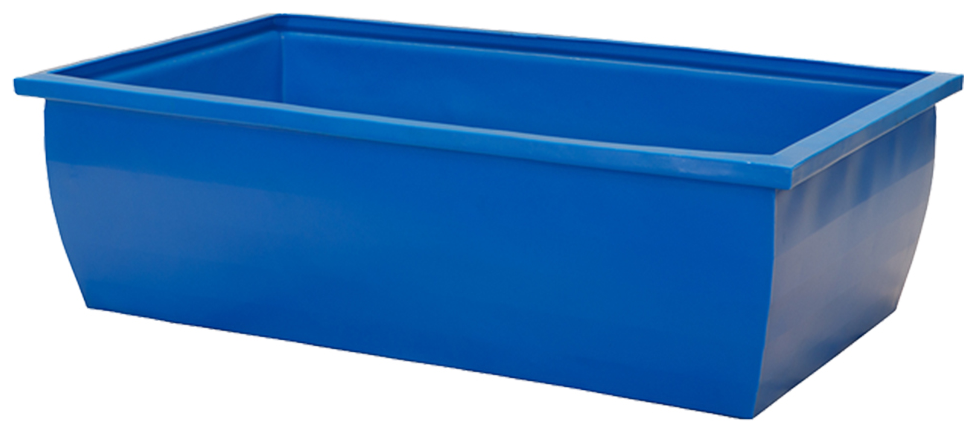
Nitin wants to construct a rectangular plastic tank for his house that can hold $80\ ft^3$ of water. The top of the tank is open. The width of tank will be $5\ ft$ but the length and heights are variables. Building the tank cost? $₹\ 20$ per sq. foot for the base and $₹\ 10$ per sq. foot for the side.

Based on the above information, answer the following questions.
  1. In order to make a least expensive water tank, Nitin need to minimize its.
  1. Volume
  2. Base
  3. Curved surface area
  4. Cost
  1. Total cost of tank as a function of $h$ can be represented as.
  1. $\ce{c(h) = 100h - 320 - 1600/ h}$
  2. $\ce{c(h) = 100h - 320h - 720h^2}$
  3. $\ce{c(h) = 100 + 320h + 1600h^2}$
  4. $\text{c}\big(\text{h}\big)=100\text{h}+320+\frac{1600}{\text{h}}$
  1. Range of $h$ is.
  1. $(3, 5)$
  2. $\big(0,\infty\big)$
  3. $(0, 8)$
  4. $(0, 3)$
  1. Value of hat which $c(h)$ is minimum, is.
  1. $4$
  2. $5$
  3. $6$
  4. $6, 7$
  1. The cost of least expensive tank is.
  1. $₹\ 1020$
  2. $₹\ 1100$
  3. $₹\ 1120$
  4. $₹\ 1220$
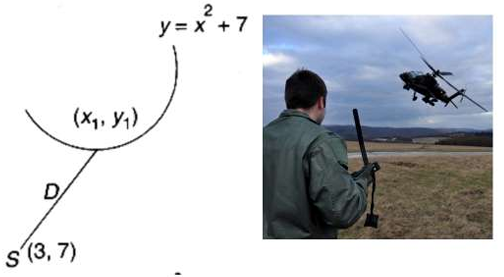
An Apache helicopter of the enemy is flying along the curve given by $y=x^2+7$. A soldier, placed at $(3,7)$ want to shoot down the helicopter when it is nearest to him.

Image

(i) If $\mathrm{P}\left(\mathrm{x}_1, \mathrm{y}_1\right)$ be the position of a helicopter on curve $\mathrm{y}=\mathrm{x}^2+7$, then find distance $\mathrm{D}$ from $\mathrm{P}$ to soldier place at $(3,7)$.

(ii) Find the critical point such that distance is minimum.

(iii) Verify by second derivative test that distance is minimum at $(1,8)$.

OR

Find the minimum distance between soldier and helicopter?

The relation between the height of the plant ( $\mathrm{y}$ in $\mathrm{cm}$ ) with respect to exposure to sunlight is governed by the following equation $\mathrm{y}=4 \mathrm{x}-\frac{1}{2} \mathrm{x}^2$ where $\mathrm{x}$ is the number of days exposed to sunlight.

Image

(i) Find the rate of growth of the plant with respect to sunlight.

(ii) What is the number of days it will take for the plant to grow to the maximum height?

(iii) Verify that height of the plant is maximum after four days by second derivative test and find the maximum height of plant.

OR

What will be the height of the plant after 2 days?

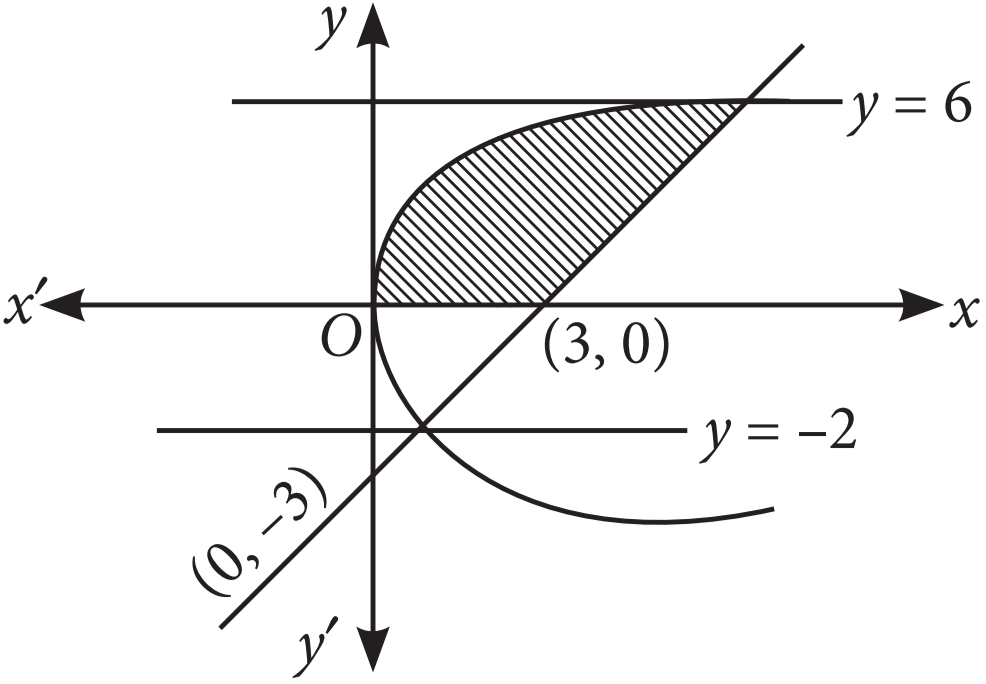
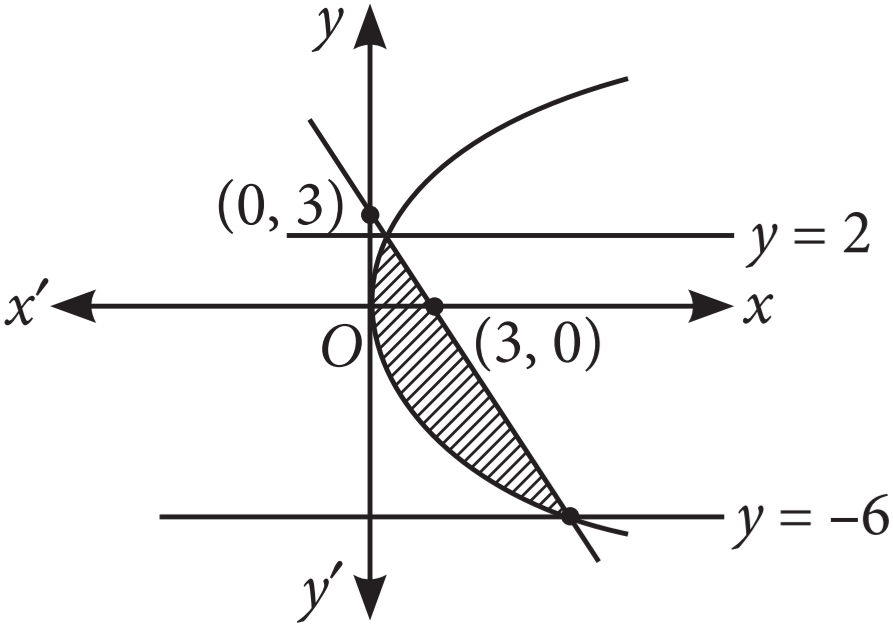
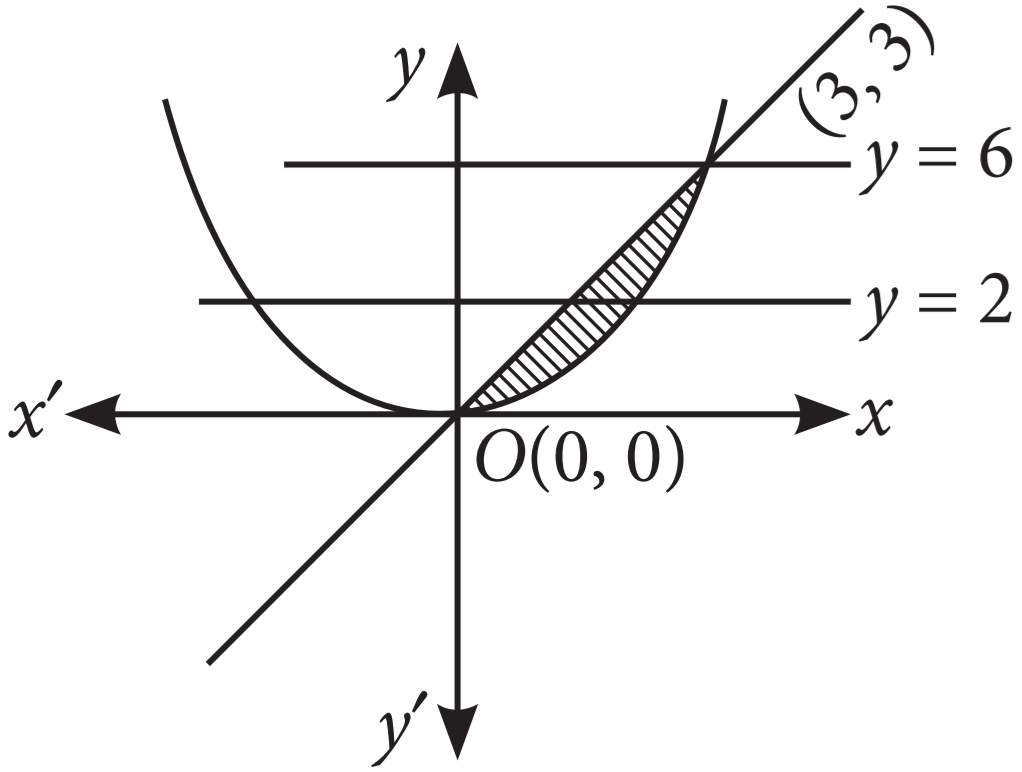
Consider the following equation of curve $y^2 = 4x$ and straight line $x + y = 3.$
Based on the above information, answer the following questions.
  1. The line $x + y = 3$ cuts the $x-$axis and $y-$axis respectively at.
  1. $(0, 2), (2, 0)$
  2. $(3, 3), (0, 0)$
  3. $(0, 3), (3, 0)$
  4. $(3, 0), (0, 3)$
  1. Point(s) of intersection of two given curves is $($are$).$
  1. $(1, -2), (-9, 6)$
  2. $(2, 1), (-6, 9)$
  3. $(1, 2), (9, -6)$
  4. None of these.
  1. Which of the following shaded portion re present the area bounded by given curves?
    1. None of these
  1. Value of the integral $\int\limits_{-6}^{2}(3-\text{y})\text{ dy}$ is
  1. $10$
  2. $20$
  3. $30$
  4. $40$
  1. Value of area bounded by given curves is.
  1. $56\text{ sq.units}$
  2. $\frac{63}{5}\text{ sq. units}$
  3. $\frac{64}{3}\text{ sq. units}$
  4. $31\text{ sq.units}$
Read the following text carefully and answer the questions that follow :
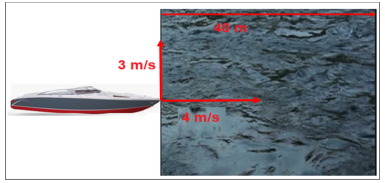
Once Ramesh was going to his native place at a village near Agra. From Delhi and Agra he went by flight, In the way, there was a river. Ramesh reached the river by taxi. Then Ramesh used a boat for crossing the river. The boat heads directly across the river $40$ m wide at $4 m/s$. The current was flowing downstream at $3 m/s.$
Image
$i.$  What is the resultant velocity of the boat? $(1)$
$ii.$  How much time does it take the boat to cross the river? $(1)$
$iii$. How far downstream is the boat when it reaches the other side? $(2)$​​​​​​​
OR
If speeds of boat and current were $1.5 m/s$ and $2.0 m/s$ then what will be resultant velocity? $(2)$