Question
Show that in any triangle $ABC a = b \cos C + c \cos B$

Answer

Let $p$ be the statement “$ABC$ is any triangle” and $q$ be the statement “
$a = b \cos C + c \cos B$”
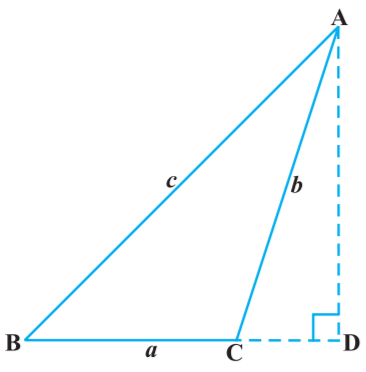
Let $ABC$ be a triangle. From A draw $AD$ perpendicular to $BC (BC$ produced if necessary$).$
As we know that any triangle has to be either acute or obtuse or right-angled, we can split p into three statements $r, s$ and $t,$ where
$r : ABC$ is an acute-angled triangle with $\angle$C is acute.
$s : ABC$ is an obtuse-angled triangle with $\angle$C is obtuse
$t : ABC$ is a right-angled triangle with $\angle C$ is a right angle.
Hence, we prove the theorem by three cases
case (i) When  $C$ is acute (Fig.
From the right-angled triangle$ ADB,$
$\frac{B D}{A B}=\cos E$
$\mathrm{BD}=\mathrm{AB} \cos \mathrm{B}$
$=c \cos B$

from the right-angled triangle $ADC $
$\frac{C D}{\Delta C}=\cos C$
$CD = AC \cos C$
$= b \cos C$
$a = BD + CD$
$= c \cos B + b \cos C ...(1)$​​​​​​​
case(ii) When $\angle C$ is obtuse in below figure.​​​​​​​

From the right angled triangle $ADB,$
$BD \over AB = \cos B$
i.e. $BD = AB \cos B$
$= c \cos B$ From the right angled triangle $ADC,$ 
$\frac{C D}{A C}=\cos \angle A C D$
$= \cos (180^o - C) = - \cos C i.e. CD = - AC \cos C = - b \cos C$
Now $a = BC = BD - CD$
i.e. $a = c \cos B - ( - b \cos C ) a = c \cos B + b \cos C ... (2)$
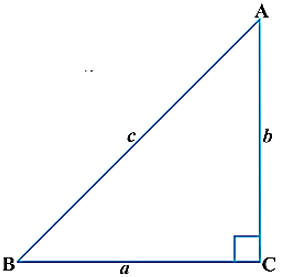
Case (iii) When $\angle C$ is a right angle in the given figure.

From the right angled triangle $ACB,$
$BC \over AB$ = cosB
i.e. $BC = AB \cos B$
$a = c \cos B,$
and $b \cos C = b \cos 900 = 0.$
Thus, we may write $a = 0 + c \cos B$ 
$= b \cos C + c \cos B ... (3)$
From $(1), (2)$ and $(3).$ We assert that for any triangle$ ABC,$
$a = b \cos C + c \cos B$
By case $(i), r \Rightarrow q$ is proved.
By case $ (ii), s \Rightarrow q$ is proved.
By case $(iii), t \Rightarrow q$ is proved.
Hence, from the proof by cases, $(r\ v\ s\ v\ t) \Rightarrow q$ is proved, i.e., $p \Rightarrow q$ is proved.

Need a full question paper?

Generate a complete, print-ready paper with questions like this in minutes — across 16+ boards, with answer keys.

Start Generating Free

Similar questions

If $\text{y}\sqrt{\text{x}^2+1}=\log\Big(\sqrt{\text{x}^2+1}-\text{x}\Big),$ prove that $\big(\text{x}^2+1\big)\frac{\text{dx}}{\text{dx}}+\text{xy}+1=0$
Find the shortest distance between the lines $\frac{{x + 1}}{7} = \frac{{y + 1}}{{ - 6}} = \frac{{z + 1}}{1}$ and $\frac{{x - 3}}{1} = \frac{{y - 5}}{{ - 2}} = \frac{{z - 7}}{1}$
Find the perpendicular distance of the point $(1,0,0)$ from the line $\frac{x-1}{2}=\frac{y+1}{-3}=\frac{z+10}{8}$. Also, find the coordinates of the foot of the perpendicular and the equation of the perpendicular.
Evaluate the following integrals:
$\int\frac{\sqrt{\tan\text{x}}}{\sin\text{x}\cos\text{x}}\text{dx}$
$\text{ If }\text{ x } =\cos\text{t} (3-2\cos^2\text{t)}\ \text{and}\ \text{y}=\sin\text{t}(3-2\sin\text{ t}),\text{ find the value of}\ \frac{\text{dy}}{\text{dx}} = \text{ at t}=\frac{\pi}{\text{4}}.$
Solve the following differential equation:
$e^x \tan y\ dx + (1 – e^x) \sec^2 y\ dy = 0.$
A diet for a sick person must contain at least 4000 units of vitamins, 50 units of minerals and 1400 of calories. Two foods A and B, are available at a cost of Rs 4 and Rs 3 per unit respectively. If one unit of A contains 200 units of vitamin, 1 unit of mineral and 40 calories and one unit of food B contains 100 units of vitamin, 2 units of minerals and 40 calories, find what combination of foods should be used to have the least cost?
In each of the show that the given differential equation is homogeneous and solve each of them.
$\text{y}'=\frac{\text{x}+\text{y}}{\text{x}}$
Find the equation of the plane which contains the line of intersection of the planes x + 2y + 3z – 4 = 0 and 2x + y – z + 5 = 0 and whose x-intercept is twice its z-intercept.
Hence write the vector equation of a plane passing through the point (2, 3, –1) and parallel to the plane obtained above.
The rate of increase of bacteria in a culture is proportional to the number of bacteria present and it is found that the number doubles in 6 hours. Prove that the bacteria becomes 8 times at the end of 18 hours.