Question
Show that it is not possible for a photon to be completely absorbed by a free electron.

Answer

If the i undergoes an elastic collision with a photon. Then applying energy conservation to this collision.

We get, $\frac{\text{hc}}{\lambda}+\text{m}_0\text{c}^2=\text{mc}^2$

and applying conservation of momentum $\frac{\text{h}}{\lambda}=\text{mv}$

Mass of e $=\text{m}=\frac{\text{m}_0}{\sqrt{1-\frac{\text{v}^2}{\text{c}^2}}}$

from above equation it can be easily shown that

V = C

V = 0

both of these results have no physical meaning hence it is not possible for a photon to be completely absorbed by a free electron.

Need a full question paper?

Generate a complete, print-ready paper with questions like this in minutes — across 16+ boards, with answer keys.
Start Generating Free

Similar questions

  1. State two important features of Einstein's photoelectric equation.
  2. Radiation of frequency 1015 Hz is incident on two photosensitive surface P and Q. There is no photoemission from surface P. Photoemission occurs from surface Q but photoelectrons have zero kinetic energy. Explain these observations and find the value of work function for surface Q.
An infinitely long thin wire carrying a uniform linear static charge density λ is placed along the z-axis. The wire is set into motion along its length with a uniform velocity $\text{v}=\text{v}\hat{\text{k}}_\text{z}$. Calculate the poynting vector $\text{S}=\frac{1}{\mu_0}(\text{E}\times\text{B})$.

In a Coolidge tube, electrons strike the target and stop inside it. Does the target get more and more negatively charged as time passes?
How are em waves produced by oscillating charges? Draw a sketch of linearly polarised em waves propagating in the Z-direction. Indicate the directions of the oscillating electric and magnetic fields.
A 100W light bulb is placed at the centre of a spherical chamber of radius 20cm. Assume that 60% of the energy supplied to the bulb is converted into light and that the surface of the chamber is perfectly absorbing. Find the pressure exerted by the light on the surface of the chamber.
i. Define mutual inductance.
ii. A pair of adjacent coils has a mutual inductance of 1.5 H. If the current in one coil changes from 0 to 20 A in 0.5 s, what is the change of flux linkage with the other coil?
A p-n photodiode is fabricated from a semiconductor with band gap of 2.8 eV. Can it detect a wavelength of 6000 nm?
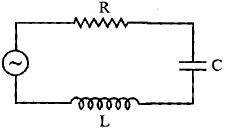
The figure shows a series LCR circuit with L = 5.0 H, C = 80 $\mu$F, R = 40 W connected to a variable frequency 240V source. Calculate

  1. The angular frequency of the source which drives the circuit at resonance.
  2. The current at the resonating frequency.
  3. The rms potential drop across the capacitor at resonance.
A ball is thrown at a speed of 40m/s at an angle of 60° with the horizontal. Find:
  1. The maximum height reached.
  2. The range of the ball. Take g = 10m/s2.
Three equal charges, 2.0 × 10-6C each, are held fixed at the three corners of an equilateral triangle of side 5cm. Find the Coulomb force experienced by one of the charges due to the rest two.