Question
Show that it is not possible for a photon to be completely absorbed by a free electron.

Answer

If the i undergoes an elastic collision with a photon. Then applying energy conservation to this collision.We get, $\frac{\text{hc}}{\lambda}+\text{m}_0\text{c}^2=\text{mc}^2$
and applying conservation of momentum $\frac{\text{h}}{\lambda}=\text{mv}$
Mass of e $=\text{m}=\frac{\text{m}_0}{\sqrt{1-\frac{\text{v}^2}{\text{c}^2}}}$
from above equation it can be easily shown that
V = C
V = 0
both of these results have no physical meaning hence it is not possible for a photon to be completely absorbed by a free electron.

Need a full question paper?

Generate a complete, print-ready paper with questions like this in minutes — across 16+ boards, with answer keys.
Start Generating Free

Similar questions

A source emits light of wavelengths 555nm and 600nm. The radiant flux of the 555nm part is 40W and of the 600nm part is 30W. The relative luminosity at 600nm is 0'6. Find:
  1. The total radiant flux.
  2. The total luminous flux.
  3. The luminous efficiency.
The equation of a travelling sound wave is $\text{y}=6.0\sin(600\text{t}-1.8\text{x})$ where y is measured in $10^{-5}m$, t in second and x in metre.
  1. Find the ratio of the displacement amplitude of the particles to the wavelength of the wave.
  2. Find the ratio of the velocity amplitude of the particles to the wave speed.
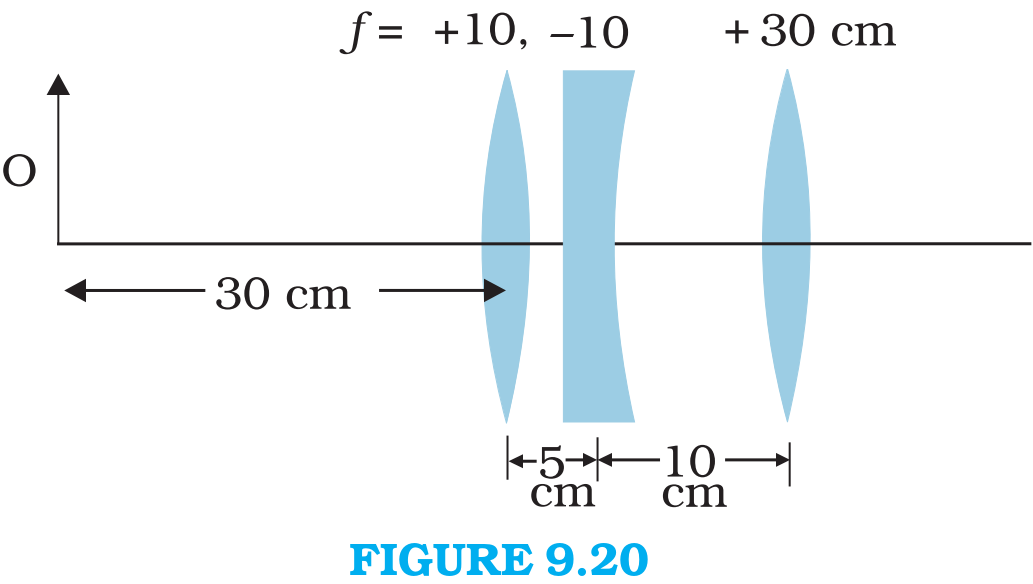
Find the position of the image formed by the lens combination given in the Fig. $9.20$.
Image
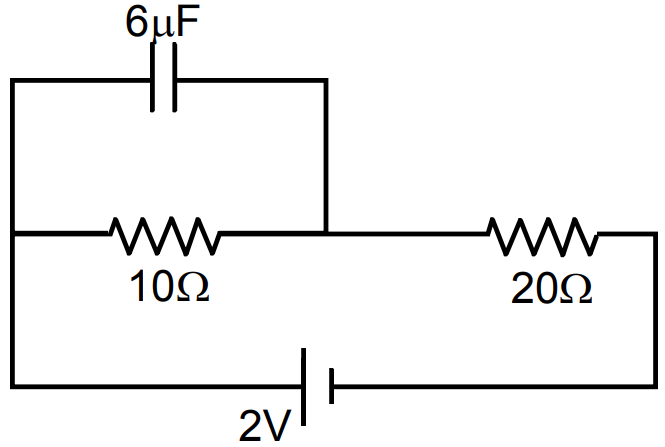
Find the charge on the capacitor shown in figure.
Draw a labelled ray diagram of a refracting telescope. Define its magnifying power and write the expression for it.
Write two important limitations of a refracting telescope over a reflecting type telescope.
One end of a rod of length 20cm is inserted in a furnace at 800K The sides of the rod are covered with an insulating material and the other end emits radiation like a blackbody. The temperature of this end is 750K in the steady state. The temperature of the surrounding air is 300K. Assuming radiation to be the only important mode of energy transfer between the surrounding and the open end of the rod, find the thermal conductivity of the rod. Stefan constant $\sigma=6.0\times10^{-8}\text{Wm}^{-2}\text{K}^{-4}.$
Write nuclear reaction equations for
  1. $\alpha\text{-decay of }\ ^{226}_{88}\text{Ra}$
  2. $\alpha-\text{decay of }\ ^{226}_{94}\text{Pu}$
  3. $\beta\text{-decay of }\ ^{32}_{15}\text{P}$
  4. $\beta\text{-decay of }\ ^{210}_{83}\text{Bi}$
  5. $\beta\text{-decay of }\ ^{11}_{6}\text{C}$
  6. $\beta^+\text{-decay of }\ ^{97}_{43}\text{Tc}$
  7. $\text{Electron capture of }\ ^{120}_{54}\text{Xe}$
Two small bodies of masses 10kg and 20kg are kept a distance 1.0m apart and released, Assuming that only mutual gravitational forces are acting, find the speeds of the particles when the separation decreases to 0.5m.
An ac genrator is made from area of cross section $3 m^2$ and a coil of 100 turns which is rotated by a constant angular velocity of $60 rad / s$ in a magnetic field of 0.04 T . Resistance of the coil is $500 \Omega$ Calculate: (i) maxumum current obtained from the generator and (ii) maximum power dissipated in the coil.
Draw a labelled ray diagram of an astronomical telescope in the near point adjustment position. A giant refracting telescope at an observatory has an objective lens of focal length 15m and an eyepiece of focal length 1.0cm. If this telescope is used to view the Moon, find the diameter of the image of the Moon formed by the objective lens. The diameter of the Moon is $3.48 \times 10^6m$, and the radius of lunar orbit is $3.8 \times 10^8m.$