APPLICATION OF DERIVATIVES — Maths STD 12 Science — Question
Gujarat BoardEnglish MediumSTD 12 ScienceMathsAPPLICATION OF DERIVATIVES5 Marks
Question
Show that of all the rectangles inscribed in a given fixed circle, the square has maximum area.
✓
Answer
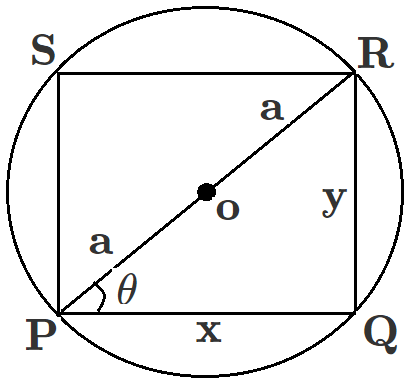
Let PQRS be the rectangle inscribed in a given circle with centre O and radius a.
Let x and y be the length and breadth of the rectangle, i. e., $x > 0$ and $y > 0.$
In right angled triangle $PQR,$ using Pythagoras theorem,
$PQ^2 + QR^2 = PR^2$
$\Rightarrow\ \text{x}^2+\text{y}^2=(2\text{a)}^2\ \Rightarrow\ \text{y}^2=4\text{a}^2-\text{x}^2\ \Rightarrow$
$\text{y}=\sqrt{4\text{a}^2-\text{x}^2}\ \dots\text{(i)}$
Let A be the area of the rectangle, then $\ \text{A }=\text{xy}=\text{x}\sqrt{4\text{a}^2-\text{x}^2}$
$\Rightarrow\ \frac{\text{d}\text{A}}{\text{dx}}=\sqrt{4\text{a}^2-\text{x}^2}+\text{x}\frac{1}{2\sqrt{4\text{a}^2-\text{x}^2}}(-2\text{x)}$ $=\sqrt{4\text{a}^2-\text{x}^2}-\frac{\text{x}^2}{\sqrt{4\text{a}^2-\text{x}^2}}=\frac{4\text{a}^2-2\text{x}^2}{\sqrt{4\text{a}^2-\text{x}^2}}$
And $\frac{\text{d}^2\text{A}}{\text{dx}^2}=\frac{\sqrt{4\text{a}^2-\text{x}^2}(-4\text{x})-(4\text{a}^2-2\text{x}^2)\frac{(-2\text{x)}}{2\sqrt{4\text{a}^2-\text{x}^2}}}{(4\text{a}^2-2\text{x}^2)}$ $=\frac{(4\text{a}^2-2\text{x}^2)(-4\text{x)}+\text{x}(4\text{a}^2-2\text{x}^2)}{(4\text{a}^2-2\text{x}^2)^{\frac{3}{2}}}$
$\Rightarrow\ \ \frac{\text{d}^2\text{A}}{\text{dx}^2}=\frac{-12\text{a}^2\text{x}+2\text{x}^3}{(4\text{a}^2-2\text{x}^2)}=\frac{-2(6\text{a}^2-\text{x}^2)}{(4\text{a}^2-2\text{x}^2)^{\frac{3}{2}}}$
Now $ \frac{\text{d}\text{A}}{\text{dx}}=0\ \Rightarrow\ \frac{4\text{a}^2-2\text{x}^2}{\sqrt{4\text{a}^2-\text{x}^2}}$ $\Rightarrow\ \ 4\text{a}^2-2\text{x}^2=0\ \Rightarrow\ \text{x}=\sqrt{2\text{a}}$
$\therefore\ \text{At }\text{x}=\sqrt{2\text{a}},\ \frac{\text{d}^2\text{A}}{\text{dx}^2}=\frac{-2\big(\sqrt{2\text{a}\big)}(6\text{a}^2-2\text{a}^2)}{2\sqrt{2\text{a}^3}}$ $=\frac{-8\sqrt{2\text{a}^3}}{2\sqrt{2\text{a}^3}}=-4\ [\text{Negative}]$
$\therefore\ \text{At}\text{x}=\sqrt{2\text{a}},$ area of rectangle is maximum.
And from eq.(i) $\text{y}=\sqrt{4\text{a}^2-2\text{a}^2}=\sqrt{2\text{a}}, \text{i. e.,}\text{x}=\text{y}=\sqrt{2\text{a}}$
Therefore, the area of inscribed rectangle is maximum when it is square.
Need a full question paper?
Generate a complete, print-ready paper with questions like this in minutes — across 16+ boards, with answer keys.