Rajasthan BoardEnglish MediumSTD 9MATHSQuadrilaterals3 Marks
Question
Show that the bisectors of angles of a parallelogram form a rectangle.
✓
Answer
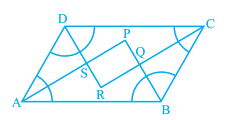
Let $P, Q, R$ and $S$ be the points of intersection of the bisectors of $\angle A$ and $\angle B, \angle B$ and $\angle C, \angle C$ and $\angle D,$ and $\angle D$ and $\angle A$ respectively of parallelogram $\text{ABCD.}$
In $\triangle ASD,$
Since $DS$ bisects $\angle D$ and $AS$ bisects $\angle A,$
therefore,
$\angle DAS + \angle ADS = \frac 12\angle A + \frac 12\angle D$
$= \frac 12 (\angle A + \angle D)$
$= \frac 12 \times 180^\circ (\angle A$ and $\angle D$ are interior angles on the same side of the transversal$)$
$= 90^\circ$
Also, $\angle DAS + \angle ADS + \angle DSA = 180^\circ ($Angle sum property of a triangle$)$
or, $90^\circ + \angle DSA = 180^\circ$
or, $\angle DSA = 90^\circ$
So, $\angle PSR = 90^\circ ($Being vertically opposite to $\angle DSA)$
Similarly, it can be shown that $\angle APB = 90^\circ$ or $\angle SPQ = 90^\circ ($as it was shown for $\angle DSA).$
Similarly, $\angle PQR = 90^\circ$ and $\angle SRQ = 90^\circ.$
So, $PQRS$ is a quadrilateral in which all angles are right angles.
We have shown that $\angle PSR = \angle PQR = 90^\circ$ and $\angle SPQ = \angle SRQ = 90^\circ.$
So both pairs of opposite angles are equal.
Therefore, $\text{PQRS}$ is a parallelogram in which one angle $($in fact all angles$)$ is $90^\circ$ and so, $\text{PQRS}$ is a rectangle.
Need a full question paper?
Generate a complete, print-ready paper with questions like this in minutes — across 16+ boards, with answer keys.