Question
Show that the bisectors of angles of a parallelogram form a rectangle.
Answer


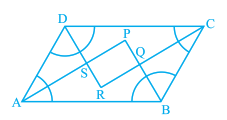
Let $P , Q , R$ and S be the points of intersection of the bisectors of $\angle A$ and $\angle B, \angle B$ and $\angle C, \angle C$ and $\angle D$, and $\angle D$ and $\angle A$ respectively of parallelogram $A B C D$.
$\text { In } \triangle A S D$
Since DS bisects $\angle D$ and AS bisects $\angle A$, therefore,
$\angle D A S+\angle A D S=\frac{1}{2} \angle A+\frac{1}{2} \angle D$
$=\frac{1}{2}(\angle A+\angle D)$
$=\frac{1}{2} \times 180^{\circ} \text { ( } \angle A \text { and } \angle D$ are interior angles on the same side of the transversal)
$=90^{\circ}$
Also, $\angle D A S+\angle A D S+\angle D S A=180^{\circ}$ (Angle sum property of a triangle)
$\text { or, } 90^{\circ}+\angle D S A=180^{\circ}$
or, $\angle D S A=90^{\circ}$
So, $\angle P S R=90^{\circ}$ (Being vertically opposite to $\angle D S A$ )
Similarly, it can be shown that $\angle A P B=90^{\circ}$ or $\angle S P Q=90^{\circ}$ (as it was shown for $\angle D S A$ ).
Similarly, $\angle P Q R=90^{\circ}$ and $\angle S R Q=90^{\circ}$.
So, PQRS is a quadrilateral in which all angles are right angles.
We have shown that $\angle P S R=\angle P Q R=90^{\circ}$ and $\angle S P Q=\angle S R Q=90^{\circ}$.
So both pairs of opposite angles are equal.
Therefore, PQRS is a parallelogram in which one angle (in fact all angles) is $90^{\circ}$ and so, PQRS is a rectangle.

Need a full question paper?

Generate a complete, print-ready paper with questions like this in minutes — across 16+ boards, with answer keys.
Start Generating Free

Similar questions

Rationalise the denominator: $\frac{1}{\sqrt{7}+\sqrt{6}-\sqrt{13}}$
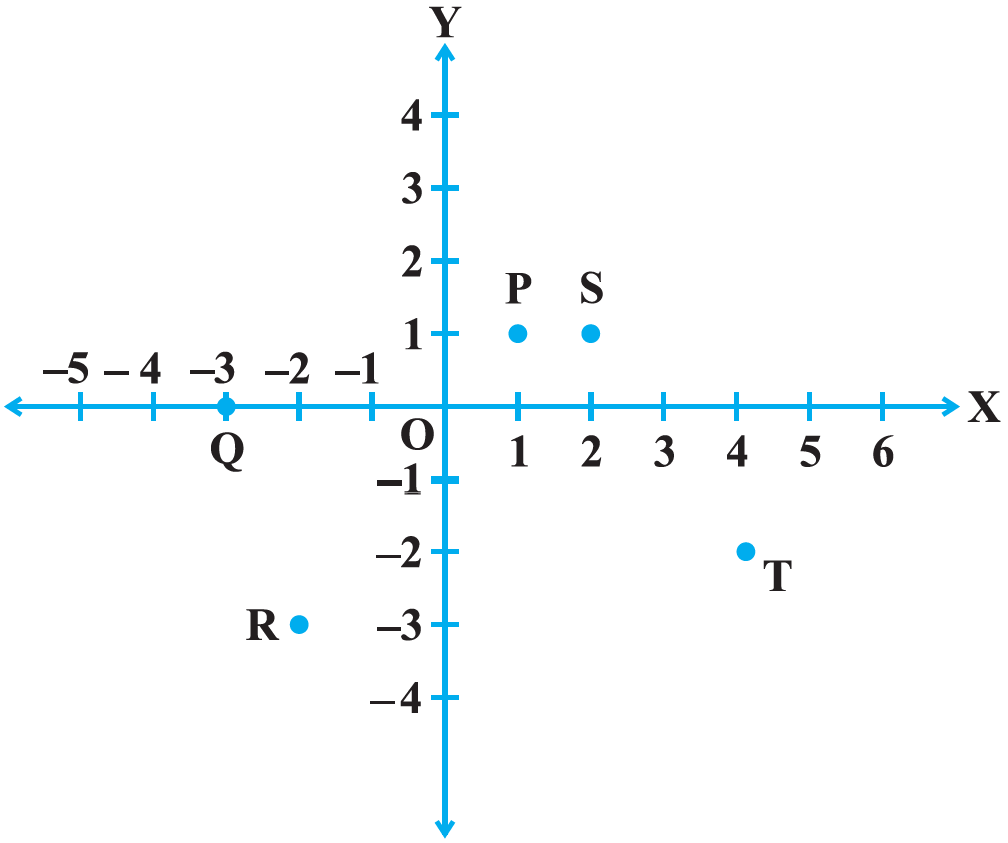
Write the coordinates of each of the points $P, Q, R, S, T$ and $O$ from the:
On one page of a telephone directory, there are $200$ phone numbers. The frequency distribution of their unit's digits is given below:
Unit's digit $0$ $1$ $2$ $3$ $4$ $5$ $6$ $7$ $8$ $9$
Frequency $19$ $22$ $23$ $19$ $21$ $24$ $23$ $18$ $16$ $15$
One of the numbers is chosen at random from the page. What is the probability that the unit's digit of the chosen number is:
$i. 5?$
$ii. 8?$
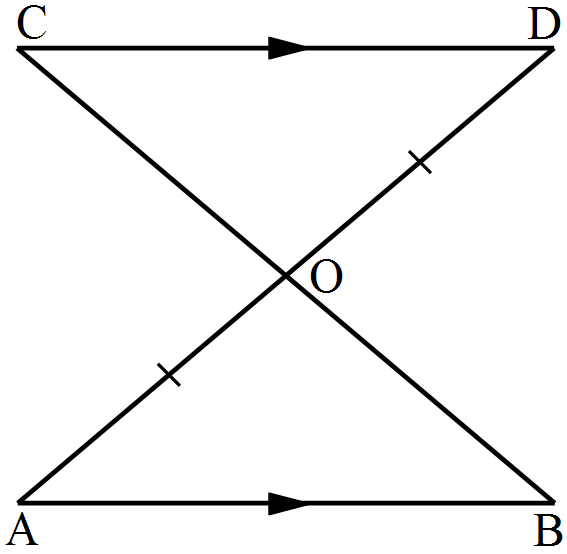
In the given figure, $AB \| CD$ and $O$ is the modpoint of $AD.$
Show that:
$i. \triangle\text{AOB}\cong\triangle\text{DOC}.$
$ii. O$ is the midpoint of $BC.$

Find the values of $x$ in each of the following:$\big(2^3\big)^4=\big(2^2\big)^\text{x}$
If $2^\text{x}=3^\text{y}=12^\text{z},$ show that $\frac{1}{\text{z}}=\frac{1}{\text{y}}+\frac{2}{\text{x}}.$
Show that the quadrilateral formed by joining the mid-points the sides of a rhombus, taken in order, form a rectangle.
A metallic sphere of radius $10.5\ cm$ is melted and then recast into smaller cones, each of radius $3.5\ cm$ and height $3\ cm$. How many cones are obtained?
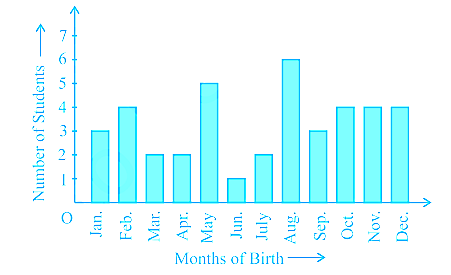
In a particular section of Class $IX, 40$ students were asked about the months of their birth and the following graph was prepared for the data so obtained:

Observe the bar graph given above and answer the following questions:
$i.$ How many students were born in the month of November?
$ii.$ In which month were the maximum number of students born?
A spherical cannonball $28\ cm$ in diameter is melted and cast into a right circular cone mould, whose base is $35\ cm$ in diameter. Find the height of the cone.