Question
Show that the equation $2\left(a^2+b^2\right) x^2+2(a+b) x+1=0$ has no real roots, when $\text{a}\neq\text{b}.$

Answer

The quadric equation is $2\left(a^2+b^2\right) x^2+2(a+b) x+1=0$
Here, $a=2\left(a^2+b^2\right), b=2(a+b)$ and $c=1$
As we know that $D=b^2-4 a c$
Putting the value of $a=2\left(a^2+b^2\right), b=2(a+b)$ and $c=1$
$ \Rightarrow D=\{2(a+b)\}^2-4 \times 2\left(a^2+b^2\right) \times 1 $
$ \Rightarrow D=4\left(a^2+2 a b+b^2\right)-8\left(a^2+b^2\right) \times 1 $
$ \Rightarrow D=4 a^2+8 a b+4 b^2-8 a^2-8 b^2 $
$ \Rightarrow D=8 a b-4 a^2-4 b^2 $
$ \Rightarrow D=-4\left(a^2-2 a b+b^2\right) $
$ \Rightarrow D=-4(a-b)^2$
We have, $\text{a}\neq\text{b}$
$\Rightarrow\text{a}-\text{b}\neq0$
Thus, the value of D < 0
Therefore, the roots of the given equation are not real.
Hence, proved.

Need a full question paper?

Generate a complete, print-ready paper with questions like this in minutes — across 16+ boards, with answer keys.

Start Generating Free

Similar questions

The base $PQ$ of two equilateral triangles $P Q R$ and $P Q R^{\prime}$ with side $2 a$ lies along $y$-axis such that the mid-point of $P Q$ is at the origin. Find the coordinates of the vertices $R$ and $R^{\prime}$ of the triangles.
If $\sec\text{A}=\frac{5}{4},$ verify that $\frac{3\sin\text{A}-4\sin^3\text{A}}{4\cos^3\text{A}-3\cos\text{A}}=\frac{3\tan\text{A}-\tan^3\text{A}}{1-3\tan^2\text{A}}.$
Find the value of k for which the root are real and equal in the following equations:
$(k + 1)x^2- 2(3k + 1)x + 8k + 1 = 0$
The frequency distribution table of more than type is as follows:
Production yield (kg/ha) (lower class limits) Cumulative frequency (cf)
More than $50$ $2 + 98 = 100$
More than $55$ $8 + 90 = 98$
More than $60$ $12 + 78 = 90$
More than $65$ $24 + 54 = 78$
More than $70$ $38 + 16 = 54$
More than $75$ $16$
Taking the lower class limits on $x-$axis and their respective cumulative frequencies on $y-$axis, its ogive can be obtained as follows:
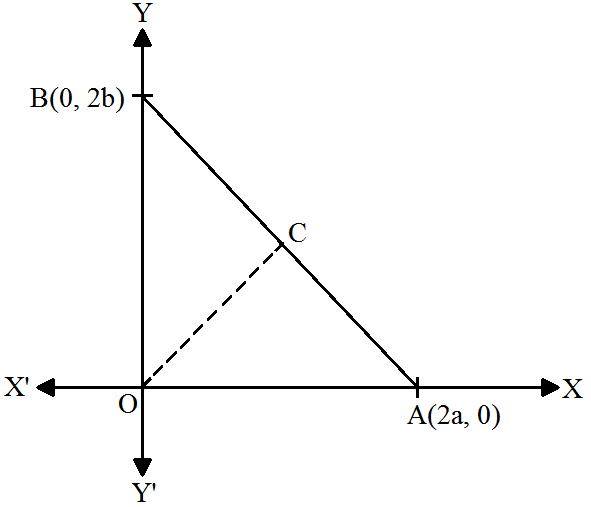
In Fig., a right triangle $BOA$ is given $C$ is the mid-point of the hypotenuse $AB$. Show that it is equidistant from the vertices $O, A$ and $B.$
The radii of the circular ends of a solid frustum of a cone are $33\ cm$ and $27\ cm$, and its slant height is $10\ cm$. Find its capacity and total surface area. $\Big[\text{Take}\ \pi=\frac{22}{7}.\Big]$
Two water taps together can fill a tank in $9\frac{3}{8}$ hours. The of larger diameter takes $10$ hours less than the smaller one to fill the tank separately. Find the time in which each tap can separately fill the tank.
A life insurance agent found the following data for distribution of ages of $100$ policy holders. Calculate the median age, if policies are only given to persons having age $18$ years onwards but less than $60 $ year.
Age (in years) Number of policyholders
Below $20$ $2$
Below $25$ $6$
Below $30$ $24$
Below $35$ $45$
Below $40$ $78$
Below $45$ $89$
Below $50$ $92$
Below $55$ $98$
Below $60$ $100$
Solve the given pair of linear equation by the elimination method and the substitution method: $3x + 4y = 10$ and $2x – 2y = 2$
Two boats approach a light house in mid-sea from opposite directions. The angles of elevation of the top of the light house from two boats are $30^\circ $ and $45^\circ $ respectively. If the distance between two boats is 100m, find the height of the light house.