Question
  1. Show that the normal component of electrostatic field has a discontinuity from one side of a charged surface to another given by

$(\text{E}_2-\text{E}_1).\hat{\text{n}}=\frac{\sigma}{\in_0}$

where $\hat{\text{n}}$ is a unit vector normal to the surface at a point and σ is the surface charge density at that point. (The direction of $\hat{\text{n}}$ is from side 1 to side 2.) Hence show that just outside a conductor, the electric field is σ $\hat{\text{n}}$0.

  1. Show that the tangential component of electrostatic field is continuous from one side of a charged surface to another.

[Hint: For (a), use Gauss’s law. For, (b) use the fact that work done by electrostatic field on a closed loop is zero.]
Answer

  1. Electric fielcl on one side of a charged body is E1 and electric field on the other side of the same body is E2. If infinite plane charged body has a uniform thickness, then electric field due to one surface of the charged body is given by,

$\vec{\text{E}}_1=-\frac{\sigma}{2\in_0}\hat{\text{n}} \dots\dots(1)$

Where,

$\hat{\text{n}}$ = Unit vector normal to the surface at a point

$\sigma$ = Surface charge density at that point

Electric field due to the other surface of the charged body,

$\vec{\text{E}}_2=-\frac{\sigma}{2\in_0}\hat{\text{n}} \dots\dots(2)$

Electric field at any point due to the two surfaces,

$\vec{\text{E}}_2-\vec{\text{E}}_1=\frac{\sigma}{2\in_0}\hat{\text{n}}+\frac{\sigma}{2\in_0}\hat{\text{n}}=\frac{\sigma}{\in_0}\hat{\text{n}}$

$(\vec{\text{E}}_2-\vec{\text{E}}_1).\hat{\text{n}}=\frac{\sigma}{\in_0} \dots\dots(3)$

Since inside a closed conductor, $\vec{\text{E}}_1=0,$

$\therefore\vec{\text{E}}=\vec{\text{E}}_2=-\frac{\sigma}{2\in_0}\hat{\text{n}}$

Therefore, the electric fielcl just outside the conductor is $\frac{\sigma}{\in_0}\hat{\text{n}}.$

  1. When a charged particle is moved from one point to the other on a closed loop, the work done by the electrostatic field is zero. Hence, the tangential component of electrostatic field Is continuous from one side of a charged surface to the other.

Need a full question paper?

Generate a complete, print-ready paper with questions like this in minutes — across 16+ boards, with answer keys.

Start Generating Free

Similar questions

State Gauss theorem in electrostatics. Apply this theorem to obtain the expression for the electric field at a point due to an infinitely long, thin, uniformly charged straight wire of linear charge density $\lambda\text{Cm}^{-1}.$
A monoenergetic electron beam with electron speed of 5.20 × 106 ms–1 is subject to a magnetic field of 1.30 × 10–4 T normal to the beam velocity. What is the radius of the circle traced by the beam, given e/m for electron equals 1.76 × 1011C kg–1.
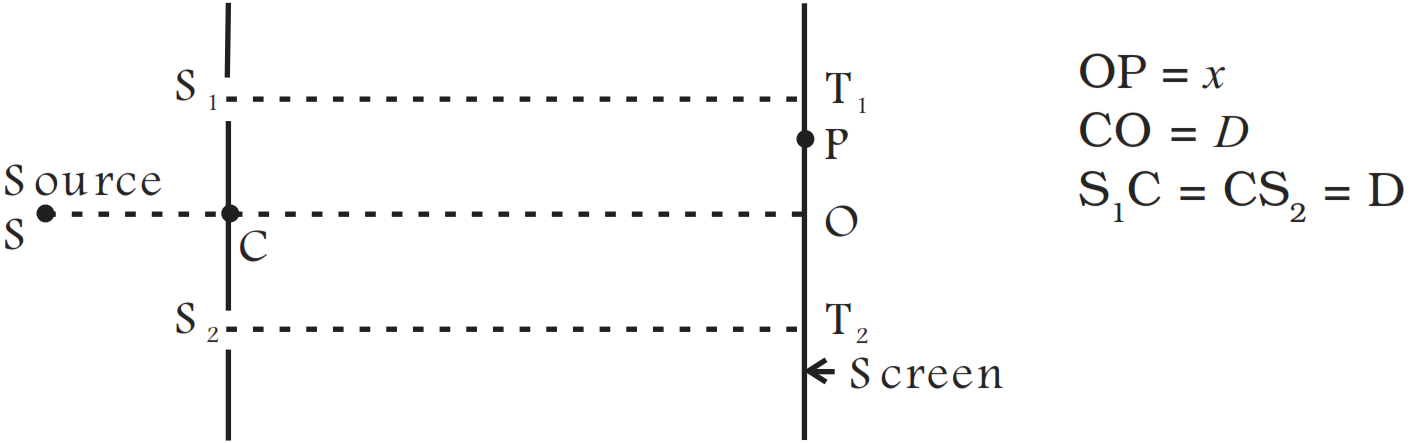
Consider a two slit interference arrangements (Fig.) such that the distance of the screen from the slits is half the distance between the slits. Obtain the value of D in terms of λ such that the first minima on the screen falls at a distance D from the centre O.

To ensure almost 100 per cent transmittivity, photographic lenses are often coated with a thin layer of dielectric material. The refractive index of this material is intermediated between that of air and glass (which makes the optical element of the lens). A typically used dielectric film is MgF2 (n = 1.38). What should the thickness of the film be so that at the center of the visible speetrum $(5000\mathring{\text{A}})$ there is maximum transmission.
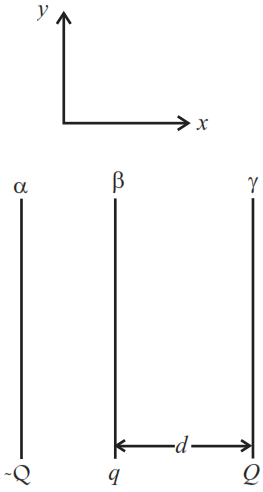
Two fixed, identical conducting plates $(\alpha\ \&\ \beta)$, each of surface area S are charged to -Q and q, respectively, where Q > q > 0. A third identical plate $(\gamma)$, free to move is located on the other side of the plate with charge q at a distance d (Fig.). The third plate is released and collides with the plate $\beta$. Assume the collision is elastic and the time of collision is sufficient to redistribute charge amongst $\beta\ \&\ \gamma$.

Find the velocity of the plate $\gamma$ after the collision and at a distance d from the plate $\beta$.
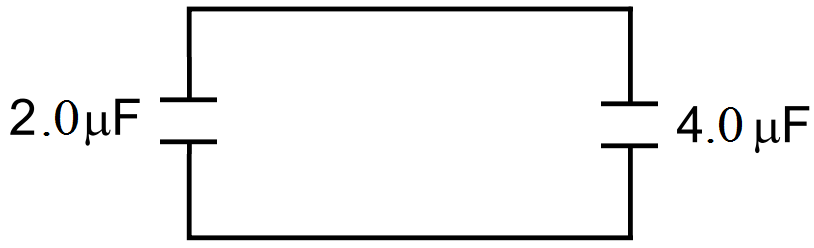
A capacitor of capacitance $2.0\mu\text{F}$ is charged to a potential difference of 12V. It is then connected to an uncharged capacitor of capacitance $4.0\mu\text{F}$ as shown in figure. Find:
  1. The charge on each of the two capacitors after the connection.
  2. The electrostatic energy stored in each of the two capacitors.
  3. The heat produced during the charge transfer from one capacitor to the other.

A gun is mounted on a railroad car. The mass of the car, the gun, the shells and the operator is 50m where m is the mass of one shell. If the velocity of the shell with respect to the gun (in its state before firing) is 200m/s, what is the recoil speed of the car after the second shot? Neglect friction.
Air is pumped into an automobile tyre's tube up to a pressure of 200kPa in the morning when the air temperature is 20°C. During the day the temperature rises to 40°C and the tube expands by 2%. Calculate the pressure of the air in the tube at this temperature.
A source emitting sound at frequency 4000Hz, is moving along the Y-axis with a speed of 22m/s. A listener is situated on the ground at the position (660m, 0). Find the frequency of the sound received by the listener at the instant the source the origin. Speed of sound in air = 330m/s.
  1. Draw a ray diagram to show image formation when the concave mirror produces a real, inverted and magnified image of the object.
  2. Obtain the mirror formula and write the expression for the linear magnification.
  3. Explain two advantages of a reflecting telescope over a refracting telescope.