Question
Show that the point $(0, 9)$ is equidistant from the points $(– 4, 1)$ and $(4, 1)$

Answer

Let $P\left(x_1, y_1\right)=P(0,9), Q\left(x_2, y_2\right)=Q(-4,1), R\left(x_3, y_3\right)=R(4,1)$
By distance formula,
$ d(P, Q)=\sqrt{\left(x_2-x_1\right)^2+\left(y_2-y_1\right)^2}$
$=\sqrt{[(-4)-0]^2+(1-9)^2}$
$=\sqrt{(-4)^2+(-8)^2}$
$=\sqrt{16+64}$
$=\sqrt{80}$
$=4 \sqrt{5} $
And
$ d(P, R)=\sqrt{\left(x_3-x_1\right)^2+\left(y_3-y_1\right)^2}$
$=\sqrt{(4-0)^2+(1-9)^2}$
$=\sqrt{4^2+(-8)^2}$
$=\sqrt{16+64}$
$=\sqrt{80}$
$=4 \sqrt{5} $
And
$d(P, R)=\sqrt{\left(x_3-x_1\right)^2+\left(y_3-y_1\right)^2}$
$=\sqrt{(4-0)^2+(1-9)^2}$
$=\sqrt{4^2+(-8)^2}$
$=\sqrt{16+64}$
$=\sqrt{80}$
$=4 \sqrt{5}$
Here, $d(P, Q)=d(P, R)$
$\therefore$ The point $(0,9)$ is equidistant from $(-4,1)$ and $(4,1)$.

Need a full question paper?

Generate a complete, print-ready paper with questions like this in minutes — across 16+ boards, with answer keys.
Start Generating Free

Similar questions

Find the value of p for the following distribution whose mean is 16.6.
x 8 12 15 P 20 25 30
f 12 16 20 24 16 8 4
If $\alpha$ and $\beta$ are the zeroes of the quadratic polynomial such that $\alpha+\beta=24$ and $\alpha-\beta=8,$ find a quadratic polynomial have $\alpha$ and $\beta$ as its zeroes.
The perimeter of a certain sector of a circle of radius 5.6m is 27.2m. Find the area of the sector.
Prove the following trigonometric identities.
$\frac{(1+\tan^2\theta)\cot\theta}{\text{cosec}^2\theta}=\tan\theta$
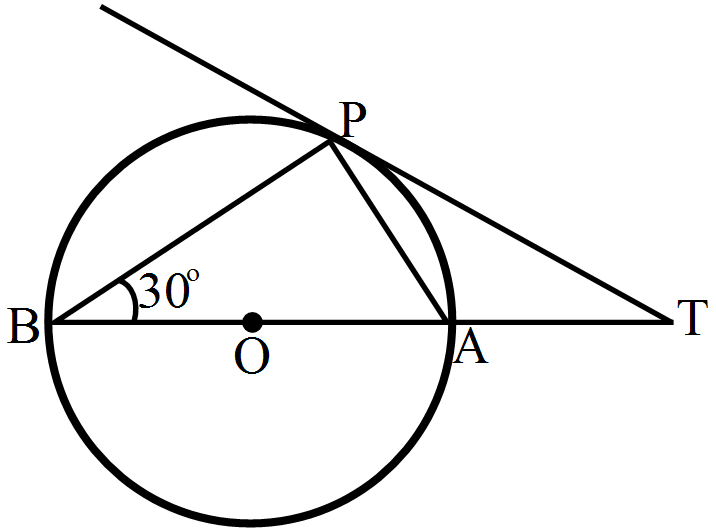
In the given figure, O is the centre of the circle and TP is the tangent to the circle from an external point T. If $\angle\text{PBT} = 30^\circ,$prove that
BA : AT = 2 : 1.
A cone of maximum size is carved out from a cube of edge 14cm. Find the surface area of the cone and of the remaining solid left out after the cone carved out.
If $\sin\theta=\frac{\sqrt{3}}{2},$ find the value of the all T-ratios of $\theta.$
Let ABCD be a square of side 2a. Find the coordinates of the vertices of this square when, The centre of the square is at the origin and coordinate axes are parallel to the sides AB and AD respectively.