Question
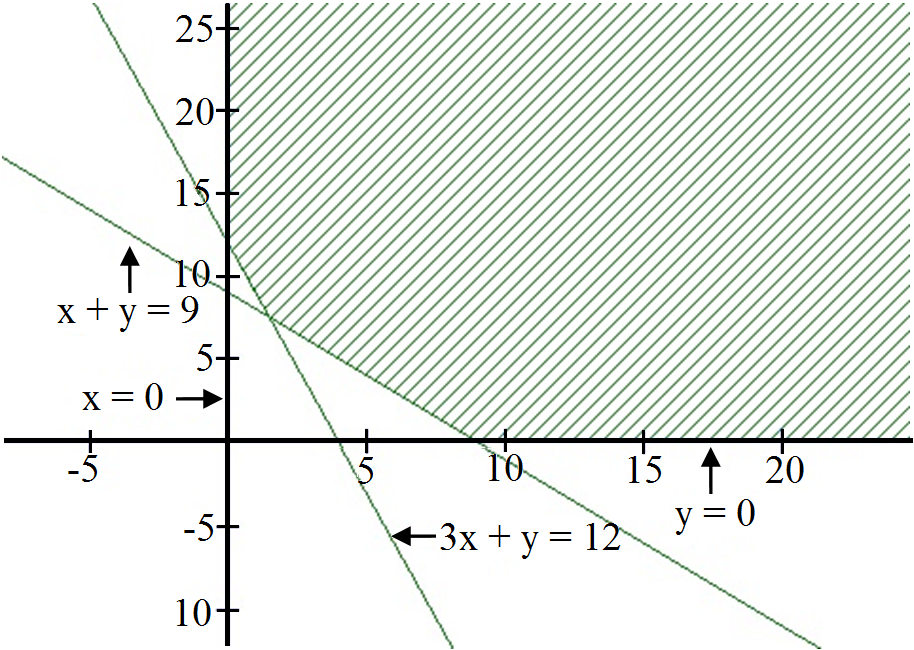
Show that the solution set of the following linear in equations is an unbounded set:
$\text{x}+\text{y}\geq9,3\text{x}+\text{y}\geq12,\text{x}\geq0,\text{y}\geq0.$
Answer


We have,

$\text{x}+\text{y}\geq9,3\text{x}+\text{y}\geq12,\text{x}\geq0,\text{y}\geq0.$

Converting the inequations into equations, we get

x + y = 9, 3x + y = 12, x = 0 and y = 0.

Region represented by $\text{x}+\text{y}\geq9.$

Putting x = 0 in x + y = 9, we get y = 9.

Putting y = 0 in x + y = 9, we get x = 9.

$\therefore$ The line x + y = 9 meets the coordinat axes at (0, 9) and (9, 0). Join these points by a thick line.

Now, putting x = 0 and y = 0 in $\text{x}+\text{y}\geq9.$ we get 0 9 This is not possible.

$\therefore$ We find that (0, 0) is not satisfies the inequation $\text{x}+\text{y}\geq9.$

So, the portion not containing the origin is represented by the given inequation.

Region represented by 3x + y > 12:

Putting x = 0 in 3x + y = 12, we get y = 12

Putting y = 0 in 3x + y = 12, we get $\text{x}=\frac{12}{3}=4$

$\therefore$ The line 3x + y = 12 meets the coordinate axes at (0, 12) and (4, 0). Joining these points by a thick line.

Now, putting x = 0 and y = 0 in $3\text{x}+\text{y}\geq12$ we get, $0\geq12$

This is not possible.

$\therefore$ We find that (0, 0) is not satisfies the inequation $3\text{x}+\text{y}\geq12.$ so the portion not containing the origin is represented by the given inequation.

Region represented by $\text{x}\geq0$ and $\text{y}\geq0$: clearly, $\text{x}\geq0$ and $\text{y}\geq0$ represent the first quadrant.

Need a full question paper?

Generate a complete, print-ready paper with questions like this in minutes — across 16+ boards, with answer keys.

Start Generating Free

Similar questions

Use the Principle of Mathematical Induction in the following Exercis.
Show that $\frac{\text{n}^5}{5}+\frac{\text{n}^3}{3}+\frac{7\text{n}}{15}$ is a natural number for all $\text{n}\in\text{N}.$
Evaluate the following limit:
$\lim\limits_{\text{x}\rightarrow{\sqrt{2}}}\frac{\sqrt{5+2\text{x}}-\big(\sqrt{2}+1\big)}{\text{x}^2-2}$
If the seventh term from the beginning and in the binomial expansion of $\Big(\sqrt[3]{2}+\frac{1}{\sqrt[3]{3}}\Big)^{\text{n}}$ are equal, is the $7^{th}$ term from the end.
Find the equation of a straight line on which length of perpendicular from the origin is four units and the line makes an angle of 120° with the positive direction of x-axis.
[Hint: Use normal form, here $\omega =30^\circ.$]
The coefficients of 2nd, 3rd and 4th terms in the expansion of $(1+\text{x})^{2\text{n}}$ are in A.P., then show that $2\text{n}^{2}-9\text{n}+7=0.$
Let P(n) be the statement: $2^{\text{n}}\geq3\text{n}.$ If p(r) is true, Show that p(r + 1) is true. Do you conclude that p(n) is true for all $\text{n}\in\text{N}$?
If $a, b, c$ are in G.P., prove that:
$(\text{a}+2\text{b}+2\text{c})(\text{a}-2\text{b}+2\text{c})=\text{a}^2+4\text{c}^2$
Find the equation of a straight line through the point of intersection of the lines 4x - 3y = 0 and 2x - 5y + 3 = 0 and parallel to 4x + 5y + 6 = 0.
If $\sec\text{x}\cos5\text{x}+1=0,$ where $0<\text{x}\leq\frac{\pi}{2},$ then find the value of x.
If a, b, c are in A.P., then show that:
$\text{b}+\text{c}-\text{a},\ \text{c}+\text{a}-\text{b},\ \text{a}+\text{b}-\text{c}$ are in A.P.