Question
Show that the vectors
$\vec{\text{a}}=\frac{1}{7}(2\hat{\text{i}}+3\hat{\text{j}}+6\hat{\text{k}}),\vec{\text{b}}=\frac{1}{7}(3\hat{\text{i}}-6\hat{\text{j}}+2\hat{\text{k}}),\vec{\text{c}}=\frac{1}{7}(6\hat{\text{i}}+2\hat{\text{j}}-3\hat{\text{k}})$ are mutually perpendicular unit vectors.
Answer

We have
$|\vec{\text{a}}|=\frac{1}{7}\sqrt{2^2+3^2+6^2}=\frac{1}{7}\sqrt{49}=\frac{7}{7}=1$
$\big|\vec{\text{b}}\big|=\frac{1}{7}\sqrt{3^2+(-6)^2+2^2}=\frac{1}{7}\sqrt{49}=\frac{7}{7}=1$
$|\vec{\text{c}}|=\frac{1}{7}\sqrt{6^2+2^2+(-3)^2}=\frac{1}{7}\sqrt{49}=\frac{7}{7}=1$
And
$\vec{\text{a}}.\vec{\text{b}}$
$=\frac{1}{7}(2\hat{\text{i}}+3\hat{\text{j}}+6\hat{\text{k}}).\frac{1}{7}(3\hat{\text{i}}-6\hat{\text{j}}+2\hat{\text{k}})$
$=\frac{1}{49}(6-18+12)$
$=0$
$\vec{\text{b}}.\vec{\text{c}}$
$=\frac{1}{7}(3\hat{\text{i}}-6\hat{\text{j}}+2\hat{\text{k}}).\frac{1}7{}(6\hat{\text{i}}+2\hat{\text{j}}-3\hat{\text{k}})$
$=\frac{1}{49}(18-12-6)$
$=0$
$\vec{\text{c}}.\vec{\text{a}}$
$=\frac{1}{7}(6\hat{\text{i}}+2\hat{\text{j}}-3\hat{\text{k}}).\frac{1}7{}(2\hat{\text{i}}+3\hat{\text{j}}+6\hat{\text{k}})$
$=\frac{1}{49}(12+6-18)$
$=0$
So, $|\vec{\text{a}}|=\big|\vec{\text{b}}\big|=|\vec{\text{c}}|=1$ and $\vec{\text{a}}.\vec{\text{b}}=\vec{\text{b}}.\vec{\text{c}}=\vec{\text{c}}.\vec{\text{a}}=0$
So, the given vectors are mutuaiiy perpendicular unit vectors.

Need a full question paper?

Generate a complete, print-ready paper with questions like this in minutes — across 16+ boards, with answer keys.

Start Generating Free

Similar questions

Determine the equation of the line passing through the points (1, 2, -4) and perpendicular to the lines $\frac{\text{x}-8}{8}=\frac{\text{y}+9}{-16}=\frac{\text{z}-10}{7}$ and $\frac{\text{x}-15}{3}=\frac{\text{y}-29}{8}=\frac{\text{z}-5}{-5}.$
If $\text{f}\text{(x)}=\begin{cases}\frac{\text{x}-4}{\text{|x}-4|}+\text{a}, &\text{if x} <4\\\text{a}+\text{b},&\text{if x}=4\\\frac{\text{x}-4}{\text{|x}-4|}+\text{b}, & \text{if x}>4\end{cases}$ is continuous at x = 4. Find a, b.
Verify Rolle's theorem of the following function on the indicated interval
$\text{f}(\text{x})=2\sin\text{x}+\sin2\text{x}\text{ on }[0,\pi]$
Compute the adjoint of the following matrices:$\begin{bmatrix} 1 & 2 & 2 \\ 2 & 1 & 2 \\ 2 & 2 & 1 \end{bmatrix}$
Verify that (adjoint A)A = |A|I = A (adjoint A) for the above matrices.
The rate of increase in the number of bacteria in a certain bacteria culture is proportional to the number present. Given the number triples in $5$ hrs, find how many bacteria will be present after $10$ hours. Also find the time necessary for the number of bacteria to be $10$ times the number of initial present.
$\int\text{x}(1-\text{x})^{23}\text{dx}$
Given $\text{A}=\begin{bmatrix}2&2&-4\\-4&2&-4\\2&-1&5\end{bmatrix},\text{B}=\begin{bmatrix}1&-1&0\\2&3&4\\0&1&2\end{bmatrix}$ , find BA and use this to solve the system of equations $y + 2z = 7, x - y = 3, 2x + 3y + 4z = 17$
find the area of the region bound by the curve $x = at ^2, y =2$ at between the ordinatrs corresponding $t =1$ and $t =2$.
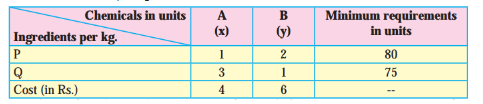
A factory produced two types of chemicals A and B. The following table gives the units of ingredients P and Q (per kg) of chemicals A and B as well as minimum requirements of P and Q and also cost per kg. chemicals A and B :

Image

Find the number of units of chemicals A and B should be produced so as to minimize the cost.

Find the matrix A such that
$\begin{bmatrix}1&1\\0&1\end{bmatrix}\text{A}=\begin{bmatrix}3&3&5\\1&0&1\end{bmatrix}$