Question
Show that vectors $\text{A}=2\hat{\text{i}}-3\hat{\text{j}}-\hat{\text{k}}$ and $\text{B}=-6\hat{\text{i}}+9\hat{\text{j}}+3\hat{\text{k}}$
are parallel.

Answer

The given vectors are $\text{A}=2\hat{\text{i}}-3\hat{\text{j}}-\hat{\text{k}}$ and $\text{B}=-6\hat{\text{i}}+9\hat{\text{j}}+3\hat{\text{k}}$ Then, the vecotrs are parallel, if A × B = 0 $\therefore\ \text{A}\times\text{B}=\begin{vmatrix}\hat{\text{i}}&\hat{\text{j}}&\hat{\text{k}}\\2&-3&-1\\-6&9&3\end{vmatrix}$ $\hat{\text{i}}(-9+9)-\hat{\text{j}}(6-6)+\hat{\text{k}}(18-18)=0$ But |A × B| = 0 $\text{AB}\sin\theta=0\ \ [\because\text{A}\neq0\text{ and B}\neq0]$ $\therefore\ \sin\theta=0\ \text{or }\theta=0$ Hence, the vectors A and B are parallel.

Need a full question paper?

Generate a complete, print-ready paper with questions like this in minutes — across 16+ boards, with answer keys.
Start Generating Free

Similar questions

A wheel rotating at a speed of $600rpm$ (revolutions per minute) about its axis is brought to rest by applying a constant torque for $10$ seconds. Find the angular deceleration and the angular velocity $5$ seconds after the application of the torque.
The magnetic field due to a long straight wire has been derived in terms of $\mu_0,$ i and d. Express this in terms of $\in_0,$ C, i and d.
What is the period of revolution of Neptune around the sun, given that the diameter of its orbit is 30 times the diameter of the earth's orbit around the sun, both orbits being assumed to be circular? Taking the moon's orbit around earth to be r and mass of earth 81 times the mass of the moon, find the position of the point from the earth where the net gravitational field is zero.
If a body travels half its total path in its last second of its fall from rest, calculate the time and height of its fall.
A person weighing $60 kg$ takes in $2000\ kcal$ diet in a day. If this energy were to be used in heating the person without any loss, what would be his rise in temperature? Given specific heat of human body is $0.83 \mathrm{cal} \mathrm{g}^{-1}{ }^{\circ} \mathrm{C}^{-1}$
A particle is subjected to two simple harmonic motions$\text{x}_1=\text{A}_1\sin\omega\text{t}$ $\text{x}_2=\text{A}_2\Big(\omega+\frac{\pi}{3}\Big)$ Find
  1. The disphcement at $t = 0.$
  2. The maximum speeil of thc particle and.
  3. The madmum accelerution of the particle.
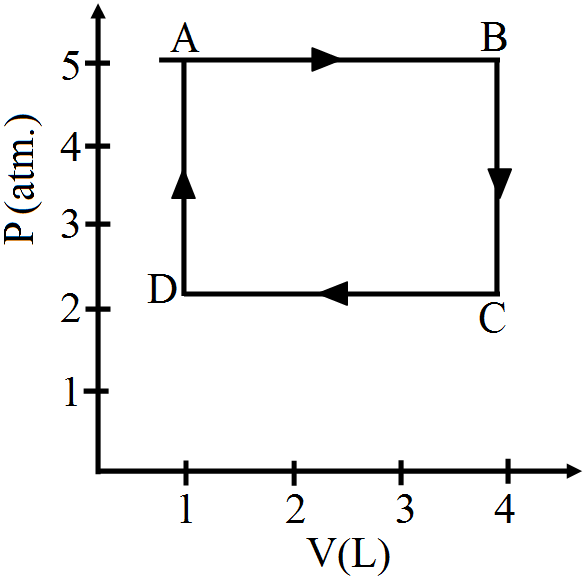
One mole of an ideal gas undergoes a cyclic change ABCD. From the given diagram, calculate the net work done in the process. $1$ atmosphere = $10^\circ dyne\ cm^{-2}$.
Explain clearly, with examples, the distinction between: Magnitude of average velocity over an interval of time, and the average speed over the same interval. [Average speed of a particle over an interval of time is defined as the total path length divided by the time interval]. Show in both (a) and (b) that the second quantity is either greater than or equal to the first. When is the equality sign true? [For simplicity, consider one-dimensional motion only]
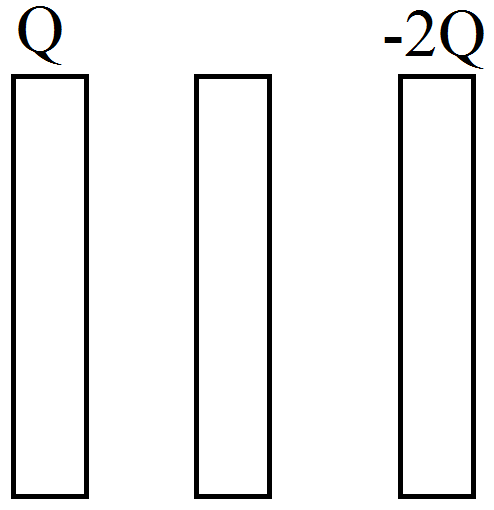
Three identical metal plates with large surface areas are kept parallel to each other as shown in figure. The leftmost plate is given a charge Q, the rightmost a charge -2Q and the middle one remains neutral. Find the charge appearing on the outer surface of the rightmost plate.
What is a heat engine? What is the best way to increase efficiency of a heat engine? Is it possible to design a thermal engine that has $100\%$ efficiency?