Question
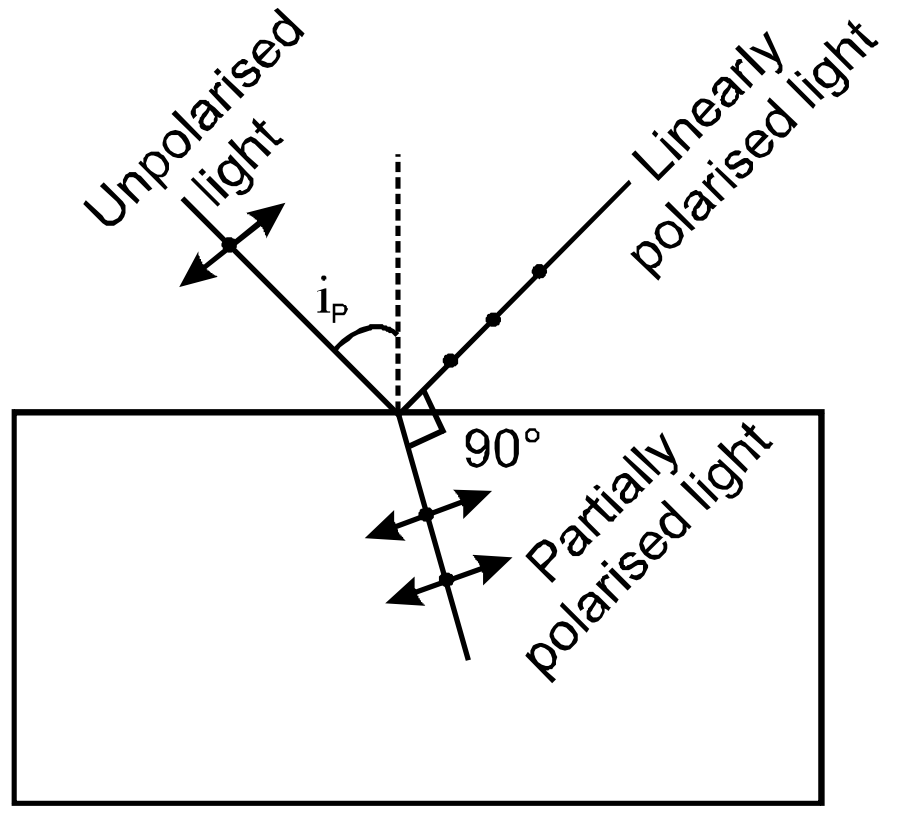
  1. Show using a proper diagram how unpolarised light can be linearly polarised by reflection from a transparent glass surface.
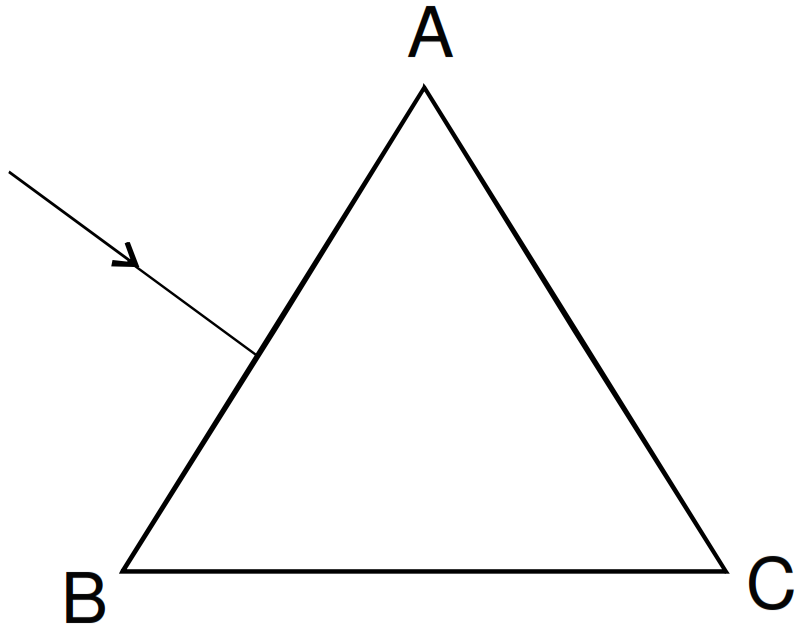
  2. The figure shows a ray of light falling normally on the face AB of an equilateral glass prism having refractive index $\frac{3}{2},$ placed in water of refractive index $\frac{4}{3}.$ Will this ray suffer total internal reflection on striking the face AC? Justify your answer.
Answer

  1.  

When unpolarised light ray is incident at an angle such that the angle between reflected of refracted rays is 90°, then reflected ray is linearly polarised. In that case incident angle is called polarising angle or Brewster angle(iP or iB).

  1. For Total internal reflection $\Big(\frac{1}{\sin\text{i}_{\text{c}}}=\mu_{\text{DR}}\Big)$

$\sin\text{i}_{\text{c}}=\Big(\frac{1}{\sin\text{i}_{\text{c}}}=\mu_{\text{DR}}\Big)$

$\sin\text{i}_{\text{c}}=\mu_{\text{wg}}$

$\sin\text{i}_{\text{c}}=\frac{4}{3}\div\frac{3}{2}$

$=\frac{4}{3}\times\frac{2}{3}$

$\sin\text{i}_{\text{c}}=\frac{8}{9}=0.88$

Now, in this case

$\sin\text{i}=\sin60^\circ=\frac{\sqrt{3}}{2}=0.867$

$\because\ \sin\text{i}<\sin\text{i}_{\text{c}}$

$\text{So,}\ \text{i}<\text{i}_{\text{c}}$

So, ray will not suffer Total internal reflection.

Need a full question paper?

Generate a complete, print-ready paper with questions like this in minutes — across 16+ boards, with answer keys.

Start Generating Free

Similar questions

A straight, long wire carries a current of 20A. Another wire carrying equal current is placed parallel to it. If the. force acting on a length of 10cm of the second wire is 2 ×10⁻⁵N, what is the separation between them?
Write Einstein’s photoelectric equation and point out any two characteristic properties of photons on which this equation is based.
Briefly, explain the three observed features which can be explained by this equation.
A beam of light consisting of two wavelengths, 650 nm and 520 nm, is used to obtain interference fringes in a Young’s double-slit experiment.
  1. Find the distance of the third bright fringe on the screen from the central maximum for wavelength 650 nm.
  2. What is the least distance from the central maximum where the bright fringes due to both the wavelengths coincide?
A healthy youngman standing at a distance of 7m from a 11.8m high building sees a kid slipping from the top floor. With what speed (assumed uniform) should he run to catch the kid at the arms height (1.8m)?
For a given position of an object, an equiconvex lens forms its real image at a distance of 60cm from the lens. A convex mirror is now kept in between this image position and the convex lens. The final image formed by this combination coincides with the object when the distance between the convex lens and the convex mirror equals 25cm. Calculate the radius of curvature of the convex mirror.
An object is to be seen through a simple microscope of focal length 12cm. Where should the object be placed so as to produce maximum angular magnification? The least distance for clear vision is 25cm.
Locate the image formed by refraction in the situation shown in figure.

The moment of inertia of a uniform rod of mass 0.50kg and length 1m is 0.10kg-m2 about a line perpendicular to the rod. Find the distance of this line from the middle point of the rod.
For a normal eye, the far point is at infinity and the near point of distinct vision is about 25 cm in front of the eye. The cornea of the eye provides a converging power of about 40 dioptres, and the least converging power of the eye-lens behind the cornea is about 20 dioptres. From this rough data estimate the range of accommodation (i.e., the range of converging power of the eye-lens) of a normal eye.
Establish a relationship between electric current and drift velocity. Draw the direction of electron flowing in a circuit by drawing an electric circuit.