Question
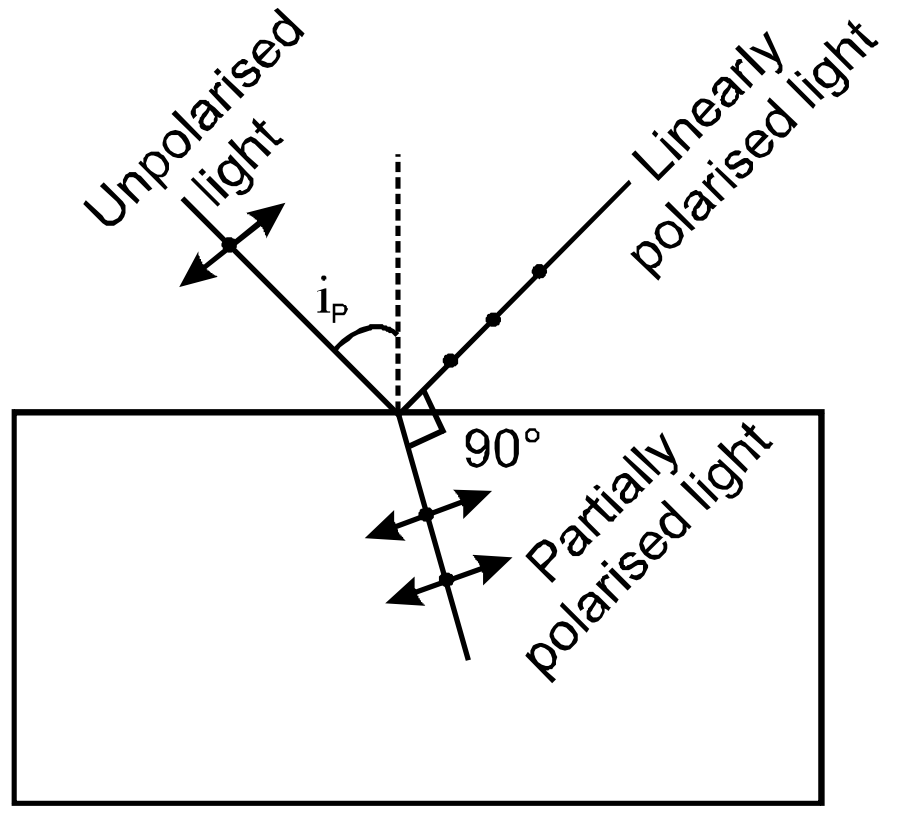
  1. Show using a proper diagram how unpolarised light can be linearly polarised by reflection from a transparent glass surface.
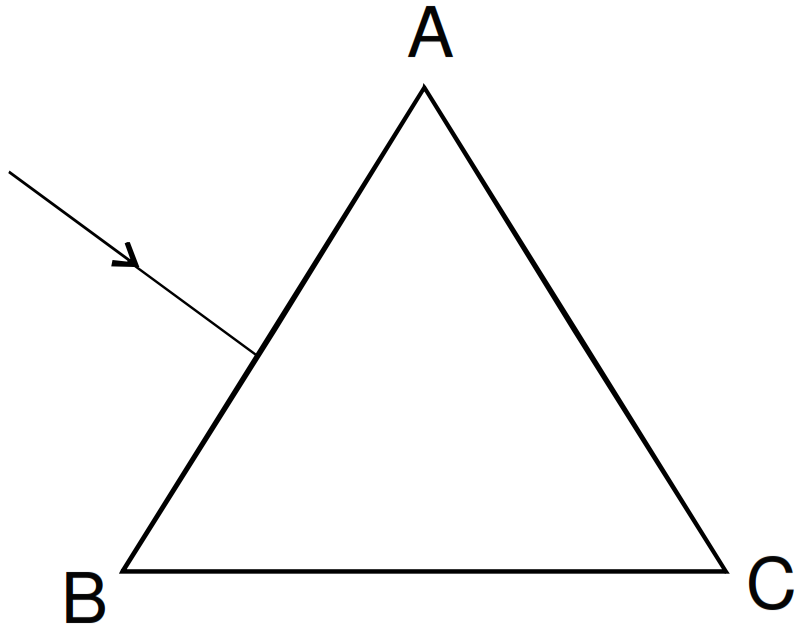
  2. The figure shows a ray of light falling normally on the face AB of an equilateral glass prism having refractive index $\frac{3}{2},$ placed in water of refractive index $\frac{4}{3}.$ Will this ray suffer total internal reflection on striking the face AC? Justify your answer.
Answer

  1.  

When unpolarised light ray is incident at an angle such that the angle between reflected of refracted rays is 90°, then reflected ray is linearly polarised. In that case incident angle is called polarising angle or Brewster angle(iP or iB).

  1. For Total internal reflection $\Big(\frac{1}{\sin\text{i}_{\text{c}}}=\mu_{\text{DR}}\Big)$

$\sin\text{i}_{\text{c}}=\Big(\frac{1}{\sin\text{i}_{\text{c}}}=\mu_{\text{DR}}\Big)$

$\sin\text{i}_{\text{c}}=\mu_{\text{wg}}$

$\sin\text{i}_{\text{c}}=\frac{4}{3}\div\frac{3}{2}$

$=\frac{4}{3}\times\frac{2}{3}$

$\sin\text{i}_{\text{c}}=\frac{8}{9}=0.88$

Now, in this case

$\sin\text{i}=\sin60^\circ=\frac{\sqrt{3}}{2}=0.867$

$\because\ \sin\text{i}<\sin\text{i}_{\text{c}}$

$\text{So,}\ \text{i}<\text{i}_{\text{c}}$

So, ray will not suffer Total internal reflection.

Need a full question paper?

Generate a complete, print-ready paper with questions like this in minutes — across 16+ boards, with answer keys.

Start Generating Free

Similar questions

Light in certain cases may be considered as a stream of particles called photons. Each photon has a linear momentum $\frac{\text{h}}{\lambda}$ where h is the Planck's constant and $\lambda$ is the wavelength of the light. A beam of light of wavelength $\lambda$ is incident on a plane mirror at an angle of incidence $\theta.$ Calculate the change in the linear momentum of a photon as the beam is reflected by the mirror.
When an apple falls from a tree what happens to its gravitational potential energy just as it reaches the ground? After it strikes the ground?
When two resistors are connected in sereis and parallel, then their equivalent resistances are $ 16~\Omega $ and $ 3~\Omega $ respectively. Find out the resistance of each resistor.
A proton has spin and magnetic moment just like an electron. Why then its effect is neglected in magnetism of materials?
What potential difference should be applied across an X-ray tube to get X-ray of wavelength not less than 0.10nm? What is the maximum energy of a photon of this X-ray in joule?
Write the name of main parts of electromagnetic spectrum with their wavelength range.
An alpha particle is accelerated through a potential difference of 100 V. Calculate:
i. The speed acquired by the alpha particle, and
ii. The de-Broglie wavelength associated with it. 
(Take mass of alpha particle $=6.4 \times 10^{-27} kg$ )
  1. State two important features of Einstein's photoelectric equation.
  2. Radiation of frequency 1015 Hz is incident on two photosensitive surface P and Q. There is no photoemission from surface P. Photoemission occurs from surface Q but photoelectrons have zero kinetic energy. Explain these observations and find the value of work function for surface Q.
  1. A student wants to use two p-n junction diodes to convert alternating current into direct current. Draw the labelled circuit diagram she would use and explain how it works.
  2. Give the truth table and circuit symbol for NAND gate.
Boron has two stable isotopes, $^{10}_5\text{B }\text{ and }\ ^{11}_5\text{B}.$ Their respective masses are 10.01294 u and 11.00931 u, and the atomic mass of boron is 10.811 u. Find the abundances of $^{10}_5\text{B }\text{ and }\ ^{11}_5\text{B}.$