Question

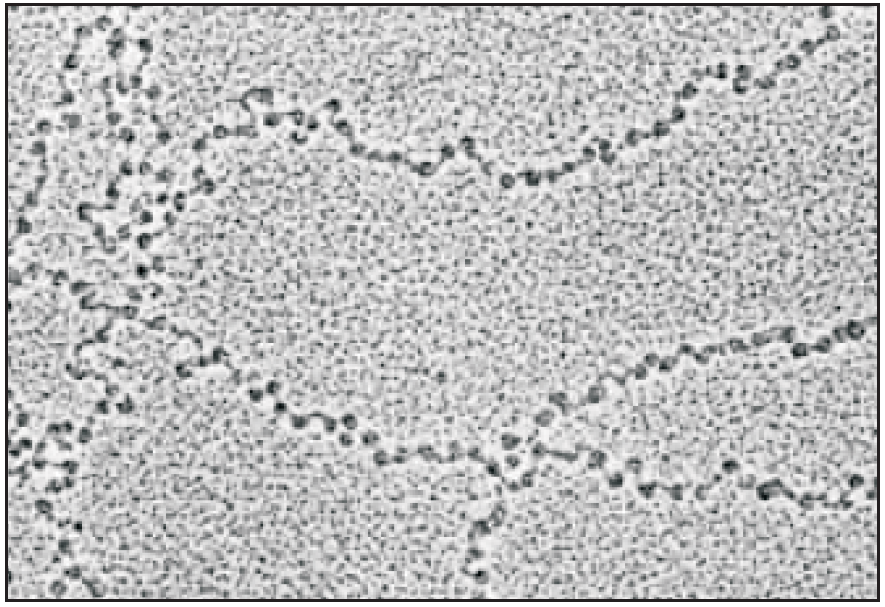
Shown above is the electron micrograph (EM) picture of 'beads-on-string'.
  1. Identify and explain the detailed structure of a bead with the help of a labelled diagram.
  2. Describe the packaging of 'beads-on-string'in a eukaryotic cell.

Answer

  1. The bead-like structures are the nucleosomes:
  1. There is a set of positively charged proteins, called histones, rich in basic amino acid residues, lysine and arginine.
  2. Histones are organised to form a unit of eight molecules, called histone octamer.
  3. The negatively charged DNA is wrapped around the positively charged histone octamer, to form a nucleosome; a nucleosome contains 200 bp of DNA helix.
  1.  
  1. The nucleosomes form the repeating units of the chromatin fibre in the nucleus; these nucleosomes of a chromatin are seen as the beads-on-string structure under electron microscope.
  2. The chromatin fibres are further coiled and condensed at metaphase stage to form the chromosomes.
  3. The packaging of chromatin at higher levels requires another set of proteins, called non histone chromosomal (NHC) proteins.

Need a full question paper?

Generate a complete, print-ready paper with questions like this in minutes — across 16+ boards, with answer keys.

Start Generating Free

Similar questions

Write a short note on electronic waste. List the various sources of e-wastes and the problems associated with its disposa
  1. Explain Polygenic inheritance and Multiple allelism with the help of suitable examples.
  2. "Phenylketonuria is a good example that explains Pleiotropy." Justify.
  1. Give reasons for:
  1. Both strands of DNA are not copied during transcription.
  2. Transcription and translation in bacteria can be coupled.
  1. Differentiate between the process of transcription in prokaryotes and eukaryotes.
Write the important characteristic of cromagnon man and also clarify that it was closest ancestor of modern man?
Find out from newspapers and popular science articles any new fossil discoveries or controversies about evolution.
Explain the carbon cycle with the help of a simplified model.
What are the various constituents of domestic sewage? Discuss the effects of sewage discharge on a river.
What is called nucleosome? Explain the packaging of DNA coil. Draw a labelled diagram of a nucleosome.
The biology teacher asked her students to verify the experiment on transformation principle in bacteria to establish DNA as genetic material. The class was divided into two groups. The teacher asked them to submit the reports. Group 2 did not use mouse and did not repeat Griffith's experiment. The teacher praised them.
  1. Which experiment did they perform?
  2. Explain the experiment in brief.
  3. Who and when performed the transformation principle experiment?
  4. What values did students of group 2 exhibit?
How does the transmission of each of the following diseases take place?
  1. Amoebiasis.
  2. Malaria.
  3. Ascariasis.
  4. Pneumonia.