Question
Shreya got a rectangular parallelepiped shaped box and spherical ball inside it as return gift. Sides of the box are $x, 2x,$ and $\frac{\text{x}}{3},$ while radius of the ball is $r.$
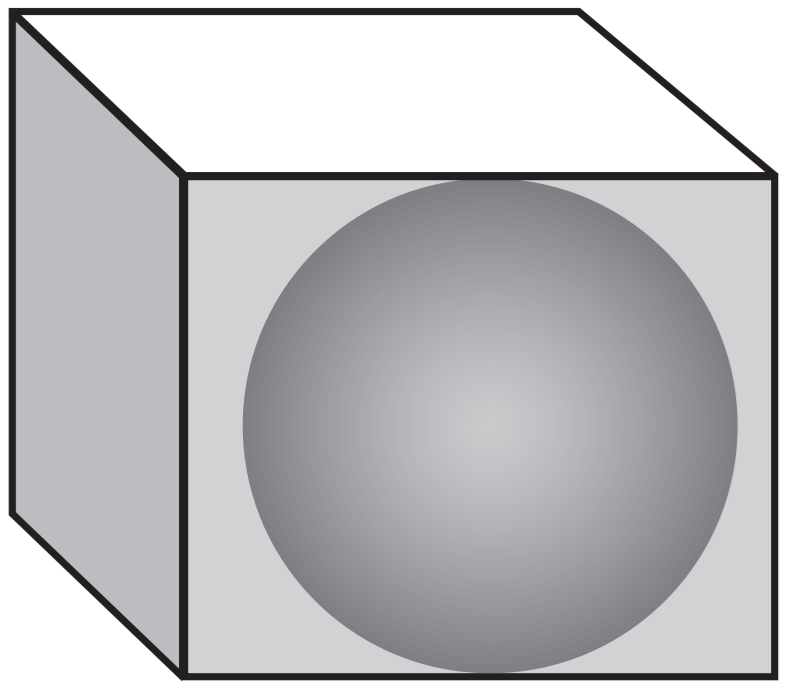
Based on the above information, answer the following questions.
  1. If $S$ represents the sum of volume of parallelepiped and sphere, then Scan be written as.
  1. $\frac{4\text{x}^3}{3}+\frac{2}{2}\pi\text{r}^2$
  2. $\frac{2\text{x}^2}{3}+\frac{4}{3}\pi\text{r}^2$
  3. $\frac{2\text{x}^3}{3}+\frac{4}{3}\pi\text{r}^3$
  4. $\frac{2}{3}\text{x}+\frac{4}{3}\pi\text{r}$
  1. If sum of the surface areas of box and ball are given to be constant $k^2$ then $x$ is equal to.
  1. $\sqrt{\frac{\text{k}^2-4\pi\text{r}^2}{6}}$
  2. $\sqrt{\frac{\text{k}^2-4\pi\text{r}}{6}}$
  3. $\sqrt{\frac{\text{k}^2-4\pi}{6}}$
  4. $\text{None of these}$
  1. The radius of the ball, when Sis minimum, is.
  1. $\sqrt{\frac{\text{k}^2}{54+\pi}}$
  2. $\sqrt{\frac{\text{k}^2}{54+4}}$
  3. $\sqrt{\frac{\text{k}^2}{64+3\pi}}$
  4. $\sqrt{\frac{\text{k}^2}{4\pi+3}}$
  1. Relation between length of the box and radius of the ball can be represented as.
  1. $\text{x} = \frac{2}{\text{r}}$
  2. $\text{x}=\frac{\text{r}}{2}$
  3. $\text{x}=\frac{2}{\text{r}}$
  4. $\text{x}=3\text{r}$
  1. Minimum value of $S$ is.
  1. $\frac{\text{k}^2}{2(3\pi+54)^\frac{2}{3}}$
  2. $\frac{\text{k}}{2(3\pi+54)^\frac{3}{2}}$
  3. $\frac{\text{k}^3}{2(4\pi+54)^\frac{1}{2}}$
  4. $\text{None of these}$

Answer

  1. $(c) \frac{2\text{x}^3}{3}+\frac{4}{3}\pi\text{r}^3$
Let $S$ be the sum of volume of parallelepiped and sphere, then
$\text{S}=\text{x}(2\text{x})\Big(\frac{\text{x}}{3}\Big)+\frac{4}{3}\pi\text{r}^3$
$=\frac{2\text{x}^3}{3}+\frac{4}{3}\pi\text{r}^3$
  1. $(a) \sqrt{\frac{\text{k}^2-4\pi\text{r}^2}{6}}$
Since, sum of surface area of box and sphere is given to be constant $k^2.$
$\therefore2\Big(\text{x}\times\text{2x}+\text{2x}\times\frac{\text{x}}{3}+\frac{\text{x}}{3}\times\text{x}\Big)+4\pi\text{r}^2=\text{k}^2$
$\Rightarrow6\text{x}^2+4\pi\text{r}^2=\text{k}^2$
$\Rightarrow\text{x}^2=\frac{\text{k}^2-4\pi\text{r}}{6}$
$\Rightarrow\text{x}=\sqrt{\frac{\text{k}^2-4\pi\text{r}}{6}}$
  1. $(b) \sqrt{\frac{\text{k}^2}{54+4}}$
From $(1)$ and $(2),$ we get
$\text{s}=\frac{2}{3}\bigg(\frac{\text{k}^2-4\pi\text{r}^2}{6}\bigg)^\frac{3}{2}+\frac{4}{3}\pi\text{r}^3$
$=\frac{2}{3\times6\sqrt{6}}(\text{k}^2-4\pi\text{r}^2)^\frac{3}{2}+\frac{4}{3}\pi\text{r}^3$
$\Rightarrow\frac{\text{ds}}{\text{dr}}=\frac{1}{9\sqrt{6}}\frac{3}{2}(\text{k}^2-4\pi\text{r}^2)^\frac{1}{2}-8\pi\text{r}+4\pi\text{r}^2$
$=4\pi\text{r}\bigg[\text{r}\frac{1}{3\sqrt{6}}\sqrt{\text{k}^2-4\pi\text{r}^2}\bigg]$
For maximum/minimum, $\frac{\text{ds}}{\text{dr}}=0$
$\Rightarrow\frac{4\pi\text{r}}{3\sqrt{6}}\sqrt{\text{k}-4\pi\text{r}^2}=-4\pi\text{r}^2$
$\text{k}^2-4\pi\text{r}^2=54\text{r}^2$
$\Rightarrow\text{r}^2=\frac{\text{k}^2}{54+4\pi}$
$\Rightarrow\text{r}=\sqrt{\frac{\text{k}^2}{54+4\pi}}$
  1. $(d) \text{x}=3\text{r}$
$\text{Since},\text{x}^2=\frac{\text{k}-4\pi\text{r}^2}{6}=\frac{1}{6}\bigg[\text{k}^2-4\pi\Big(\frac{\text{k}^2}{54+4\pi}\Big)\bigg]
[$From $(2)$ and $(3)$
$=\frac{9\text{k}^2}{54+4\pi}=9\Big(\frac{\text{k}^2}{54+4\pi}\Big)=9\text{r}^2=(3\text{r})^2$
$\Rightarrow x = 3r$​​​​​​​
  1. $(c) \frac{\text{k}^3}{2(4\pi+54)^\frac{1}{2}}$
Minimum value of $S$ is given by
$\frac{2}{3}(3\text{r})^3+\frac{4}{3}\pi\text{r}^3$
$=18\text{r}^3+\frac{4}{3}\pi\text{r}^3=\bigg(18+\frac{4}{3}\pi\bigg)\text{r}^3$
$\bigg(18+\frac{4}{3}\pi\bigg)\text{r}^3\bigg(\frac{\text{k}^2}{54+4\pi}\bigg)^\frac{3}{2}$
$\frac{1}{3}\frac{\text{k}^3}{(54+4\pi)^\frac{1}{2}}$

Need a full question paper?

Generate a complete, print-ready paper with questions like this in minutes — across 16+ boards, with answer keys.

Start Generating Free

Similar questions

Read the following passage and answer the questions given below : In an Office three employees James, Sophia and Oliver process incoming copies of a certain form. James processes $50\%$ of the forms, Sophia processes $20\%$ and Oliver the remaining $30\%$ of the forms. James has an error rate of $0.06,$ Sophia has an error rate of $0.04$ and Oliver has an error rate of $0.03$. Based on the above information, answer the following questions.
Image
$(i)$ Find the probability that Sophia processed the form and committed an error.
$(ii)$ Find the total probability of committing an error in processing the form.
$(iii)$ The manager of the Company wants to do a quality check. During inspection, he selects a form at random from the days output of processed form. If the form selected at random has an error, find the probability that the form is not processed by James.
$OR$
$(iii)$ Let E be the event of committing an error in processing the form and let $12 ,EE$ and $3 E$ be the events that James, Sophia and Oliver processed the form. Find the value of $\sum_{i=1}^3 P\left(E_i \mid E\right)$
 In a wedding ceremony, consists of father, mother, daughter and son line up at random for a family photograph, as shown in figure.
Based on the above information, answer the following questions.
  1. Find the probability that daughter is at one end, given that father and mother are in the middle.
  1. $1$
  2. $\frac{1}{2}$
  3. $\frac{1}{3}$
  4. $\frac{2}{3}$
  1. Find the probability that mother is at right end, given that son and daughter are together.
  1. $\frac{1}{2}$
  2. $\frac{1}{3}$
  3. $\frac{1}{4}$
  4. $0$
  1. Find the probability that father and mother are in the middle, given that son is at right end.
  1. $\frac{1}{4}$
  2. $\frac{1}{2}$
  3. $\frac{1}{3}$
  4. $\frac{2}{3}$
  1. Find the probability that father and son are standing together, given that mother and daughter are standing together.
  1. $0$
  2. $1$
  3. $\frac{1}{2}$
  4. $\frac{2}{3}$
  1. Find the probability that father and mother are on either of the ends, given that son is at second position from the right end.
  1. $\frac{1}{3}$
  2. $\frac{2}{3}$
  3. $\frac{1}{4}$
  4. $\frac{2}{5}$  
Consider 2 families A and B. Suppose there are 4 men, 4 women and 4 children in family A and 2 men, 2 women and 2 children in family B. The recommended daily amount of calories is 2400 for a man, 1900 for a woman, 1800 for children and 45 grams of proteins for a man, 55 grams for a woman and 33 grams for children.

Image

(i) Represent the requirement of calories and proteins for each person in matrix form.

(ii) Find the requirement of calories of family A and requirement of proteins of family B.

(iii) Represent the requirement of calories and proteins If each person increases the protein intake by $5 \%$ and decrease the calories by $5 \%$ in matrix form.

OR

If $\mathrm{A}$ and $\mathrm{B}$ are two matrices such that $\mathrm{AB}=\mathrm{B}$ and $\mathrm{BA}=\mathrm{A}$, then find $\mathrm{A}^2+\mathrm{B}^2$ in terms of $\mathrm{A}$ and $\mathrm{B}$.

A relation R on a set A is said to be an equivalence relation on A iff it is:
  1. Reflexive i.e., $(\text{a, a})\in\ \text{R} \ \forall \ \text{a}\in\text{A}.$
  2. Symmetric i.e., $(\text{a, b})\in\ \text{R} \Rightarrow \text{(b, a) } \in\text{R}\ \forall \ \text{a, b}\in\text{A}.$
  3. Transitive i.e., $(\text{a, b})\in\ \text{R} \ \text{and}\ \text{(b, c) } \in\text{R}\Rightarrow\text{(a, c)}\in\text{R}\ \forall \ \text{a, b, c}\in\text{A}.$
Based on the above information, answer the following questions.
  1. If the relation R = {(1, 1), (1, 2), (1, 3), (2, 2), (2, 3), (3, 1), (3, 2), (3, 3)} defined on the set A = {1, 2, 3}, then R is:
  1. Reflexive
  2. Symmetric
  3. Transitive
  4. Equivalence
  1. If the relation R = {(1, 2), (2, 1), (1, 3), (3, 1)} defined on the set A = {1, 2, 3}, then R is:
  1. Reflexive
  2. Symmetric
  3. Transitive
  4. Equivalence
  1. If the relation R on the set N of all natural numbers defined as R = {(x, y): y = x + 5 and x < 4}, then R is:
  1. Reflexive
  2. Symmetric
  3. Transitive
  4. Equivalence
  1. If the relation R on the set A = {1, 2, 3, ........., 13, 14} defined as R = {(x, y): 3x - y = O}, then R is:
  1. Reflexive
  2. Symmetric
  3. Transitive
  4. Equivalence
  1. If the relation R on the set A = {I, 2, 3} defined as R = {(1, 1), (1, 2), (1, 3), (2, 1), (2, 2), (2, 3), (3, 1), (3, 2), (3, 3)}, then R is:
  1. Reflexive only
  2. Symmetric only
  3. Transitive only
  4. Equivalence
Two farmers Shyam and Balwan Singh cultivate only three varieties of pulses namely Urad, Masoor and Mung. The sale (in ₹) of these varieties of pulses by both the farmers in the month of September and October are given by the following matrices A and B.

September sales (in ₹)
$\begin{matrix}\ \ \ \ \ \ \ \ \ \ \text{Urad}&\text{Masoor}&\text{Mung}\end{matrix}\\\text{A}=\begin{bmatrix}10000&20000&30000\\50000&30000&10000\end{bmatrix}\begin{matrix}\text{Shayam}\\\text{Balwan singh}\end{matrix}$
October sales (in ₹)
$\begin{matrix}\ \ \ \ \ \ \ \ \ \ \text{Urad}&\text{Masoor}&\text{Mung}\end{matrix}\\\text{B}=\begin{bmatrix}10000&20000&30000\\50000&30000&10000\end{bmatrix}\begin{matrix}\text{Shayam}\\\text{Balwan singh}\end{matrix}$
Using algebra of matrices, answer the following questions.
  1. The combined sales of Masoor in September and October, for farmer Balwan Singh, is:
  1. ₹ 80000
  2. ₹ 90000
  3. ₹ 40000
  4. ₹ 135000
  1. The combined sales of Urad in September and October, for farmer Shyam is:
  1. ₹ 20000
  2. ₹ 30000
  3. ₹ 36000
  4. ₹ 15000
  1. Find the decrease in sales of Mung from September to October, for the farmer Shyam.
  1. ₹ 24000
  2. ₹ 10000
  3. ₹ 30000
  4. No change
  1. If both farmers receive 2% profit on gross sales, compute the profit for each farmer and for each variety sold in October.
  1. $\begin{matrix} \ \text{Urad}&\text{Masoor}&\text{Mung}\end{matrix}\\\begin{bmatrix}100&\ \ \ \ \ \ 200&\ \ \ \ \ 220\\400&\ \ \ \ \ \ 300&\ \ \ \ \ 200\end{bmatrix}\begin{matrix}\text{Shayam}\\\text{Balwan singh}\end{matrix}$
  2. $\begin{matrix} \ \text{Urad}&\text{Masoor}&\text{Mung}\end{matrix}\\\begin{bmatrix}100&\ \ \ \ \ \ 200&\ \ \ \ \ 120\\400&\ \ \ \ \ \ 200&\ \ \ \ \ 200\end{bmatrix}\begin{matrix}\text{Shayam}\\\text{Balwan singh}\end{matrix}$
  3. $\begin{matrix} \ \text{Urad}&\text{Masoor}&\text{Mung}\end{matrix}\\\begin{bmatrix}150&\ \ \ \ \ \ 200&\ \ \ \ \ 220\\400&\ \ \ \ \ \ 200&\ \ \ \ \ 280\end{bmatrix}\begin{matrix}\text{Shayam}\\\text{Balwan singh}\end{matrix}$
  4. $\begin{matrix} \ \text{Urad}&\text{Masoor}&\text{Mung}\end{matrix}\\\begin{bmatrix}100&\ \ \ \ \ \ 200&\ \ \ \ \ 120\\250&\ \ \ \ \ \ 200&\ \ \ \ \ 220\end{bmatrix}\begin{matrix}\text{Shayam}\\\text{Balwan singh}\end{matrix}$
  1. Which variety of pulse has the highest selling value in the month of September for the farmer Balwan Singh?
  1. Urad
  2. Masoor
  3. Mung
  4. All of these have the same price
Nitin wants to construct a rectangular plastic tank for his house that can hold $80\ ft^3$ of water. The top of the tank is open. The width of tank will be $5\ ft$ but the length and heights are variables. Building the tank cost? $₹\ 20$ per sq. foot for the base and $₹\ 10$ per sq. foot for the side.

Based on the above information, answer the following questions.
  1. In order to make a least expensive water tank, Nitin need to minimize its.
  1. Volume
  2. Base
  3. Curved surface area
  4. Cost
  1. Total cost of tank as a function of $h$ can be represented as.
  1. $\ce{c(h) = 100h - 320 - 1600/ h}$
  2. $\ce{c(h) = 100h - 320h - 720h^2}$
  3. $\ce{c(h) = 100 + 320h + 1600h^2}$
  4. $\text{c}\big(\text{h}\big)=100\text{h}+320+\frac{1600}{\text{h}}$
  1. Range of $h$ is.
  1. $(3, 5)$
  2. $\big(0,\infty\big)$
  3. $(0, 8)$
  4. $(0, 3)$
  1. Value of hat which $c(h)$ is minimum, is.
  1. $4$
  2. $5$
  3. $6$
  4. $6, 7$
  1. The cost of least expensive tank is.
  1. $₹\ 1020$
  2. $₹\ 1100$
  3. $₹\ 1120$
  4. $₹\ 1220$
The relation between the height of the plant ( $\mathrm{y}$ in $\mathrm{cm}$ ) with respect to exposure to sunlight is governed by the following equation $\mathrm{y}=4 \mathrm{x}-\frac{1}{2} \mathrm{x}^2$ where $\mathrm{x}$ is the number of days exposed to sunlight.

Image

(i) Find the rate of growth of the plant with respect to sunlight.

(ii) What is the number of days it will take for the plant to grow to the maximum height?

(iii) Verify that height of the plant is maximum after four days by second derivative test and find the maximum height of plant.

OR

What will be the height of the plant after 2 days?

Read the following text carefully and answer the questions that follow:
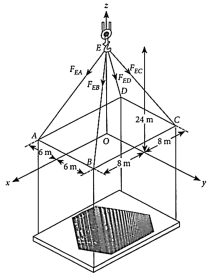
Consider the following diagram, where the forces in the cable are given.
Image
i. What is the cartesian equation of line along $EA$? $(1)$
$\rightarrow$
$ii.$ The vector $ED$ is $(1)$
$iii.$ The length of the cable $EB$ is $(2)$
$OR$
What is the result of adding up all the vectors along the cables? $(2)$
Consider the mapping $f: A \rightarrow B$ is defined by $f(x) = x - 1$ such that $f$ is a bijection.
Based on the above information, answer the following questions.
  1. Domain of $f$ is:
  1. $R - {2}$
  2. $R$
  3. $R - {1, 2}$
  4. $R - {0}$
  1. Range of $f$ is:
  1. $R$
  2. $R - {2}$
  3. $R - {0}$
  4. $R - {1, 2}$
  1. If $g: R - {2} \rightarrow R - {1}$ is defined by $g(x) = 2f(x) - 1,$ then $g(x)$ in terms of $x$ is:
  1. $\frac{\text{x}+2}{\text{x}}$
  2. $\frac{\text{x}+1}{\text{x}-2}$
  3. $\frac{\text{x}-2}{\text{x}}$
  4. $\frac{\text{x}}{\text{x}-2}$
  1. The function $g$ defined above, is:
  1. One$-$one
  2. Many$-$one
  3. into
  4. None of these
  1. A function $f(x)$ is said to be one$-$one iff.
  1. $\ce{f(x_1) = f(x_2) \Rightarrow -x_{1 }= x_2}$
  2. $\ce{f(-x_1) = f(-x_2) \Rightarrow -x_1 = x_2}$
  3. $\ce{f(x_1) = f(x_2) \Rightarrow x_1 = x_2}$
  4. None of these
If a real valued function $f(x)$ is finitely derivable at any point of its domain, it is necessarily continuous at that point. But its converse need not be true.
For example, every polynomial, constant function are both continuous as well as differentiable and inverse trigonometric functions are continuous and differentiable in its domains etc.
Based on the above information, answer the following questions.
  1. If $\text{f}(\text{x})=\begin{cases}\text{x},\text{for x}\leq0\\0,\text{for x}>0\end{cases},$ then at $x = 0$
  1. $f(x)$ is differentiable and continuous.
  2. $f(x)$ is neither continuous nor differentiable.
  3. $f(x)$ is continuous but not differentiable.
  4. None of these.
  1. If $\text{f}(\text{x})=|\text{x}-1|,\text{x }\epsilon\text{ R},$ then at $x = 1$
  1. $f(x)$ is not continuous.
  2. $f(x)$ is continuous but not differentiable.
  3. $f(x)$ is continuous and differentiable.
  4. None of these.
  1. $f(x) = x^3$ is:
  1. Continuous but not differentiable at $x = 3$
  2. Continuous but not differentiable at $x = 3$
  3. Neither continuous nor differentiable at $x = 3$
  4. None of these.
  1. If $\text{f}(\text{x})=[\sin\text{x}],$ then which of the following is true?
  1. $f(x)$ is continuous and differentiable at $x = 0$.
  2. $f(x)$ is discontinuous at $x = 0.$
  3. $f(x)$ is continuous at $x = 0$ but not differentiable.
  4. $f(x)$ is differentiable but not continuous at $\text{x}=\frac{\pi}{2}.$
  1. If $\text{f}(\text{x})=\sin^{-1}\text{x},-1\leq\text{x}\leq1,$ then:
  1. $f(x)$ is both continuous and differentiable.
  2. $f(x)$ is neither continuous nor differentiable.
  3. $f(x)$ is continuous but not differentiable.
  4. None of these.