Question
Shreya got a rectangular parallelepiped shaped box and spherical ball inside it as return gift. Sides of the box are $x, 2x,$ and $\frac{\text{x}}{3},$ while radius of the ball is $r.$
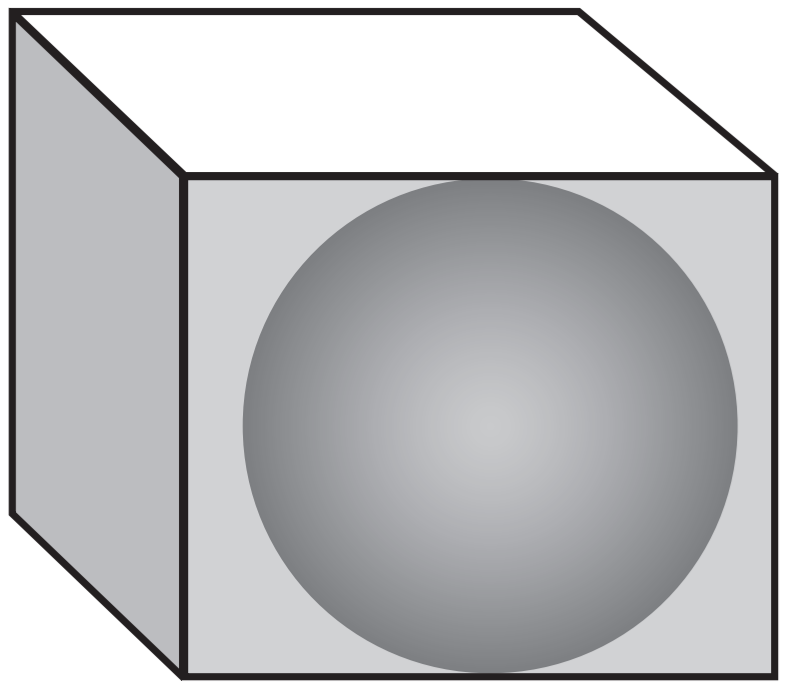
Based on the above information, answer the following questions.
  1. If S represents the sum of volume of parallelepiped and sphere, then Scan be written as.
  1. $\frac{4\text{x}^3}{3}+\frac{2}{2}\pi\text{r}^2$
  2. $\frac{2\text{x}^2}{3}+\frac{4}{3}\pi\text{r}^2$
  3. $\frac{2\text{x}^3}{3}+\frac{4}{3}\pi\text{r}^3$
  4. $\frac{2}{3}\text{x}+\frac{4}{3}\pi\text{r}$
  1. If sum of the surface areas of box and ball are given to be constant $k^2$ then $x$ is equal to.
  1. $\sqrt{\frac{\text{k}^2-4\pi\text{r}^2}{6}}$
  2. $\sqrt{\frac{\text{k}^2-4\pi\text{r}}{6}}$
  3. $\sqrt{\frac{\text{k}^2-4\pi}{6}}$
  4. $\text{None of these}$
  1. The radius of the ball, when Sis minimum, is.
  1. $\sqrt{\frac{\text{k}^2}{54+\pi}}$
  2. $\sqrt{\frac{\text{k}^2}{54+4}}$
  3. $\sqrt{\frac{\text{k}^2}{64+3\pi}}$
  4. $\sqrt{\frac{\text{k}^2}{4\pi+3}}$
  1. Relation between length of the box and radius of the ball can be represented as.
  1. $\text{x} = \frac{2}{\text{r}}$
  2. $\text{x}=\frac{\text{r}}{2}$
  3. $\text{x}=\frac{2}{\text{r}}$
  4. $\text{x}=3\text{r}$
  1. Minimum value of $S$ is.
  1. $\frac{\text{k}^2}{2(3\pi+54)^\frac{2}{3}}$
  2. $\frac{\text{k}}{2(3\pi+54)^\frac{3}{2}}$
  3. $\frac{\text{k}^3}{2(4\pi+54)^\frac{1}{2}}$
  4. $\text{None of these}$

Answer

  1. (c) $\frac{2\text{x}^3}{3}+\frac{4}{3}\pi\text{r}^3$
Solution:
Let $S$ be the sum of volume of parallelepiped and sphere, then
$\text{S}=\text{x}(2\text{x})\Big(\frac{\text{x}}{3}\Big)+\frac{4}{3}\pi\text{r}^3=\frac{2\text{x}^3}{3}+\frac{4}{3}\pi\text{r}^3$
  1. (a) $\sqrt{\frac{\text{k}^2-4\pi\text{r}^2}{6}}$
Solution:
Since, sum of surface area of box and sphere is given to be constant $k^2.$
$\therefore2\Big(\text{x}\times\text{2x}+\text{2x}\times\frac{\text{x}}{3}+\frac{\text{x}}{3}\times\text{x}\Big)+4\pi\text{r}^2=\text{k}^2$
$\Rightarrow6\text{x}^2+4\pi\text{r}^2=\text{k}^2$
$\Rightarrow\text{x}^2=\frac{\text{k}^2-4\pi\text{r}}{6}\Rightarrow\text{x}=\sqrt{\frac{\text{k}^2-4\pi\text{r}}{6}}$
  1. (b) $\sqrt{\frac{\text{k}^2}{54+4}}$
Solution:
From $(1)$ and $(2),$ we get
$\text{s}=\frac{2}{3}\bigg(\frac{\text{k}^2-4\pi\text{r}^2}{6}\bigg)^\frac{3}{2}+\frac{4}{3}\pi\text{r}^3$
$=\frac{2}{3\times6\sqrt{6}}(\text{k}^2-4\pi\text{r}^2)^\frac{3}{2}+\frac{4}{3}\pi\text{r}^3$
$\Rightarrow\frac{\text{ds}}{\text{dr}}=\frac{1}{9\sqrt{6}}\frac{3}{2}(\text{k}^2-4\pi\text{r}^2)^\frac{1}{2}-8\pi\text{r}+4\pi\text{r}^2$
$=4\pi\text{r}\bigg[\text{r}\frac{1}{3\sqrt{6}}\sqrt{\text{k}^2-4\pi\text{r}^2}\bigg]$
For maximum/minimum, $\frac{\text{ds}}{\text{dr}}=0$
$\Rightarrow\frac{4\pi\text{r}}{3\sqrt{6}}\sqrt{\text{k}-4\pi\text{r}^2}=-4\pi\text{r}^2$
$\text{k}^2-4\pi\text{r}^2=54\text{r}^2$
$\Rightarrow\text{r}^2=\frac{\text{k}^2}{54+4\pi}\Rightarrow\text{r}=\sqrt{\frac{\text{k}^2}{54+4\pi}}$
  1. (d) $\text{x}=3\text{r}$
Solution:
$\text{Since},\text{x}^2=\frac{\text{k}-4\pi\text{r}^2}{6}=\frac{1}{6}\bigg[\text{k}^2-4\pi\Big(\frac{\text{k}^2}{54+4\pi}\Big)\bigg]$
[From (2) and (3)
$=\frac{9\text{k}^2}{54+4\pi}=9\Big(\frac{\text{k}^2}{54+4\pi}\Big)=9\text{r}^2=(3\text{r})^2$
$⇒ x = 3r$
  1. (c) $\frac{\text{k}^3}{2(4\pi+54)^\frac{1}{2}}$
Solution:
Minimum value of $S$ is given by
$\frac{2}{3}(3\text{r})^3+\frac{4}{3}\pi\text{r}^3$
$=18\text{r}^3+\frac{4}{3}\pi\text{r}^3=\bigg(18+\frac{4}{3}\pi\bigg)\text{r}^3$
$\bigg(18+\frac{4}{3}\pi\bigg)\text{r}^3\bigg(\frac{\text{k}^2}{54+4\pi}\bigg)^\frac{3}{2}$
$\frac{1}{3}\frac{\text{k}^3}{(54+4\pi)^\frac{1}{2}}$

Need a full question paper?

Generate a complete, print-ready paper with questions like this in minutes — across 16+ boards, with answer keys.

Start Generating Free

Similar questions

 On her birthday, Seema decided to donate some money to the children of an orphanage home. If there were $8$ children less, everyone would have got $₹10$ more. However, if there were $16$ children more, everyone would have got $₹10$ less. Let the number of children be $\mathrm{x}$ and the amount distributed by Seema for one child be $\mathrm{y} \ ($in $₹)$.Image
$(i)$ Represent given information in matrix algebra.
$(ii)$ Find the adjoint of Matrix containing information about of number of children and amount she paid?
$(iii)$ Find the number of children who were given some money by Seema?
OR
How much amount does Seema spend in distributing the money to all the students of the Orphanage?
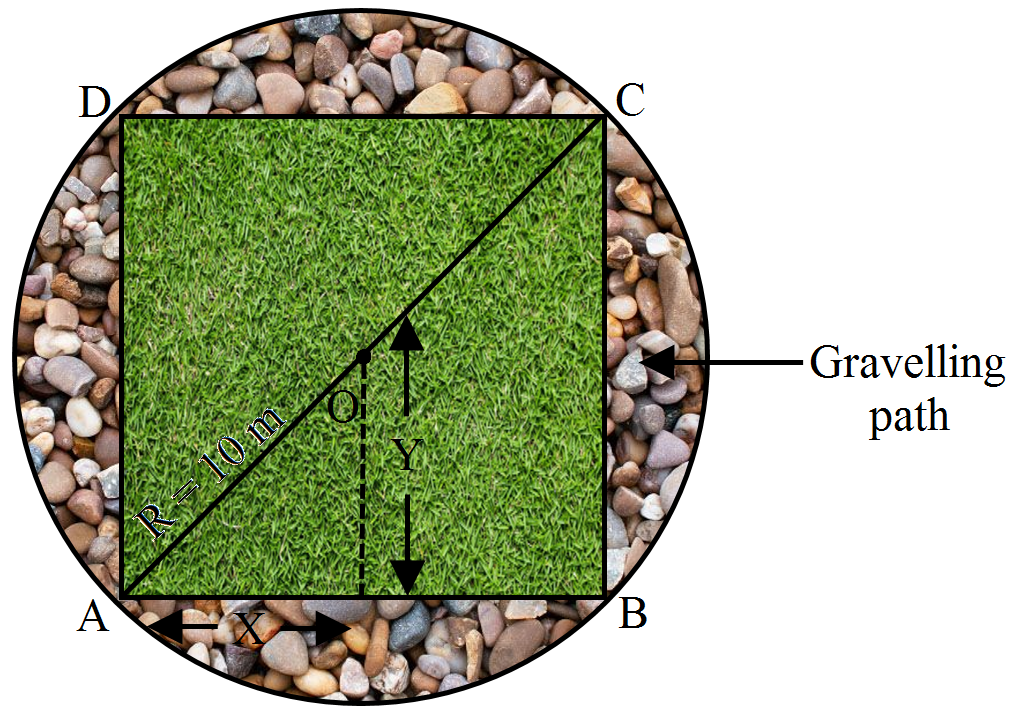
In a society there is a garden in the shape of rectangle inscribed in a circle of radius 10m as shown in given figure.

Based on the above information, answer the following questions.
  1. If 2x and 2y denotes the length and breadth in metres, of the rectangular part, then the relation between the variables is.
  1. $x^2 - y^2 = 10$
  2. $x^2 + y^2 = 10$
  3. $x^2 + y^2 = 100$
  4. $x^2 - y^2 = 100$
  1. The area (A) of green grass, in terms of x, is given by.
  1. $2\text{x}\sqrt{100-\text{x}^2}$
  2. $4\text{x}\sqrt{100-\text{x}^2}$
  3. $2\text{x}\sqrt{100+\text{x}^2}$
  4. $4\text{x}\sqrt{100+\text{x}^2}$
  1. The maximum value of A is.
  1. $100\text{m}^2$
  2. $200\text{m}^2$
  3. $400\text{m}^2$
  4. $1600\text{m}^2$
  1. The value of length of rectangle, when A is maximum, is.
  1. $10\sqrt{2}\text{m}$
  2. $20\sqrt{2}\text{m}$
  3. $20\text{m}$
  4. $5\sqrt{2}\text{m}$
  1. The area of gravelling path is.
  1. $100(\pi+2)\text{m}^2$
  2. $100(\pi-2)\text{m}^2$
  3. $200(\pi+2)\text{m}^2$
  4. $200(\pi-2)\text{m}^2$
A student is preparing for the competitive examinations LIC AAO, SSC CGL and Bank P.O. The probabilities that the student is selected independently in competitive examination of LIC AAO, SSC CGL and Bank P.O. are a, band c respectively. Of these examinations, students has 50% chance of selection in at least one, 40% chance of selection in at least two and 30% chance of selection in exactly two examinations.

Based on the above information, answer the following questions.
  1. The value of a+ b + e - ab - be - ca + abe is:
  1. 0.3
  2. 0.5
  3. 0.7
  4. 0.6
  1. The value of ab + be + ae - 2abe is:
  1. 0.5
  2. 0.3
  3. 0.4
  4. 0.6
  1. The value of abe is:
  1. 0.1
  2. 0.5
  3. 0.7
  4. 0.3
  1. The value of ab + be + ae is:
  1. 0.1
  2. 0.6
  3. 0.5
  4. 0.3
  1. The value of a + b + e is:
  1. 1
  2. 1.5
  3. 1.6
  4. 1.4
A doctor is to visit a patient. From the past experience, it is known that the probabilities that he will come by cab, metro, bike or by other means of transport are respectively $0.3, 0.2, 0.1$ and $0.4$. 'Tile probabilities that he will be late are $0.25, 0.3, 0.35$ and $0.1$ if he comes by cab, metro, bike and other means of transport respectively.

 Based on the above information, answer the following questions.
  1. When the doctor arrives late, what is the probability that he comes by metro?
  1. $\frac{5}{14}$
  2. $\frac{2}{7}$
  3. $\frac{5}{21}$
  4. $\frac{1}{6}$
  1. When the doctor arrives late, what is the probability that he comes by cab?
  1. $\frac{4}{21}$
  2. $\frac{1}{7}$
  3. $\frac{5}{14}$
  4. $\frac{2}{21}$
  1. When the doctor arrives late, what is the probability that he comes by bike?
  1. $\frac{5}{21}$
  2. $\frac{4}{7}$
  3. $\frac{5}{6}$
  4. $\frac{1}{6}$
  1. When the doctor arrives late, what is the probability that he comes by other means of transport?
  1. $\frac{6}{7}$
  2. $\frac{5}{14}$
  3. $\frac{4}{21}$
  4. $\frac{2}{7}$
  1. What is the probability that the doctor is late by any means?
  1. $1$
  2. $0$
  3. $\frac{1}{2}$
  4. $\frac{1}{4}$
Read the following text carefully and answer the questions that follow:
In a street two lamp posts are $600$ feet apart. The light intensity at a distance d from the first $($stronger$)$ lamp post.$\frac{1000}{d^2}$ the light intensity at distance d from the second $($weaker$)$ lamp post is $\frac{125}{d^2} \ ($in both cases the light intensity is inversely proportional to the square of the distance to the light source$)$. The combined light intensity is the sum of the two light intensities coming from both lamp posts.
Image
$i$. If $l(x)$ denotes the combined light intensity, then find the value of $x$ so that $I(x)$ is minimum.
$ii$. Find the darkest spot between the two lights.
$iii$. If you are in between the lamp posts, at distance $x$ feet from the stronger light, then write the combined light intensity coming from both lamp posts as function of $x$.
OR
Find the minimum combined light intensity?
The relation between the height of the plant ( $\mathrm{y}$ in $\mathrm{cm}$ ) with respect to exposure to sunlight is governed by the following equation $\mathrm{y}=4 \mathrm{x}-\frac{1}{2} \mathrm{x}^2$ where $\mathrm{x}$ is the number of days exposed to sunlight.

Image

(i) Find the rate of growth of the plant with respect to sunlight.

(ii) What is the number of days it will take for the plant to grow to the maximum height?

(iii) Verify that height of the plant is maximum after four days by second derivative test and find the maximum height of plant.

OR

What will be the height of the plant after 2 days?

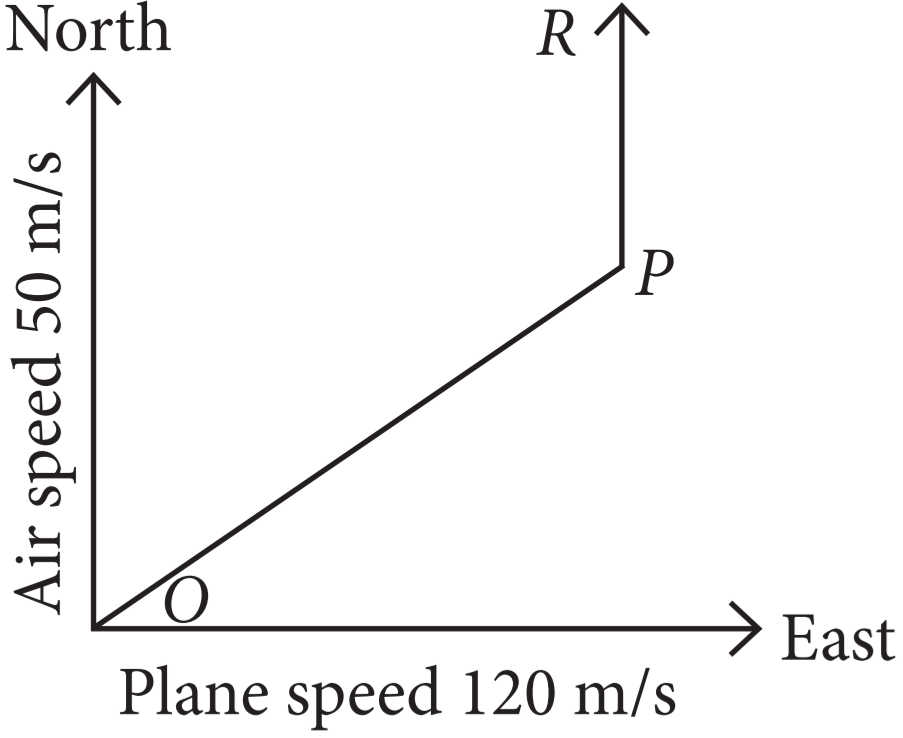
A plane started from airport situated at O with a velocity of 120m/s towards east. Air is blowing at a velocity of 50m/ s towards the north as shown in the figure.
The plane travelled 1hr in OP direction with the resultant velocity. From P to R the plane travelled 1hr keeping velocity of 120m/s and finally landed at R.

Based on the above information, answer the following questions.
  1. What is the resultant velocity from O to P?
  1. 100m/ s
  2. 130m/ s
  3. 126m/ s
  4. 180m/ s
  1. What is the direction of travel of plane from O to P with East?
  1. $\tan^{-1}\Big(\frac{5}{12}\Big)$
  2. $\tan^{-1}\Big(\frac{12}{3}\Big)$
  3. 50
  4. 80
  1. What is the displacement from O to P?
  1. 600km
  2. 468km
  3. 532km
  4. 500km
  1. What is the resultant velocity from P to R?
  1. 120m/ s
  2. 70m/ s
  3. 170m/ s
  4. 200m/ s
  1. What is the displacement from P to R?
  1. 450km
  2. 532km
  3. 610km
  4. 612km
Read the following text carefully and answer the questions that follow:
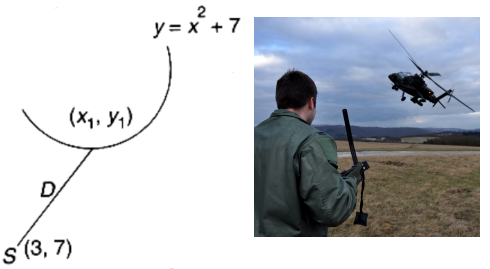
An Apache helicopter of the enemy is flying along the curve given by $y=x^2+7$. A soldier, placed at $(3,7)$ want to shoot down the helicopter when it is nearest to him.
Image
$i.$ If $P \left( x _1, y _1\right)$ be the position of a helicopter on curve $y=x^2+7$ then find distance $D$ from $P$ to soldier place at $(3.7).(1)$
$ii.$ Find the critical point such that distance is minimum. $(1)$
$iii$. Verify by second derivative test that distance is minimum at $(1, 8). (2)$
OR
Find the minimum distance between soldier and helicopter? $(2)$
In a murder investigation, a corpse was found by a detective at exactly $8$ p.m. Being alert, the detective measured the body temperature and found it to be $70^\circ F$ Two hours later, the detective measured the body temperature again and found it to be $60^\circ F,$ where the room temperature is $50^\circ F$ Also, it is given the body temperature at the time of death was normal, i.e., $98.6^\circ F.$
Let T be the temperature of the body at any time t and initial time is taken to be $8$ p.m.

Based on the above information, answer the following questions.
  1. By Newton's law of cooling, $\frac{\text{dT}}{\text{dt}}$ is proportional to:
  1. $T - 60$
  2. $T - 50$
  3. $T - 70$
  4. $T - 98.6$
  1. When $t = 0$, then body temperature is equal to:
  1. $50^\circ F$
  2. $60^\circ F$
  3. $70^\circ F$
  4. $98.6^\circ F$
  1. When $t = 2$, then body temperature is equal to:
  1. $50^\circ F$
  2. $60^\circ F$
  3. $70^\circ F$
  4. $98.6^\circ F$
  1. The value of T at any time t is:
  1. $50+20\Big(\frac{1}{2}\Big)^\text{t}$
  2. $50+20\Big(\frac{1}{2}\Big)^\text{t-1}$
  3. $50+20\Big(\frac{1}{2}\Big)^\frac{\text{t}}{2}$
  4. None of these
  1. If it is given that $\log_\text{e} (2.43) = 0.88789$ and $\log_\text{e} (0.5) = -0.69315,$ then the time at which the murder occur is:
  1. $7:30$ p.m.
  2. $5:30$ p.m.
  3. $6:00$ p.m.
  4. $5:00$ p.m.
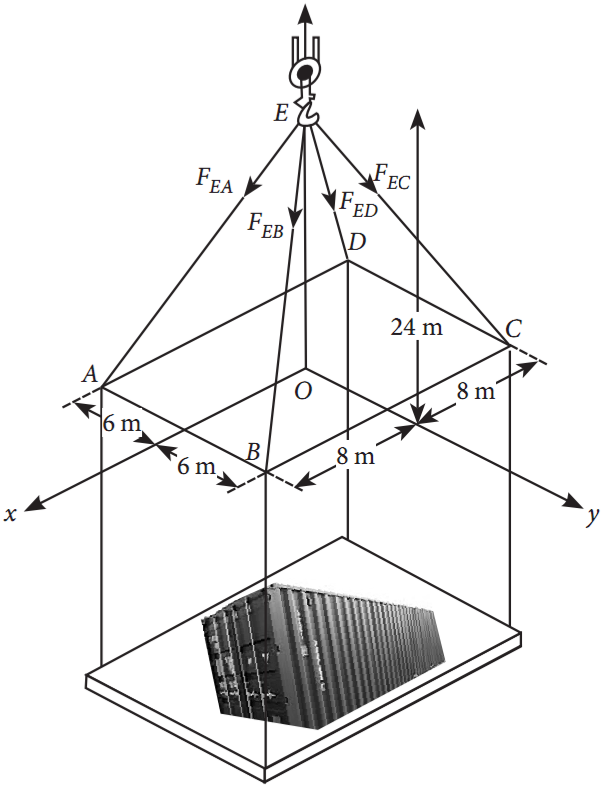
Consider the following diagram, where the forces in the cable are given. Based on the above information, answer the following questions.
  1. The cartesian equation of line along EA is:
  1. $\frac{\text{x}}{-4}=\frac{\text{y}}{3}=\frac{\text{z}}{12}$
  2. $\frac{\text{x}}{-4}=\frac{\text{y}}{3}=\frac{\text{z}-24}{12}$
  3. $\frac{\text{x}}{-3}=\frac{\text{y}}{3}=\frac{\text{z}-12}{12}$
  4. $\frac{\text{x}}{3}=\frac{\text{y}}{4}=\frac{\text{z}-24}{12}$
  1. The vector $\overline{\text{ED}}$ is:
  1. $8\hat{\text{i}}-6\hat{\text{j}}+24\hat{\text{k}}$
  2. $-8\hat{\text{i}}-6\hat{\text{j}}+24\hat{\text{k}}$
  3. $-8\hat{\text{i}}-6\hat{\text{j}}-24\hat{\text{k}}$
  4. $8\hat{\text{i}}+6\hat{\text{j}}+24\hat{\text{k}}$
  1. The length of the cable EB is:
  1. 24 units
  2. 26 units
  3. 27 units
  4. 25 units
  1. The length of cable EC is equal to the length of:
  1. EA
  2. EB
  3. ED
  4. All of these
  1. The sum of all vectors along the cables is:
  1. $96\hat{\text{i}}$
  2. $96\hat{\text{j}}$
  3. $-96\hat{\text{k}}$
  4. $96\hat{\text{k}}$