MCQ
S.I. unit of magnetic moment is :
- A
- ✓
- C
- D
Generate a complete, print-ready paper with questions like this in minutes — across 16+ boards, with answer keys.
Forty electric bulbs are connected in series across a 220 V supply. After one bulb is fused, the remaining 39 are connected again in series across the same supply. The illumination will be
|
(a) More with 40 bulbs than with 39 |
(b) More with 39 bulbs than with 40 |
|
(c) Equal in both the cases |
(d) In the ratio of |
Field inside a solenoid is
|
(a) Directly proportional to its length |
|
(b) Directly proportional to current |
|
(c) Inversely proportional to total number of turns |
|
(d) Inversely proportional to current |
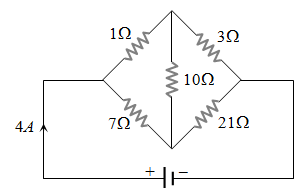
In the circuit shown in figure, the current drawn from the battery is 4A. If 10 W resistor is replaced by 20 W resistor, then current drawn from the circuit will be
|
(a) 1 A |
(b) 2 A |
(c) 3 A |
(d) 0 A |
Two resistors having equal resistances are joined in series and a current is passed through the combination. Neglect any variation in resistance as the temperature changes. In a given time interval
|
(a) Equal amounts of thermal energy must be produced in the resistors |
|
(b) Unequal amounts of thermal energy may be produced |
|
(c) The temperature must rise equally in the resistors |
|
(d) The temperature must rise unequally in the resistors |
A hydrogen atom (ionisation potential 13.6 eV) makes a transition from third excited state to first excited state. The energy of the photon emitted in the process is
|
(a) 1.89 eV |
(b) 2.55 eV |
(c) 12.09 eV |
(d) 12.75 eV |
The refractive index of water is 4 / 3 and that of glass is 5/3. What will be the critical angle for the ray of light entering water from the glass
|
(a) |
(b) |
(c) |
(d) |


