MCQ
Simple harmonic motion is such a harmonic motion in which the restoring force F is directly proportional to :
  • A
    Amplitude
  • displacement
  • C
    Velocity
  • D
    Square of displacement

Answer

Correct option: B.
displacement
(B)

Need a full question paper?

Generate a complete, print-ready paper with questions like this in minutes — across 16+ boards, with answer keys.

Start Generating Free

Similar questions

Three simple harmonic motions of equal amplitudes $A$ and equal time periods in the same direction combine. The phase of the second motion is $60^o$ ahead of the first and the phase of the third motion is $60^o$ ahead of the second. Find the amplitude of the resultant motion
A capillary tube made of glass of radius $0.15\, mm$ is dipped vertically in a beaker filled with methylene iodide (surface tension $=0.05\, Nm ^{-1},$ density $\left.=667\, kg m ^{-3}\right)$ which rises to height $h$ in the tube. It is observed that the two tangents drawn from liquid-glass interfaces (from opp. sides of the capillary) make an angle of $60^{\circ}$ with one another. Then $h$ is close to $......m$

$\left(g=10\, ms ^{-2}\right)$

A gas is contained in a metallic cylinder fitted with a piston. The piston is suddenly moved in to compress the gas and is maintained at this position. As time passes the pressure of the gas in the cylinder:
The dimensions of the product $\mu_{0} \varepsilon_{0}$ are related to those of velocity as
A simple pendulum consisting of a ball of mass $m$ tied to a thread of length $l$ is made to swing on a circular arc of angle $\theta $ in a vertical plane. At the end of this arc, another ball of mass $m$ is placed at rest. The momentum transferred to this ball at rest by the swinging ball is
A person can throw a ball upto a maximum range of $100 \,m$. How high above the ground he can throw the same ball?
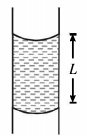
A vertical glass capillary tube of radius $r$ open at both ends contains some water (surface tension $T$ and density $\rho$ ). If $L$ be the length of the water column, then:
Electromagnetic waves are produced by:
In a head$-$on elastic collision of two bodies of equal masses:
If the position vector of a particle is

$\vec r =  - \cos \,t\hat i + \sin \,t\hat j - 18\,t\hat k$

then what is the magnitude of its acceleration ?