Question
Simplify: $\frac{2+\sqrt{3}}{2-\sqrt{3}}+\frac{2-\sqrt{3}}{2+\sqrt{3}}+\frac{\sqrt{3}-1}{\sqrt{3}+1}$

Answer

$\frac{2+\sqrt{3}}{2-\sqrt{3}}+\frac{2-\sqrt{3}}{2+\sqrt{3}}+\frac{\sqrt{3}-1}{\sqrt{3}+1}$
$=\frac{2+\sqrt{3}}{2-\sqrt{3}}\times\frac{2+\sqrt{3}}{2+\sqrt{3}}\times\frac{2+\sqrt{3}}{2-\sqrt{3}}+\frac{2-\sqrt{3}}{2-\sqrt{3}}+\frac{\sqrt{3}-1}{\sqrt{3}+1}\times\frac{\sqrt{3}-1}{\sqrt{3}-1}$
$=\frac{\big(2+\sqrt{3}\big)^2}{2^2-\big(\sqrt{3}\big)^2}+\frac{\big(2-\sqrt{3}\big)^2}{2^2-\big(\sqrt{3}\big)^2}+\frac{\big(\sqrt{3}-1\big)^2}{\big(\sqrt{3}\big)^2-1}$
$=\frac{2^2+2\times2\sqrt{3}+\big(\sqrt{3}\big)^2}{4-3}+\frac{2^2-2\times2\sqrt{3}+\big(\sqrt{3}\big)^2}{4-3}+\frac{\big(\sqrt{3}\big)^2-2\sqrt{3}+1}{3-1}$
$=\frac{4+4\sqrt{3}+3}{1}+\frac{4-4\sqrt{3}+3}{1}+\frac{3-2\sqrt{3}+1}{2}$
$=7+4\sqrt{3}+7-4\sqrt{3}+\frac{4-2\sqrt{3}}{2}$
$=14+2-\sqrt{3}$
$=16-\sqrt{3}$

Need a full question paper?

Generate a complete, print-ready paper with questions like this in minutes — across 16+ boards, with answer keys.
Start Generating Free

Similar questions

If $\text{p}=\frac{3-\sqrt{5}}{3+\sqrt{5}}$ and $\text{q}=\frac{3+\sqrt{5}}{3-\sqrt{5}},$ find the value of $p^2 + q^2.$
The daily minimum temperatures in degrees Celsius recorded in a certain arctic region are as follows:
$-12.5, -10.8, -18.6, -8.4, -10.8, -4.2, -4.8, -6.7, -13.2, -11.8, -2.3, 1.2, 2.6, 0, -2.4, 0, 3.2, 2.7, 3.4, 0, -2.4, -2.4, 0, 3.2, 2.7, 3.4, 0, -2.4, -5.8, -8.9, -14.6, -12.3, -11.5, -7.8, -2.9.$
Represent them as frequency distribution table taking $-19.9$ to $-15$ as the first class interval.
If $\text{a}=\frac{\sqrt{3}-\sqrt{2}}{\sqrt{3}+\sqrt{2}}$ and $\text{b}=\frac{\sqrt{3}+\sqrt{2}}{\sqrt{3}-\sqrt{2}},$ find the value of $a^2 + b^2 - 5ab$.
Find the volume, curved surface area and the total surface area of a cone whose height and slant height are $6\ cm$ and $10\ cm$ respectively. $\big(\text{Take}\ \pi=3.14\big)$
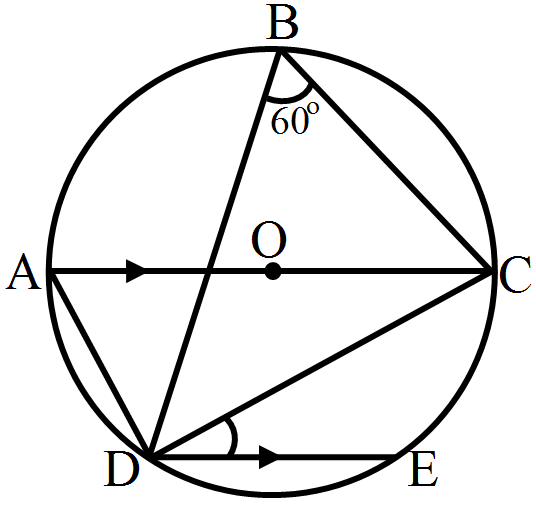
In the adjoining figure, $DE$ is a chord parallel to diameter $AC$ of the circle with centre $O$. If $\angle\text{CBD}=60^\circ,$calculate $\angle\text{CDE}.$
In triangles $ABC$ and $CDE$, if $AC = CE, BC = CD$, $\angle\text{A}=60^\circ,\angle\text{C}=30^\circ$ and $\angle\text{D}=90^\circ.$ Are two triangles congruent?
Simplify $\frac{\sqrt{13}-\sqrt{11}}{\sqrt{13}+\sqrt{11}}+\frac{\sqrt{13}+\sqrt{11}}{\sqrt{13}-\sqrt{11}}$
Express $2.\overline{36}+0.\overline{23}$ as a fraction in simplest form.
The capacity of a closed cylindrical vessel of height 1m is 15.4 litres. How many square metres of metal sheet would be needed to make it?

$\Big[$Hint: Assume $\pi=\frac{22}{7},$ unless stated otherwise$\Big]$
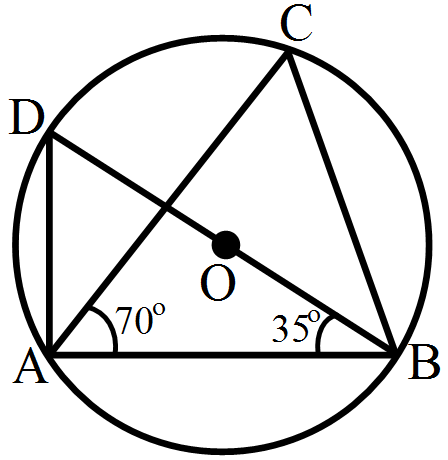
In the given figure, $O$ is the centre of the circle. If $\angle\text{ABD}=35^\circ$ and $\angle\text{BAC}=70^\circ,$find $\angle\text{ACB}.$