Question
Simplify: $\frac{4+\sqrt{5}}{4-\sqrt{5}}+\frac{4-\sqrt{5}}{4+\sqrt{5}}$

Answer

For rationalising the denominator of a number, we multilply its numerator and denominator by its rationalising factor.
If $a$ and $b$ are integers, then $\big(\text{a}+\sqrt{\text{b}}\big)$ and $\big(\text{a}-\sqrt{\text{b}}\big)$ are rationalising factor of each other, as $\big(\text{a}+\sqrt{\text{b}}\big)\big(\text{a}-\sqrt{\text{b}}\big)=\big(\text{a}^2-\text{b}\big),$ which is rational. Let us rationalise the denominator of the first term on the left hand side.
We have, $\frac{4+\sqrt{5}}{4-\sqrt{5}}=\frac{4+\sqrt{5}}{4-\sqrt{5}}\times\frac{4+\sqrt{5}}{4+\sqrt{5}}$
$=\frac{\big(4+\sqrt{5}\big)^2}{(4)^2-\big(\sqrt{5}\big)^2}$
$=\frac{(4)^2+2(4)\big(\sqrt{5}\big)+\big(\sqrt{5}\big)^2}{16-5}$
$\frac{4+\sqrt{5}}{4-\sqrt{5}}=\frac{16+8\sqrt{5}+5}{11}=\frac{21+8\sqrt{5}}{11} \ ...(1)$
Now consider the denominator of the second term on the left hand side:
$\frac{4-\sqrt{5}}{4+\sqrt{5}}=\frac{4-\sqrt{5}}{4+\sqrt{5}}\times\frac{4-\sqrt{5}}{4-\sqrt{5}}$
$=\frac{\big(4-\sqrt{5}\big)^2}{(4)^2-\big(\sqrt{5}\big)^2}$
$=\frac{(4)^2-2(4)\big(\sqrt{5}\big)+\big(\sqrt{5}\big)^2}{16-5}$
$\frac{4-\sqrt{5}}{4+\sqrt{5}}=\frac{16-8\sqrt{5}+5}{11}=\frac{21-8\sqrt{5}}{11} \ ...(2)$
Adding equations $(1)$ and $(2)$, we have,
$\therefore \ \frac{4+\sqrt{5}}{4-\sqrt{5}}+\frac{4-\sqrt{5}}{4+\sqrt{5}}=\frac{21+8\sqrt{5}}{11}=\frac{21-8\sqrt{5}}{11}$
$=\frac{21+8\sqrt{5}+21-8\sqrt{5}}{11}=\frac{42}{11}$

Need a full question paper?

Generate a complete, print-ready paper with questions like this in minutes — across 16+ boards, with answer keys.
Start Generating Free

Similar questions

A line segment $AB$ is of length $5\ cm$. Draw a circle of radius $4\ cm$ passing through $A$ and $B$. Can you draw a circle of radius $2\ cm$ passing through $A$ and $B$? Give reason in support of your answer.
A cuboidal water tank is $6m$ long, $5m $wide and $4.5m$ deep. How many liters of water can it hold?
Draw the graph of the following linear equations in two variables: $x + y = 4$
A wooden bookshelf has external dimensions as follows: Height $= 110\ cm$, Depth $= 25\ cm,$ Breadth $= 85\ cm$ (See figure). The thickness of the plank is $5\ cm$ everywhere. The external faces are to be polished and the inner faces are to be painted. If the rate of polishing is $20$ paise per $cm^2$. Find the total expenses required for polishing and painting the surface of the bookshelf.
A circle has radius $\sqrt{2}\text{cm}.$ It is divided into two segments by a chord of length $2\ cm.$ Prove that the angle subtended by the chord at a point in major segment is $45^\circ .$
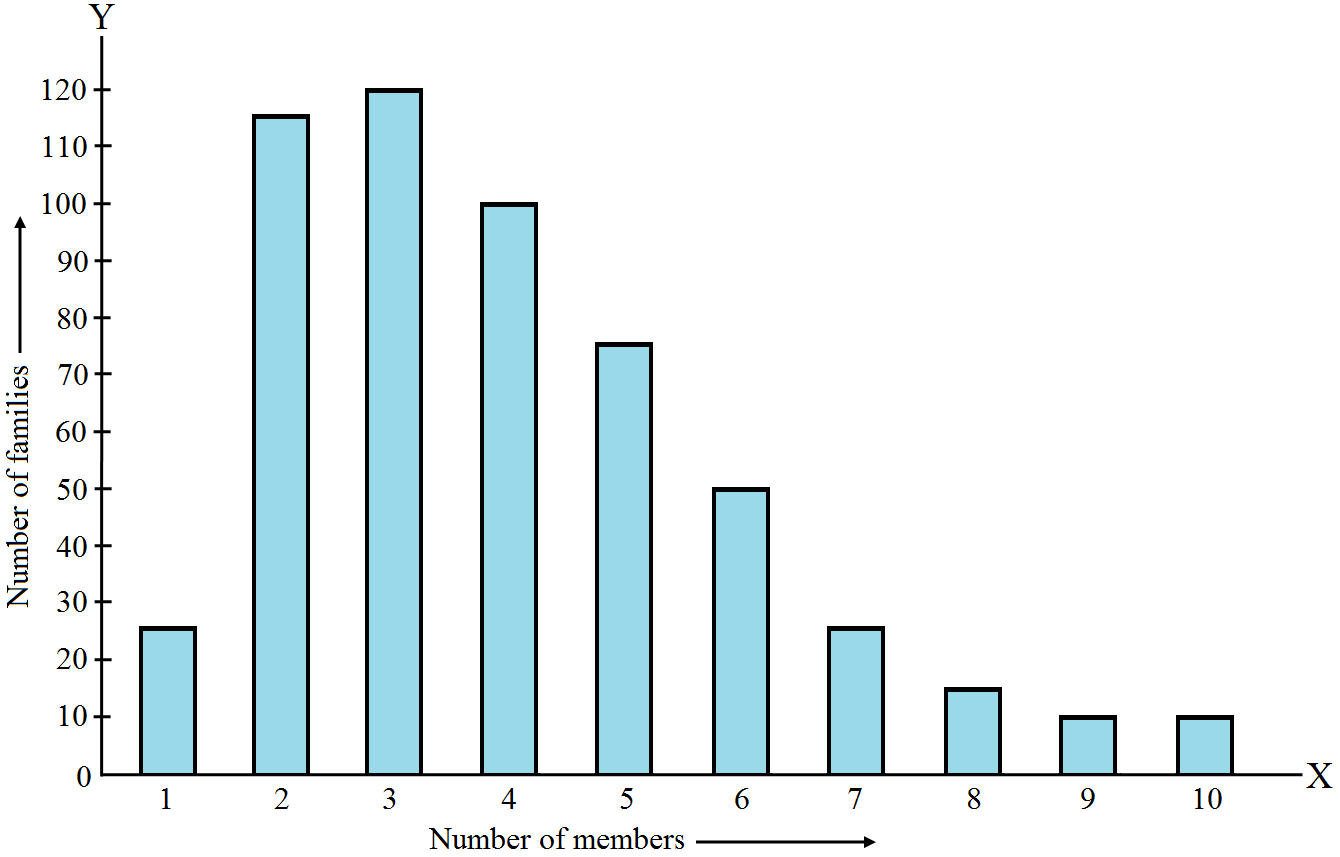
Read the bar graph given in figure and answer the following questions:
$i.$ What is the information given by the bar graph?
$ii.$ What is the number of families having $6$ members?
$iii.$ How many members per family are there in the maximum number of families? Also tell the number of such families.
$iv.$ What are the number of members per family for which the number of families are equal? Also, tell the number of such families?
Represent $\sqrt{10.5}$ on the number line.
The paint in a certain container is sufficient to paint on an area equal to $9.375\ m^2$, How many bricks of dimension $22.5\ cm \times 10\ cm$ $\times 7.5\ cm$ can be painted out of this container?
If $V$ is the volume of a cuboid of dimensions $a, b, c$ and $S$ is its surface area, then prove that:
$\frac{1}{\text{V}}=\frac{2}{\text{S}}\Big(\frac{1}{\text{a}}+\frac{1}{\text{b}}+\frac{1}{\text{c}}\Big)$