Question
Simplify: $\frac{7+3\sqrt5}{3+\sqrt5}-\frac{7-3\sqrt5}{3-\sqrt5}$

Answer

We know that rationalization factor for $3+\sqrt5$ and $3-\sqrt5$ are $3-\sqrt5$ and $3+\sqrt5$ respectively.
We will multiply numerator and denominator of the given expression $\frac{7+3\sqrt5}{3+\sqrt5}$ and $\frac{7-3\sqrt5}{3+\sqrt5}$ by $3-\sqrt5$ and $3+\sqrt5$ respectively.
to get $\frac{7+3\sqrt5}{3+\sqrt5}\times\frac{3-\sqrt5}{3-\sqrt5}-\frac{7-3\sqrt5}{3-\sqrt5}\times\frac{3+\sqrt5}{3+\sqrt5}$
$\ =\frac{7\times3-7\times\sqrt5+9\times\sqrt5-3\times\big(\sqrt5\big)^2}{(3)^2-\big(\sqrt5\big)^2}-\frac{7\times3+7\times\sqrt5-9\times\sqrt5-3\times\big(\sqrt5\big)^2}{(3)^2-\big(\sqrt5\big)^2}$
$=\frac{21-7\sqrt5+9\sqrt5-3\times5}{9-5}-\frac{21+7\sqrt5-9\sqrt5-3\times5}{9-5}$
$=\frac{21+2\sqrt5-15}{4}-\frac{21-2\sqrt5-15}{4}$
$=\frac{6+2\sqrt5-6+2\sqrt5}{4}$
$=\frac{4\sqrt5}{4}$
$=\sqrt5$
Hence the given expression is simplified to $\sqrt5.$

Need a full question paper?

Generate a complete, print-ready paper with questions like this in minutes — across 16+ boards, with answer keys.
Start Generating Free

Similar questions

Find the values of $a$ and $b$ so that the polynomial $\left(x^3-10 x^2+a x+b\right)$ is exactly divisible by $(x-1)$ as well as $(x-2)$.
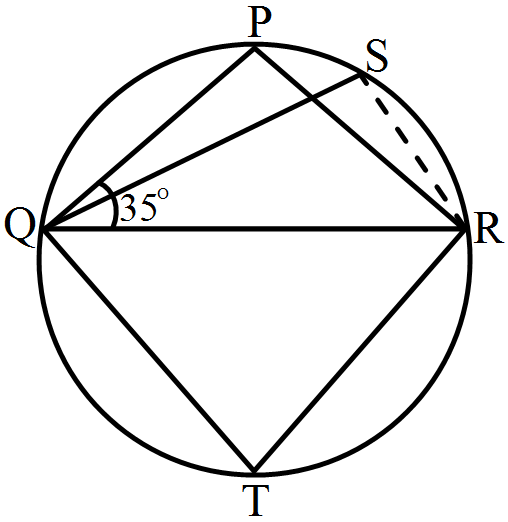
In the given figure, $\triangle\text{PQR}$ is an isosceles triangle with $PQ = PR$ and $\text{m}\angle\text{PQR}=35^\circ.$ Find $\text{m}\angle\text{QSR}$ and $\text{m}\angle\text{QTR}.$
If an angle of a parallelogram is two-third of its adjacent angle, find the angles of the parallelogram.
Represent $\sqrt{7.28}$ geometrically on the number line.
$\text{PQRS}$ is a trapezium having $PS$ and $QR$ as parallel sides. $A$ is any point on $PQ$ and $B$ is a point on $SR$ such that $AB \| QR$. If area of $\triangle\text{PBQ}$ is $17\ cm^2$, find the area of $\triangle\text{ASR}.$
D, E and F are respectively the mid-points of the sides AB, BC and CA of a triangle ABC. Prove that by joining these mid-points D, E and F, the triangles ABC is divided into four congruent triangles.
In the following, using the remainder theorem, find the remainder when $f(x)$ is divided by $g(x)$ and verify the by actual division: $f(x) = x^3 + 4x^2 - 3x + 10, g(x) = x + 4$
E and F are points on diagonal AC of a parallelogram ABCD such that AE = CF. Show that BFDE is a parallelogram.
It being given that $\sqrt{3}=1.732,\sqrt{5}=2.236,\sqrt{6}=2.449$ and $\sqrt{10}=3.162,$ find to three places of decimal, the value of the following: $\frac{\sqrt{5}+\sqrt{2}}{\sqrt{5}-\sqrt{2}}$