Question
Simplify:
$\frac{1}{\sqrt{3}+\sqrt{2}}-\frac{2}{\sqrt{5}-\sqrt{3}}-\frac{3}{\sqrt{2}-\sqrt{5}}$

Answer

$\frac{1}{\sqrt{3}+\sqrt{2}}-\frac{2}{\sqrt{5}-\sqrt{3}}-\frac{3}{\sqrt{2}-\sqrt{5}}$
$=\frac{1}{\sqrt{3}-\sqrt{2}}\times\frac{\sqrt{3}+\sqrt{2}}{\sqrt{3}+\sqrt{2}}-\frac{2}{\sqrt{5}-\sqrt{3}}$ $\times\frac{\sqrt{5}+\sqrt{3}}{\sqrt{5}+\sqrt{3}}-\frac{3}{\sqrt{2}-\sqrt{5}}\times\frac{\sqrt{2}+\sqrt{5}}{\sqrt{2}+\sqrt{5}}$
$=\frac{\sqrt{3}+\sqrt{2}}{\big(\sqrt{3}\big)^2-\big(\sqrt{2}\big)^2}-\frac{2\big(\sqrt{5}+\sqrt{3}\big)}{\big(\sqrt{5}\big)^2-\big(\sqrt{3}\big)^2}-\frac{3\big(\sqrt{2}+\sqrt{5}\big)}{\big(\sqrt{2}\big)^2-\big(\sqrt{5}\big)^2}$
$=\frac{\sqrt{3}+\sqrt{2}}{3-2}-\frac{2\big(\sqrt{5}+\sqrt{3}\big)}{5-3}-\frac{3\big(\sqrt{2}+\sqrt{5}\big)}{2-5}$
$=\frac{\sqrt{3}+\sqrt{2}}{1}-\frac{2\big(\sqrt{5}+\sqrt{3}\big)}{2}-\frac{3\big(\sqrt{2}+\sqrt{5}\big)}{-3}$
$=\big(\sqrt{3}+\sqrt{2}\big)-\big(\sqrt{5}+\sqrt{3}\big)+\big(\sqrt{2}+\sqrt{5}\big)$
$=\sqrt{3}+\sqrt{2}-\sqrt{5}-\sqrt{3}+\sqrt{2}+\sqrt{5}$
$=2\sqrt{2}$

Need a full question paper?

Generate a complete, print-ready paper with questions like this in minutes — across 16+ boards, with answer keys.

Start Generating Free

Similar questions

Three angles of a quadrilateral are respectively equal to 110°, 50° and 40°. Find its fourth angle.
A shopkeeper has one laddoo of radius 5cm. With the same material, how many laddoos of radius 2.5cm can be made?
Express the following in the form $\frac{\text{p}}{\text{q}},$ where p and q are integers and $\text{q}\neq0$:
.00323232...
If $2^\text{x}=3^\text{y}=6^{-\text{z}},$ Show that $\frac{1}{\text{x}}+\frac{1}{\text{y}}+\frac{1}{\text{z}}=0.$
The monthly profits (in ₹) of 100 shops are distributed as follows:
Profits per shop:
0-50
50-100
100-150
150-200
200-250
250-300
No. of shops:
12
18
27
20
17
6
Draw a histogram for the data and show the frequency polygon for it.
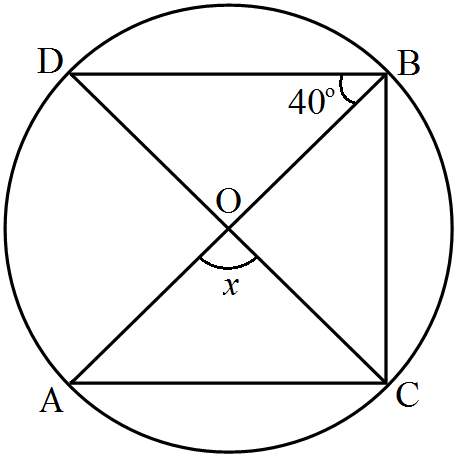
If O is the centre of the circle, find the value of x in the following figure:

Evaluate the following:
1113 - 893
If BM and CN are the perpendiculars drawn on the sides AC and AB of the triangle ABC, prove that the points B, C, M and N are concyclic.
Angles opposite to equal sides of an isosceles triangle are equal.This result can be proved in many ways. One of the proofs is given here.
(Street Plan): A city has two main roads which cross each other at the centre of the city. These two roads are along the North-South direction and East-West direction. All the other streets of the city run parallel to these roads and are 200 m apart. There are 5 streets in each direction. Using 1cm = 200 m, draw a model of the city on your notebook. Represent the roads/streets by single lines. There are many cross- streets in your model. A particular cross-street is made by two streets, one running in the North-South direction and another in the East-West direction. Cross street is referred to in this manner: If the 2nd street running in the North-South direction and 5th in the East-West direction meet at some crossing, then we will call this cross-street (2, 5). Using this convention, find: how many cross - streets can be referred to as (4, 3).