Question
Simplify the following expressions:
$(x^2 - x + 1)^2 - (x^2 + x + 1)^2$

Answer

Expanding,
we get $\left[x^2-x+1\right]^2-\left[x^2+x+1\right]^2$
$\left.=\left(x^2\right)^2+(-x)^2+1^2+2\left(x^2\right)(-x)+2(-x)(1)+2 x^2\right)-\left[\left(x^2\right)^2+x^2+1+2 x^2 x+2 x(1)+2 x^2(1)\right]$
${\left[\therefore(x+y+z)^2=x^2+y^2+z^2+2 x y+2 y z+2 x z\right]}$
$=x^4+y^2+1-2 x^3-2 x+2 x^2-x^2-x^4-1-2 x^3-2 x-2 x^2$
$=-4 x^3-4 x=-4 x\left(x^2+1\right)$
Hence simplified equation
$=\left[x^2-x+1\right]^2-\left[x^2+x+1\right]^2$
$=-4 x\left(x^2+1\right)$

Need a full question paper?

Generate a complete, print-ready paper with questions like this in minutes — across 16+ boards, with answer keys.
Start Generating Free

Similar questions

A measuring jar of internal diameter 10cm is partially filled with water. Four equal spherical balls of diameter 2cm each are dropped in it and they sink down in water completely. What will be the change in the level of water in the jar?
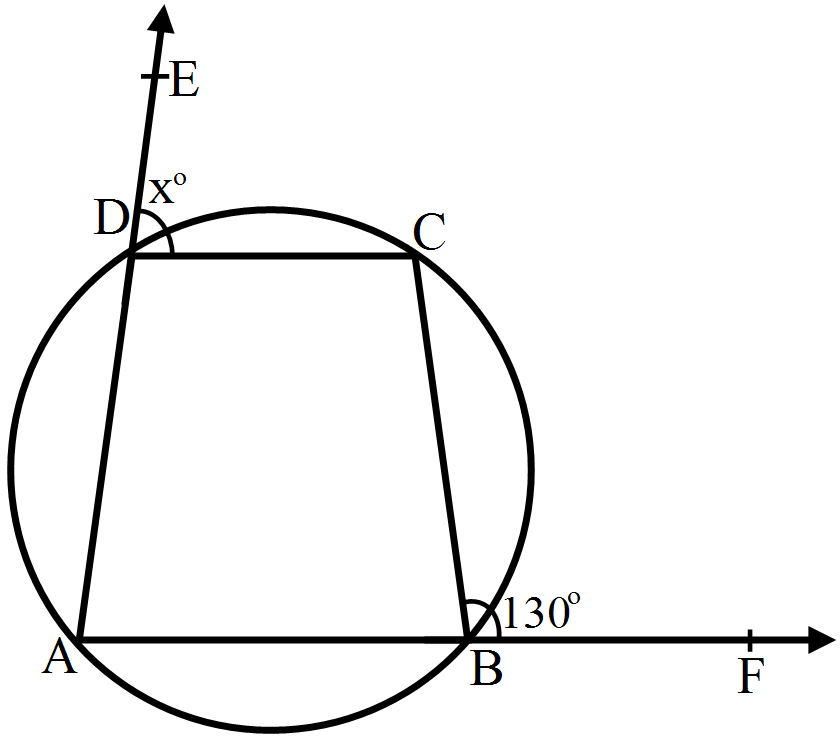
In the given figure, sides AD and AB of cyclic quadrilateral ABCD are produced to E and Frespectively. If $\angle\text{CBF}=130^\circ$ and $\angle\text{CDE}=\text{x}^\circ,$ find the value of x.
Draw the graphs of the following linear equations on the same graph paper:
2x + 3y = 12, x - y = 1
Find the coordinates of the vertices of the triangle formed by the two straight lines and the y-axis. Also, find the area of the triangle.
Prove that $\text{a}^2+\text{b}^2+\text{c}^2-\text{ab}-\text{bc}-\text{ca}$ is always non negetive for all values of a, b and c.
If $\text{x}^4+\frac{1}{\text{x}^4}=194,$ find $\text{x}^3+\frac{1}{\text{x}^3},\ \text{x}^2+\frac{1}{\text{x}^2}$ and $\text{x}+\frac{1}{\text{x}}.$
The adjacent sides of a parallelogram $ABCD$ measure $34cm$ and $20cm$, and the diagonal $AC$ measures $42cm$. Find the area of parallelogram.
Solve. $\frac{\sqrt{x+7}+\sqrt{x-2}}{\sqrt{x+7}-\sqrt{x-2}}=\frac{5}{1}$
If the mean of x + 2, 2x + 3, 3x + 4, 4x + 5 is x + 2, find x.
Find six rational numbers between 3 and 4.
A wall of length 10 m was to be built across an open ground. The height of the wall is 4 m and thickness of the wall is 24 cm .
If this wall is to be built up with bricks whose dimensions are $24 cm \times 12 cm \times 8 cm$,
how many bricks would be required?