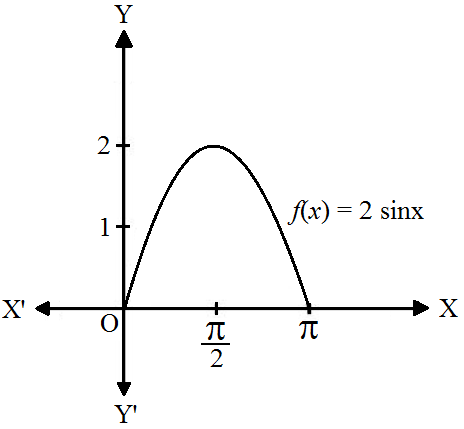
Question
Sketch the graphs of the following function:
$\text{f(x)}=2\sin\text{x},0\leq\text{x}\leq\pi$

Answer

$\text{f(x)}=2\sin\text{x},0\leq\text{x}\leq\pi$
$\text{x}$ $0$ $\pi$
$\text{f(x)}=2\sin\text{x}$ $0$ $0$

Need a full question paper?

Generate a complete, print-ready paper with questions like this in minutes — across 16+ boards, with answer keys.

Start Generating Free

Similar questions

If the  $n^{th}$ term $a_n$ of  sequence is given by $\text{a}_\text{n}=\text{n}^2-\text{n}+1,$ write down its first five terms.
A straight line moves so that the sum of the reciprocals of its intercepts made on axes is constant. Show that the line passes through a fixed point.
[Hint: $\frac{\text{x}}{\text{a}}+\frac{\text{y}}{\text{b}}=1$ where $\frac{1}{\text{a}}+\frac{1}{\text{b}}=\text{constant}=\frac{1}{\text{k}}(\text{say}).$ This implies that $\frac{\text{k}}{\text{a}}+\frac{\text{k}}{\text{b}}=1$ line passes through the fixed point (k, k).]
If $C _0, C _1, C _2, \ldots \ldots . C _n$ are the binomial coefficients in the expansion of $(1+x)^n$, then prove that :
$C_0-\frac{C_1}{2}+\frac{C_2}{3}-\frac{C_3}{4}+\ldots \ldots \ldots+\frac{(-1)^n \cdot C_n}{n+1}=\frac{1}{n+1}$
Find the $12^{th}$ term of a G.P. whose $8^{th}$ term is $192$ and the common ratio is $2.$
Find the distance between the following pairs of points:
A(3, 2, -1) and B(-1, -1, -1).
Solve the inequality $\frac{x}{4}<\frac{(5 x-2)}{3}-\frac{(7 x-3)}{5}$ for real x.
If in a $\triangle\text{ABC},\angle\text{A}=45^\circ,\angle\text{B}=60^{\circ},$ and $\angle\text{C}=75^{\circ},$ find the ratio of its sides.
Find the distance of the point (2, 3) from the line 2x - 3y + 9 = 0 measured along a line making an angle of 45° with the x-axis.
Find the distance of the point $(3, -5)$ from the line $3x - 4y - 26 = 0$
If A = {1, 2, 3}, B = {4, 5, 6}, the given following are relations from A to B? Give reason in support of your answer.
A × B.