Question
✓
Answer
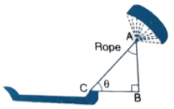
(i) (b): From Fig. we find that $A B=200 m$ and $\theta=30^{\circ}$. In right triangle $A B C$, we obtain
$
\sin \theta=\frac{A B}{A C} \Rightarrow \sin 30^{\circ}=\frac{200}{A C} \Rightarrow \frac{1}{2}=\frac{200}{A C} \Rightarrow A C=400 m
$
(ii) (c): We have, $A B=200 m$ and $\theta=30^{\circ}$. In right triangle $A B C$, we obtain
$
\tan 30^{\circ}=\frac{A B}{B C} \Rightarrow \frac{1}{\sqrt{3}}=\frac{200}{B C} \Rightarrow B C=200 \sqrt{3} m
$
(iii) (d): If $B C=15 m$ and $\theta=30^{\circ}$, then
$
\tan \theta=\frac{A B}{B C} \Rightarrow \tan 30^{\circ}=\frac{A B}{15} \Rightarrow \frac{1}{\sqrt{3}}=\frac{A B}{15} \Rightarrow A B=5 \sqrt{3} m
$
(iv) (c): In $\triangle A B C$, we obtain
$
\tan \theta=\frac{A B}{B C} \Rightarrow \tan \theta=1 \Rightarrow \tan \theta=\tan 45^{\circ} \Rightarrow \theta=45^{\circ}
$
$
\sin \theta=\frac{A B}{A C} \Rightarrow \sin 30^{\circ}=\frac{200}{A C} \Rightarrow \frac{1}{2}=\frac{200}{A C} \Rightarrow A C=400 m
$
(ii) (c): We have, $A B=200 m$ and $\theta=30^{\circ}$. In right triangle $A B C$, we obtain
$
\tan 30^{\circ}=\frac{A B}{B C} \Rightarrow \frac{1}{\sqrt{3}}=\frac{200}{B C} \Rightarrow B C=200 \sqrt{3} m
$
(iii) (d): If $B C=15 m$ and $\theta=30^{\circ}$, then
$
\tan \theta=\frac{A B}{B C} \Rightarrow \tan 30^{\circ}=\frac{A B}{15} \Rightarrow \frac{1}{\sqrt{3}}=\frac{A B}{15} \Rightarrow A B=5 \sqrt{3} m
$
(iv) (c): In $\triangle A B C$, we obtain
$
\tan \theta=\frac{A B}{B C} \Rightarrow \tan \theta=1 \Rightarrow \tan \theta=\tan 45^{\circ} \Rightarrow \theta=45^{\circ}
$
Need a full question paper?
Generate a complete, print-ready paper with questions like this in minutes — across 16+ boards, with answer keys.
Explore more
Similar questions
Read the following text carefully and answer the questions that follow:
An object which is thrown or projected into the air, subject to only the acceleration of gravity is called a projectile, and its path is called its trajectory. This curved path was shown by Galileo to be a parabola. Parabola is represented by a polynomial. If the polynomial to represent the distance covered is, $p(t)=-5 t^2+40 t+1.2$
i. What is the degree of the polynomial $p(t)=-5 t^2+40 t+1.2$ ? (1)
ii. What is the height of the projectile at the time of 4 seconds after it is launched? (1)
iii. What is the name of the polynomial $p(t)=-5 t^2+40 t+1.2$ that is classified based on its degree? (2)
OR
What are the factors of the given quadratic equation $p(x)=x^2-5 x+6$ ? (2)
→An object which is thrown or projected into the air, subject to only the acceleration of gravity is called a projectile, and its path is called its trajectory. This curved path was shown by Galileo to be a parabola. Parabola is represented by a polynomial. If the polynomial to represent the distance covered is, $p(t)=-5 t^2+40 t+1.2$
i. What is the degree of the polynomial $p(t)=-5 t^2+40 t+1.2$ ? (1)
ii. What is the height of the projectile at the time of 4 seconds after it is launched? (1)
iii. What is the name of the polynomial $p(t)=-5 t^2+40 t+1.2$ that is classified based on its degree? (2)
OR
What are the factors of the given quadratic equation $p(x)=x^2-5 x+6$ ? (2)
Teewan, Arun and Pankaj were celebrating the festival of Diwali in open ground with firecrackers. There is a pedestal in the ground. All of sudden Teewan stands on a pedestal and releases a sky lantern from the top of the pedestal.
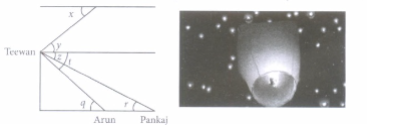
Based on the above information, answer the following questions.
(i) If the position of Pankaj is 25 m away from the base of the pedestal and Zr = 30°, then find the height of the pedestal.
(ii)If the vertical height of sky lantern from the top of pedestal is 12 m and∠y = 30°, then distance between Teewan and sky lantern ?
(iii) If ∠q = 60° and position of Arun is 15 m away from the base of pedestal, then find the height of pedestal.
OR
Which one is a pair of angles of depression?
A backyard is in the shape of a triangle $\text{ABC}$ with right angle at $B$. $AB =7 m$ and $BC =15 m$. A circular pit was dug inside it such that it touches the walls $A C, B C$ and $A B$ at $P, Q$ and $R$ respectively such that $AP =x m$.
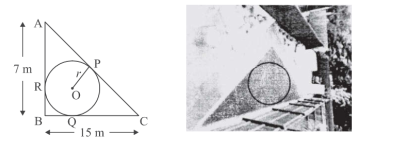
Based on the above information, answer the following questions:
$(i)$ Find the length of $AR$ in terms of $x$.
$(ii)$ Write the type of quadrilateral $\text{BQOR} $.
$(iii) \ (a)$ Find the length $PC$ in terms of $x$ and hence find the value of $x$.
OR
$(b)$ Find $x$ and hence find the radius $r$ of circle.
→Based on the above information, answer the following questions:
$(i)$ Find the length of $AR$ in terms of $x$.
$(ii)$ Write the type of quadrilateral $\text{BQOR} $.
$(iii) \ (a)$ Find the length $PC$ in terms of $x$ and hence find the value of $x$.
OR
$(b)$ Find $x$ and hence find the radius $r$ of circle.
Two families- Gupta's and Singhal's are lived in a colony. Gupta family has two children while Singhal family has 3 children.

On the basis of the above information, answer the following questions.
- Find the probability that Mr Singhal has exactly 2 girls and 1 boy.
- What is the probability of Gupta having atleast 1 boy?
- What is the probability of Gupta having atleast 1 Girl?
Or
What is the probability of Singhal having no boy?
Pookalam is the flower bed or flower pattern designed during Onam in Kerala. It is similar as Rangoli in North India and Kolam in Tamil Nadu. During the festival of Onam, your school is planning to conduct a Pookalam competition. Your friend whose partner in competition, suggests two design given below:
Design I: This design is made with a circle of radius 32 cm having equilateral triangle $A B C$ in the middle as shown in Fig. 12.11.
Design II: This Pookalam is made with 9 circular designs each of radius 7 cm .
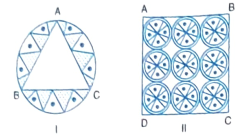
(i) In design-1, the side of equilateral triangle is
(a) $12 \sqrt{3} cm$ $\qquad$ (b) $32 \sqrt{3} cm$ $\qquad$ (c) 48 cm $\qquad$ (d) 64 cm
(ii) In devign-1, the altitude of the equilaleral triangle is
(a) 8 cm $\qquad$ (b) 12 cm $\qquad$ (c) 48 cm $\qquad$ (d) 52 cm
(iii) In design-II, the area of square $A B C D$ is
(a) $1264 cm^2$ $\qquad$ (b) $1764 cm^2$ $\qquad$ (c) $1830 cm^2$ $\qquad$ (d) $1944 cm^2$
(iv) In desgn-II, the area of cach circular region is
(a) $124 cm^2$ $\qquad$ (b) $132 cm^2$ $\qquad$ (c) $144 cm^2$ $\qquad$ (d) $154 cm^2$
→→Design I: This design is made with a circle of radius 32 cm having equilateral triangle $A B C$ in the middle as shown in Fig. 12.11.
Design II: This Pookalam is made with 9 circular designs each of radius 7 cm .
(i) In design-1, the side of equilateral triangle is
(a) $12 \sqrt{3} cm$ $\qquad$ (b) $32 \sqrt{3} cm$ $\qquad$ (c) 48 cm $\qquad$ (d) 64 cm
(ii) In devign-1, the altitude of the equilaleral triangle is
(a) 8 cm $\qquad$ (b) 12 cm $\qquad$ (c) 48 cm $\qquad$ (d) 52 cm
(iii) In design-II, the area of square $A B C D$ is
(a) $1264 cm^2$ $\qquad$ (b) $1764 cm^2$ $\qquad$ (c) $1830 cm^2$ $\qquad$ (d) $1944 cm^2$
(iv) In desgn-II, the area of cach circular region is
(a) $124 cm^2$ $\qquad$ (b) $132 cm^2$ $\qquad$ (c) $144 cm^2$ $\qquad$ (d) $154 cm^2$

A hunter found a tall tower inside a dense forest. He was planning to climb the tower and noticed that the angle of depression was 40° and the height of the tower was 45 cm. His fellow colleague however, said that the angle of depression is actually 10° less than what the hunter has measured.Keeping into account the new angle of depression, answer the following questions.
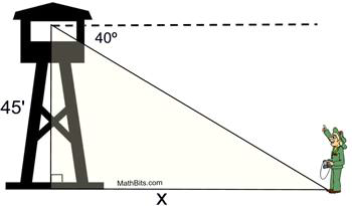
(i) What is the new angle of elevation to the top of the tower ?
(ii) What is the new distance of the hunter from the base of the tower ?
OR
If his fellow colleague said that the angle the angle of depression is actually 20° more than
what the hunter has measured, what should be the distance of the hunter from the base of the tower
(iii)Did the distance of the hunter increase or decrease due to change of angle of depression ?
The angle of elevation of a tower from a point on the same level as the foot of the tower is 30°. On advancing 150 metres towards the foot of the tower, the angle of elevation of the tower becomes 60°. Show that the height of the tower is 129.9 metres. $(\text{Use }\sqrt{3}=1.7323=1.732)$
→