MCQ
Smooth muscles are_
  • A
    voluntary, branched,uninucleate
  • B
    voluntary, multinucleate, cylindrical
  • C
    involuntary, cylindrical, multinucleate
  • involuntary, spindle shaped, uninucleated, tapering

Answer

Correct option: D.
involuntary, spindle shaped, uninucleated, tapering
d
Smooth muscle is an involuntary, spindle shaped, uninucleated, tapering and non-striated muscle. Smooth muscle is responsible for the contractility of hollow organs, such as blood vessels, the gastrointestinal tract, the bladder, or the uterus. Its structure differs greatly from that of skeletal muscle, although it can develop isometric force per crosssectional area which is equal to that of skeletal muscle.

Need a full question paper?

Generate a complete, print-ready paper with questions like this in minutes — across 16+ boards, with answer keys.
Start Generating Free

Similar questions

Which type of scales are found on the skin of cartilaginous fishes?
The sex determination pattern in honeybee is called
Which fact suggests that most oxygen is transported from lungs to the tissues combined with haemoglobin rather than dissolved in blood plasma?
An antibody is
A man can inherit his $X-$chromosome from his
Substance which is finally excreted in the urine
Mark the given statements True (T) or False (F).
(i) William Harvey discovered blood circulation and disproved 'bad humor' hypothesis of health.
(ii) Health is defined as a state of complete physical, mental and social well-being.
(ii) Disease causing organisms are called pathogen.
(iv) Salmonella typhi bacterium causes typhoid fever in humans.
(v) Sustained high fever, weakness, stomach pain, constipation, headache and loss of appetite are common symptom of influenza disease.
(vi) Typhoid fever is confirmed by widal test.
(vii) A classical case in medicine in spread of typhoid by a female named Mary mallon nicknamed Typhoid Mary has been reported.
(viii) Bacteria like Streptococcus pneumoniae and Haemophilus influenzae are responsible for the disease pneumonia in humans infects alveoli.
(ix) Rhino viruses cause most common infectious human ailments common cold, which usually last for 3-7 days.
(x) Different species of Plasmodium: P. Vivax, P. Malaria and P.Falciparum are responsible for causing malaria. Malignant malaria is caused by P. Vivax.
(xi) Plasmodium enters human body as sporozoites through bite of infected female anopheles mosquito.
(xii) During malaria, the rupture of RBCs is associated with release of toxic subastance haemozoin.
(xiii) In malaria the Plasmodium parasite reproduces sexually in liver cells and forms gametocytes (sexual stage) in RBCs in humans.
Choose the correct option given below :-
In a dihybrid cross $80$ plants are obtained. The ratio of homozygous and heterozygous shall be
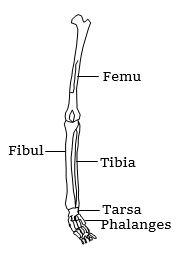
Given below is a diagram of the left human hindlimb as seen from front. It has certain mistakes in labeling. Two of the wrongly labelled bones are
Identify the correct statements regarding chemiosmotic hypothesis:
(a) Splitting of the water molecule takes place on the inner side of the membrane.
(b) Protons accumulate within the lumen of the thylakoids.
(c) Primary acceptor of electron transfers the electrons to an electron carrier.
(d) NADP reductase enzyme is located on the stroma side of the membrane.
(e) Protons increase in number in stroma.
Choose the correct answer from the options givenbelow: