MCQ
$S{O_2} + {H_2}S \to $ product. the final product is
- ✓${H_2}O + S$
- B${H_2}S{O_4}$
- C${H_2}S{O_3}$
- D${H_2}{S_2}{O_3}$
$S{O_2}$ oxidises ${H_2}S$ into $S$.
Generate a complete, print-ready paper with questions like this in minutes — across 16+ boards, with answer keys.
| $I$ | $II$ | |
| $[Cr(H_2O)_6]^{+2}$ | $[Cr(H_2O)_6]^{+3}$ | $(a)$ |
| $[Fe(H_2O)_6]^{+3}$ | $[Fe(CN)_6]^{-3}$ | $(b)$ |
| $[Fe(CN)_6]^{+3}$ | $[Ru(CN)_6]^{-3}$ | $(c)$ |
| $[NiF_6]^{-4}$ | $[NiF_6]^{-2}$ | $(d)$ |
$A + D \rightleftharpoons AD,AD + D \rightleftharpoons A{D_2}$, $A{D_2} + D \rightleftharpoons A{D_3}$. Then equilibrium constant $'K'$ for $A + 3D \rightleftharpoons A{D_3}$ is related as
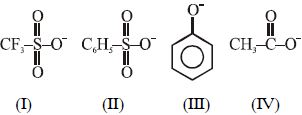
when attached to $sp^3$ hybridised carbon, their leaving group ability in nucleophilic substitution reaction decrease in the order.