Question
Soaps and detergents are both types of salts. State the difference between the two. Write the mechanism of the cleansing action of soaps. Why do soaps not form lather (foam) with hard water? Mention any two problems that arise due to the use of detergents instead of soaps.
Answer

The molecules of soap are sodium or potassium salts of long-chain carboxylic acids. Detergents are generally ammonium or sulphonate salts of long chain carboxylic acids.
Cleansing action of soap can be described as follows:
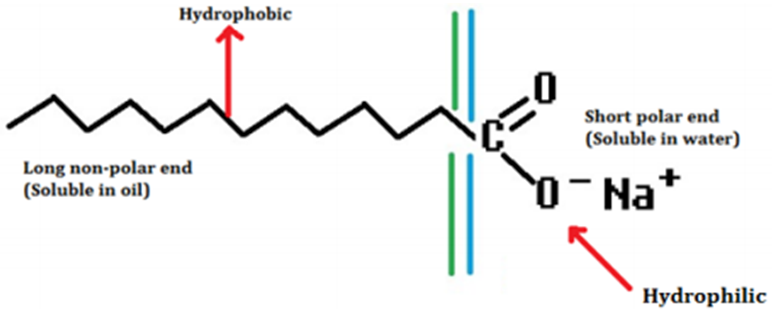
  1. A soap molecule has a tadpole-shaped structure.
  2. At one end (long non-polar end) of the soap molecule is a hydrocarbon chain which is insoluble in water but soluble in oil.
  3. At the other end (short polar end) of the soap molecule, there is a carboxylate ion which is hydrophilic, i.e. water soluble but insoluble in oil.

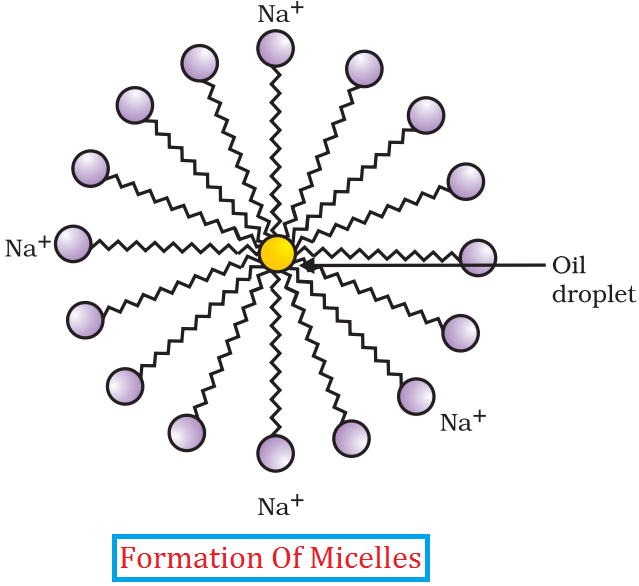
Soap on mixing with water forms a concentrated solution and causes foaming. The long non-polar end of soap gravitates towards and surrounds the dirt and absorbs the dust in it. The short polar end with the carboxylate ion repels the water away from the dirt. A spherical aggregate of soap molecules is formed in the soap solution in water and is called a micelle. Thus, the soap molecule dissolves the dirt and our clothes get clean.

Soaps do not form lather in hard water because Hard water contains calcium and magnesium salts. Soap molecules react with calcium and magnesium salts to form an insoluble precipitate called scum.
Two problems arise because of the use of detergents instead of soap:
  1. Soaps are biodegradable, while detergents are non-biodegradable; hence, detergents accumulate in the environment and cause problems.
  2. Certain phosphate additives are added to detergents. These phosphate additives act as nutrients for algae which form a thick green scum over the river water and upset the animal life in the river.

Need a full question paper?

Generate a complete, print-ready paper with questions like this in minutes — across 16+ boards, with answer keys.

Start Generating Free

Similar questions

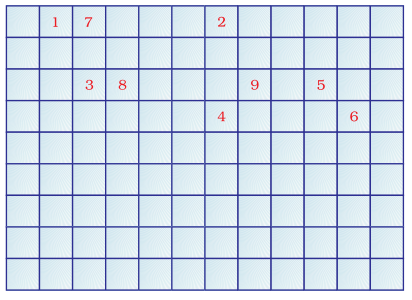
Complete the following cross word puzzle (Figure).
Across:
  1. An element with atomic number 12.
  1. Metal used in making cans and member of Group 14.
  2. A lustrous non-metal which has 7 electrons in its outermost shell.
​​​​​​​Down:
  1. Highly reactive and soft metal which imparts yellow colour when subjected to flame and is kept in kerosene.
  1. The first element of second Period.
  2. An element which is used in making fluorescent bulbs and is second member of Group 18 in the Modern Periodic Table.
  3. A radioactive element which is the last member of halogen family.
  4. Metal which is an important constituent of steel and forms rust when exposed to moist air.
  5. The first metalloid in Modern Periodic Table whose fibres are used in making bullet-proof vests.
Write the difference between nutrition in plants and animals.
A woman uses pills A as a method of birth control (or preventing pregnancy). The pills A stop the ovaries from releasing ovum into oviducts. Another woman uses pills B as a method of birth control. The pills B kill the sperms and prevent pregnancy.
  1. What do the pills A contain?
  2. What is the common name of pills A?
  3. What do the pills B contain?
  4. What is the common name of pills B?
  5. What is the general name of these methods of birth control?
The organs A of a person have been damaged completely due to which too much of a poisonous waste material B has started accumulating in his blood, making it dirty. In order to save this person's life, the blood from an artery in the person's arm is made to flow into long tubes made of substance E which are kept in coiled form in a tank containing solution F. This solution contains three materials G, H and I in similar proportions to those in normal blood. As the person's blood passes through long tubes of substance E, most of the wastes present in it go into solution. The clean blood is then put back into a vein in the arm of the person for circulation.
  1. What are organs A?
  2. Name the waste substance B.
  3. What are (i) E and (ii) F? Name G, H and I.
  4. What is the process described above known as?
Describe double circulation in human beings. Why is it necessary?
  1. Match the terms given in column I with the terms given in column II and column III having the same meaning:
  Column I Column II Column III
(i)
Secondary consumer
Herbivore
$1^{\text {st }}$ trophic level
(ii)
Primary consumer
Autotroph
$3^{\text {rd }}$ trophic level
(iii)
Producer
Carnivore
$4^{\text {th }}$ trophic level
(iv)
Tertiary consumer
Large carnivore
$2^{\text {nd }}$ trophic level
  1. Give one example of a food chain having four organisms. Below each organism write the three appropriate terms from the part (a) above which you think it represents.
What is meant by pair of contrasting characters?
Describe the parts of our tooth with the help of a labelled diagram.
What are the different types of tropisms? Define each type of tropism. Write the name of stimulus in each case.
A student focussed the image of a candle flame on a white screen using a convex lens. He noted down the position of the candle screen and the lens as under,
Position of candle = 12.0cm
Position of convex lens = 50.0cm
Position of the screen = 88.0cm
  1. What is the focal length of the convex lens?
  2. Where will the image be formed if he shifts the candle towards the lens at a position of 31.0cm?
  3. What will be the nature of the image formed if he further shifts the candle towards the lens?
  4. Draw a ray diagram to show the formation of the image in case (iii) as said above.