MCQ
Sodium chromate, $Na_2CrO_4$ is made commercially by
  • A
    heating mixture of $Cr_2O_3$ and $Na_2CO_3$
  • heating mixture of chromite ore and sodium carbonate in the presence of oxygen
  • C
    heating sodium dichromate with sodium carbonate
  • D
    reacting $NaOH$ with chromic acid

Answer

Correct option: B.
heating mixture of chromite ore and sodium carbonate in the presence of oxygen
b

Need a full question paper?

Generate a complete, print-ready paper with questions like this in minutes — across 16+ boards, with answer keys.

Start Generating Free

Similar questions

Below are two statements. One is labeled as Assertion $(A)$ and the other as Reason $(R):$

Assertion $(A):$ $​\mathrm{H}_2 \mathrm{Te}$ is more acidic than $\mathrm{H}_2 \mathrm{~S}$.

Reason $(R):$  The bond dissociation enthalpy of $\mathrm{H}_2 \mathrm{Te}$ is less than that of $\mathrm{H}_2 \mathrm{~S}$.

In the context of the above statements, choose the correct answer from the following options:

Given below are two statements, one is labelled as Assertion $A$ and the other is labelled as Reason $R$.

Assertion $A$ : Benzene is more stable than hypothetical cyclohexatriene.

Reason $R$ : The delocalized $\pi$ electron cloud is attracted more strongly by nuclei of carbon atoms. In the light of the above statements, choose the correct answer from the options given below:

Ammonia gas dissolves in water to give $N{H_4}OH.$ In this reaction water acts as
The elevation in boiling point for one molal solution of a solute in a solvent is called
$NH _{3}$ reacts with bleaching powder to given :
Which of the following is least ionic?
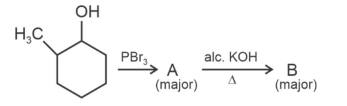
Major products $\mathrm{A}$ and $\mathrm{B}$ formed in the following reaction sequence, are
The solubility in water of a sparingly soluble salt $A{B_2}$ is $1.0 \times {10^{ - 5}}mol\,{l^{ - 1}}$. Its solubility product number will be
The enthalpy changes for the following processes are listed below :
$Cl_2(g) \to 2Cl(g), 242.3\, kJ\, mol^{-1}$
$I_2(g) \to 2I(g), 151.0\, kJ\, mol^{-1}$
$ICl(g) \to I(g) + Cl(g), 211.3 kJ\, mol^{-1}$
$I_2(s) \to  I_2(g), 62.76\, kJ\, mol^{-1}$
Given that the standard states for iodine and chlorine are $I_2(s)$ and $Cl_2(g)$, the standard enthalpy of formation for $ICl(g)$ is .............. $\mathrm{kJ\,mol}^{-1}$
The colour of copper sulphide is