Question
Sodium metal is kept in kerosene but not water. Why?

Answer

Sodium is a highly reactive metal. When exposed to air, it starts to burn and forms sodium oxide. Similarly, it reacts vigorously with water. It does not react with kerosene. Therefore, to prevent its exposure to moisture and air, it is kept in kerosene.

Need a full question paper?

Generate a complete, print-ready paper with questions like this in minutes — across 16+ boards, with answer keys.
Start Generating Free

Similar questions

What will happen if the blood rich in oxygen and the blood rich in carbon dioxide mix with each other?
Explain, with examples, why we find animals of certain kind living in particular climatic conditions.
A snake charmer came to the society and smelled the presence of a cobra near the guardroom. The head of the society agreed to allow the man to search, catch and take away the snake with him. Little Krishi who was seeing all this, disagreed. She explained the people that it might disturb the food chain in the environment. Now, answer the following questions.
(i) Describe food chain.
(ii) Construct a food chain involving snake at one of its level.
How is zygote formed in plants?
Unscramble the underlined word in the following sentences :
(i) The discharge of blood in adolescent girls which generally occurs every 28-30 days is nstmnoiaretu.
(ii) The hoarseness in the voice of adolescent boys is due to enlarged iceov xob.
(iii) Secondary sexual characteristics are natural signs that the body is preparing for adulthood and mark the onset of urtvpeb.
(iv) We should say NO to lahoclo and srugd as they are addictive.
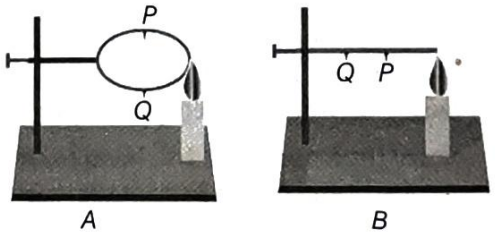
In the arrangements A and B as shown in figure, pins Pand Q are fixed to a metal loop and an iron rod with the help of wax. In which case, both the pins are likely to fall at different times? Explain.
Image
Why does an athlete breathe faster and deeper than usual after finishing the race?
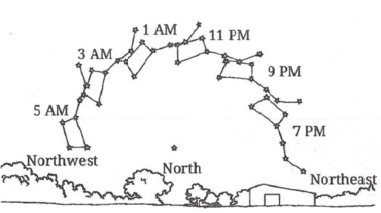
Refer to the sketch provided, which shows the positions of the Big Dipper constellation in the night sky from 7 PM to 5 AM, as observed by a student in Pune on the night of 1-2 April.
Image
(a) What causes the Big Dipper to appear to move across the night sky in a circular path around the Pole Star? Explain the scientific reason behind this observation.
(b) Based on the positions shown in the sketch, describe the apparent direction of movement of the Big Dipper. What does this tell us about the Earth's motion?
Why did bubbles form when Aman spilled vinegar on eggshells?