MCQ
Solder is an alloy of
- A$70\%$ lead, $ 30\%$ tin
- ✓$30\%$ lead, $70\%$ tin
- C$80\%$ lead, $20\%$ tin
- D$90\%$ $Cu, 10\%$ tin
Generate a complete, print-ready paper with questions like this in minutes — across 16+ boards, with answer keys.
Choose the correct statement($s$).
$(A)$ The order of basicity is $II > I > III > IV$ .
$(B)$ The magnitude of $p K_{ b }$ difference between $I$ and $II$ is more than that between $III$ and $IV$.
$(C)$ Resonance effect is more in $III$ than in $IV$.
$(D)$ Steric effect makes compound $IV$ more basic than $III$.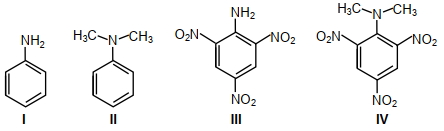
$(i)\,\,(CH_3)_2CH - CH_2Br \xrightarrow{{{C_2}{H_5}OH}}$ $ (CH_3)_2CH - CH_2OC_2H_5 + HBr$
$(ii)\,\,(CH_3)_2CH - CH_2Br \xrightarrow{{{C_2}{H_5}O^-}} $ $(CH_3)_2CH - CH_2OC_2H_5 + Br^-$
The mechanisms of reactions $(i)$ and $(ii)$ are respectively
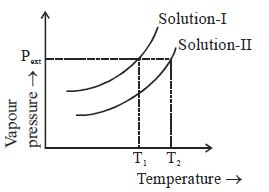
$1.$ The metal rod ${M}$ is
$(A)$ $\mathrm{Fe}$ $(B)$ $\mathrm{Cu}$ $(C)$ $\mathrm{Ni}$ $(D)$ $\mathrm{Co}$
$2.$ The compound ${N}$ is
$(A)$ $\mathrm{AgNO}_3$ $(B)$ $\mathrm{Zn}\left(\mathrm{NO}_3\right)_2$
$(C)$ $\mathrm{Al}\left(\mathrm{NO}_3\right)_3$ $(D)$ $\mathrm{Pb}\left(\mathrm{NO}_3\right)_2$
$3.$ The final solution contains
$(A)$ $\left[\mathrm{Pb}\left(\mathrm{NH}_3\right)_4\right]^{2+}$ and $\left[\mathrm{CoCl}_4\right]^{2-}$
$(B)$ $\left[\mathrm{Al}\left(\mathrm{NH}_3\right)_4\right]^{3+}$ and $\left[\mathrm{Cu}\left(\mathrm{NH}_3\right)_4\right]^{2+}$
$(C)$ $\left[\mathrm{Ag}\left(\mathrm{NH}_3\right)_2\right]^{+}$and $\left[\mathrm{Cu}\left(\mathrm{NH}_3\right)_4\right]^{2+}$
$(D)$ $\left[\mathrm{Ag}\left(\mathrm{NH}_3\right)_2\right]^{+}$and $\left[\mathrm{Ni}\left(\mathrm{NH}_3\right)_6\right]^{2+}$
Give the answer question $1,2$ and $3.$