MCQ
Solution of a linear inequality in variable $x$ is represented on number line.
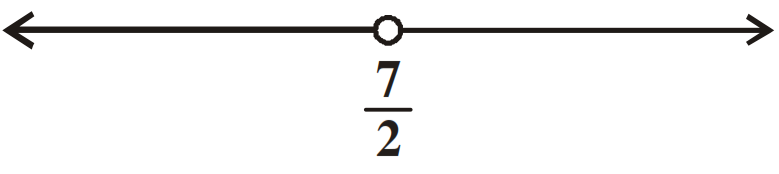
  • $\text{x}\in\big(-\infty,\frac{7}{2}\big)$ 
  • B
    $\text{x}\in\big(-\infty,\frac{7}{2}\big]$ 
  • C
    $\text{x}\in\big(\frac{7}{2},-\infty\big)$ 
  • D
    $\text{x}\in\big(\frac{7}{2},\infty\big)$

Answer

Correct option: A.
$\text{x}\in\big(-\infty,\frac{7}{2}\big)$ 
The given graph all real values of $x$ greater than and equal $\frac{7}{2}$ on real number line.
So, $\text{x}\in\big(-\infty,\frac{7}{2}\big)$

Need a full question paper?

Generate a complete, print-ready paper with questions like this in minutes — across 16+ boards, with answer keys.

Start Generating Free

Similar questions

If $5 + ix^3y^2$ and $x^3 + y^2 + 6i$ are conjugate complex numbers and arg $(x + iy) = \theta $ , then ${\tan ^2}\,\theta $ is equal to
If $\text{y}=\frac{1+\frac{1}{\text{x}^{2}}}{1-\frac{1}{\text{x}^{2}}}$ then $\frac{\text{dy}}{\text{dx}}$ is equal to:
The points $C$ and $D$ on a semicircle with $A B$ as diameter are such that $A C=1, C D=2$ and $D B=3$. Then, the length of $A B$ lies in the interval.
Let ${S_k} = \frac{{1 + 2 + 3 + .... + k}}{k}$. If $S_1^2 + S_2^2 + ....... + S_{10}^2 = \frac{5}{{12}}A$, then $A$ equal to
The mean deviation of the data $3, 10, 10, 4, 7, 10, 5$ from the mean is:
The sum $\sum\limits_{i = 0}^m {\left( {\begin{array}{*{20}{c}}{10}\\i\end{array}} \right)} \,\left( {\begin{array}{*{20}{c}}{20}\\{m - i}\end{array}} \right)\,,$ $\left( {{\rm{where}}\,\left( {\begin{array}{*{20}{c}}p\\q\end{array}} \right)\, = 0\,{\rm{if}}\,p < q} \right)$, is maximum when m is
A plane is parallel to yz-plane so it is perpendicular to:
Let $a, b, c > 1, a^3, b^3$ and $c^3$ be in $A.P.$, and $\log _a b$, $\log _c a$ and $\log _b c$ be in G.P. If the sum of first $20$ terms of an $A.P.$, whose first term is $\frac{a+4 b+c}{3}$ and the common difference is $\frac{a-8 b+c}{10}$ is $-444$, then abc is equal to
What is the value of $\frac{\text{d}}{\text{dx}}\text{(ex sinx + ex cos ⁡x)}?$
If the sum of the coefficients of all the positive even powers of $x$ in the binomial expansion of $\left(2 x^{3}+\frac{3}{x}\right)^{10}$ is $5^{10}-\beta \cdot 3^{9}$, then $\beta$ is equal to