MCQ
Solution of differential equation $\frac{{dy}}{{dx}} = 2xy$ is
  • $y = c{e^{{x^2}}}$
  • B
    ${y^2} = 2{x^2} + c$
  • C
    $y = {e^{ - {x^2}}} + c$
  • D
    $y = {x^2} + c$

Answer

Correct option: A.
$y = c{e^{{x^2}}}$
a
(a) $\int_{}^{} {\frac{{dy}}{y} = \int_{}^{} {2xdx} } $ ==> ${\log _e}y = {x^2} + c$

==> $y = {e^{{x^2} + c}} = {e^c}{e^{{x^2}}}$ ==> $y = c{e^{{x^2}}}$.

Need a full question paper?

Generate a complete, print-ready paper with questions like this in minutes — across 16+ boards, with answer keys.

Start Generating Free

Similar questions

If $\text{f}(\text{x})=\frac{\sin^{-1}\text{x}}{\sqrt{1-\text{x}}^2},$ then $(1-\text{x})^2\text{f}''(\text{x})-\text{xf}(\text{x})=$
  1. 1
  2. -1
  3. 0
  4. None of these
The length of the perpendicular drawn from the point $(5, 4, -1)$ on the line $\frac{{x - 1}}{2} = \frac{y}{9} = \frac{z}{5}$ is
R is a relation on the set Z of integers and it is given by (x, y) ∈ R ⇔ | x - y | ≤ 1. Then, R is:
  1. Reflexive and transitive.
  2. Reflexive and symmetric.
  3. Symmetric and transitive.
  4. An equivalence relation.
If $A$ and $B$ are two events such that $A \subset B$ and $P(B) \neq 0$, then which of the following is correct?
If $\left(\frac{1}{2}, \frac{1}{3}, n\right)$ are the direction cosines of a line, then the value of $n$ is
Smaller area enclosed by the circle x2 + y2 = 4 and the line x + y = 2 is:
  1. $2(\pi-2)$
  2. $\pi-2$
  3. $\pi-1$
  4. $2(\pi+2)$
If A and B are $3 \times 3$ order matrices and $| A |=5$, $|B|=3$, then $|3 A B|=$ __________ .
For two $3\times3$ matrices $A$ and $B$ , let $A+ B\, = 2B'$ and $3A + 2B\, = I_3$, where $B'$ is the transpose of $B$ and $I_3$ is $3\times3$ identity matrix. Then
For any real numbers $\alpha$ and $\beta$, let $y_{\alpha, \beta}(x), x \in R$, be the solution of the differential equation

$\frac{d y}{d x}+\alpha y=x e^{\beta x}, y(1)=1$

Let $S=\left\{y_{\alpha \beta}(x): \alpha, \beta \in R \right\}$. Then which of the following functions belong(s) to the set $S$ ?

$(A)$ $f( x )=\frac{ x ^2}{2} e ^{- x }+\left( e -\frac{1}{2}\right) e ^{- x }$

$(B)$ $f( x )=-\frac{ x ^2}{2} e ^{- x }+\left( e +\frac{1}{2}\right) e ^{- x }$

$(C)$ $f( x )=\frac{ e ^{ x }}{2}\left( x -\frac{1}{2}\right)+\left( e -\frac{ e ^2}{4}\right) e ^{- x }$

$(D)$ $f( x )=\frac{ e ^{ x }}{2}\left(\frac{1}{2}- x \right)+\left( e +\frac{ e ^2}{4}\right) e ^{- x }$
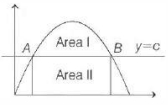
The figure shows a portion of the graph $y=2 x-4 x^3$.The line $y=c$ is such that the areas of the regions marked $I$ and $II$ are equal. If $a, b$ are the $x$-coordinates of $A, B$ respectively, then $a+b$ equals