MCQ
Solution of the differential eqn. $\frac{dy}{dx}-2 \frac{y}{x}=x^3$ is :-
  • A
    $2y = x^6 + cx^2$
  • B
    $2y = cx^2 -x^6$
  • $2y = cx^2 + x^4$
  • D
    None of these

Answer

Correct option: C.
$2y = cx^2 + x^4$
c

Need a full question paper?

Generate a complete, print-ready paper with questions like this in minutes — across 16+ boards, with answer keys.

Start Generating Free

Similar questions

If $A=\left[\begin{array}{lll}1 & 0 & 1 \\ 0 & 0 & 0 \\ 1 & 0 & 1\end{array}\right]$, then $A^2=$ ?
If $ a, b, c$  are three non-coplanar vector, then $\frac{{a\,.\,b \times c}}{{c \times a\,.\,b}} + \frac{{b\,.\,a \times c}}{{c\,.\,a \times b}}$=
Let $E$ and $F$ be two independent events. The probability that exactly one of them occurs is $\frac{11}{25}$ and the probability of none of them occurring is $\frac{2}{25}$. If $P(T)$ denotes the probability of occurrence of the event $T$, then

$(A)$ $P(E)=\frac{4}{5}, P(F)=\frac{3}{5}$

$(B)$ $P(E)=\frac{1}{5}, P(F)=\frac{2}{5}$

$(C)$ $P(E)=\frac{2}{5}, P(F)=\frac{1}{5}$

$(D)$ $P(E)=\frac{3}{5}, P(F)=\frac{4}{5}$
Total number of equivalence relations defined in the set $S = \{a, b, c\}$ is:
The additive inverse of $A+B$, where $A$ and $B$ are given as $A=\left[\begin{array}{ll}2 & 5 \\ 9 & 3\end{array}\right], B=\left[\begin{array}{cc}-1 & 2 \\ 3 & -9\end{array}\right]$ is
The value of ${\cos ^{ - 1}}\left[ {\cot \left\{ {{{\sin }^{ - 1}}\sqrt {\frac{{2 - \sqrt 3 }}{4}}  + {{\cos }^{ - 1}}\frac{{\sqrt {12} }}{4} + {{\sec }^{ - 1}}\sqrt 2 } \right\}} \right]$ is
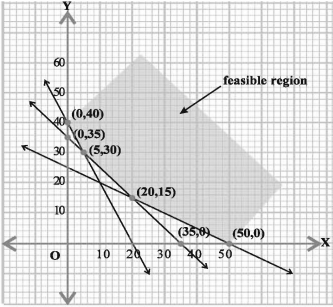
The following graph represents a feasible region. Minimum value of $z=5 x+4 y$ is $\ldots \ldots$
If the points $(2,-3),(k,-1)$ and $(0,4)$ are collinear, then find the value of $4 k$.
If $A=\left[\begin{array}{ll}5 & x \\ y & 0\end{array}\right]$ and $A=A^T$, where $A^T$ is the transpose of the matrix $A$, then
Let $\vec{a}=-\hat{i}-\hat{k}, \vec{b}=-\hat{i}+\hat{j}$ and $\vec{c}=\hat{i}+2 \hat{j}+3 \hat{k}$ be three given vectors. If $\vec{r}$ is a vector such that $\vec{r} \times \vec{b}=\vec{c} \times \vec{b}$ and $\vec{r} \cdot \vec{a}=0$, then the value of $\vec{r} \cdot \vec{b}$ is