Question
Solve :$2^{2x}+ 2^{x+2} - 4 \times 2^3= 0$

Answer

$2^{2x}+ 2^{x+2} - 4 \times 2^3= 0$
$\Rightarrow ( 2^x)^2 + 2^x. 2^2 - 4 \times 2 \times 2 \times 2 = 0$
$\Rightarrow ( 2^x)^2 + 2^x. 2^2 - 32 = 0$
Putting $y = 2^x$
$\Rightarrow y^2 + 4y - 32 = 0$
$\Rightarrow y2 + 8y - 4y - 32 = 0$
$\Rightarrow y( y + 8 ) - 4( y + 8 ) = 0$
$\Rightarrow ( y + 8 )( y - 4 ) = 0$
$\Rightarrow y + 8 = 0$ or $y - 4 = 0$
$\Rightarrow y = - 8$ or $y = 4$
$\Rightarrow 2^x = - 8$ or $2^x = 4$
$\Rightarrow 2^x = 2^2$
$[ \because 2^x = - 8$ is not possible. $]$
$\Rightarrow x = 2.$

Need a full question paper?

Generate a complete, print-ready paper with questions like this in minutes — across 16+ boards, with answer keys.
Start Generating Free

Similar questions

In $\triangle ABC, X$ is the mid $-$ point of $AB,$ and $Y$ is the mid $-$ point of $AC. BY$ and $CX$ are produced and meet the straight line through $A$ parallel to $BC$ at $P$ and $Q$ respectively. Prove $AP = AQ.$
If \sin $A =\frac{\sqrt{3}}{2}$ and $\cos B =\frac{\sqrt{3}}{2} ,$ find the value of $: \frac{\tan A-\tan B}{1+\tan A \tan B}$
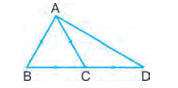
In the given figure, $\triangle ABC$ is an equilateral triangle whose base BC is produced to D such that $BC = CD$. Calculate :
(i) $\angle ACD$
(ii) $\angle ADC$.
Image
The course of an enemy submarine, as plotted on rectangular co$-$ordinate axes, gives the equation $2x + 3y = 4$. On the same axes, a destroyer's course is indicated by the graph $x - y = 7$. Use the graphical method to find the point at which the paths of the submarine and the destroyer intersect?
Construct a rhombus $\text{ABCD},$ when: $A = 60^\circ$ and height $= 3.0 \ cm.$
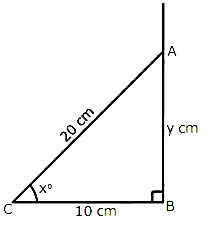
From the given figure,find:$(i)\cos x^\circ ;(ii)\ x^\circ ;(iii)\frac{1}{\tan ^2 x^{\circ}}-\frac{1}{\sin ^2 x^{\circ}};(iv)$ Use $\tan x^o,$ to find the value of $y.$
Calculate the median of the following sets of number:$1, 9, 10, 8, 2, 4, 4, 3, 9, 1, 5, 6, 2$ and $4.$
A cylindrical tube, open at both ends, is made of metal. The bore $($internal diameter$)$ of the tube is $10.4 \ cm$ and its length is $25 \ cm$. The thickness of the metal is $8 \ mm$ everywhere. Calculate the volume of the metal. Also, find the weight of the tube if $1 \ cm^3$ of the metal weighs $1.42\ g.$
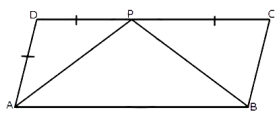
In the following figure, $\text{ABCD}$ is a parallelogram.
Image
Prove that:$(i) AP$ bisects $\angle A,(ii) B P$ bisects $\angle B,(iii) \angle DAP +\angle BCP =\angle APB$
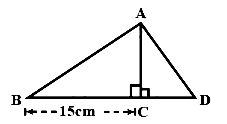
In the given figure;$BC = 15 \ cm$ and $\sin B =\frac{4}{5}$
  1. Calculate the measure of $AB$ and $AC.$
  2. Now, if $\tan \angle ADC = 1;$ calculate the measures of $CD$ and $AD.$
    Also, show that $: \tan^2B - \frac{1}{\cos ^2 B }=-1$