Question
Solve $\frac{3 t-2}{3}+\frac{2 t+3}{2}=t+\frac{7}{6}$

Answer

We have, $\frac{3 t-2}{3}+\frac{2 t+3}{2}=t+\frac{7}{6}$
$\Rightarrow \quad \frac{3 t-2}{3}+\frac{2 t+3}{2}-\frac{t}{1}=\frac{7}{6}\quad$ [transposing $t$ to LHS]
$\Rightarrow \frac{2 \times(3 t-2)+3 \times(2 t+3)-6 \times t}{6}=\frac{7}{6}$
$\Rightarrow \quad \frac{6 t-4+6 t+9-6 t}{6}=\frac{7}{6}$
$\Rightarrow \quad \frac{6 t+5}{6}=\frac{7}{6}$
$\Rightarrow \quad(6 t+5)=\frac{7 \times 6}{6}\quad$ [multiplying both sides by 6]
$\Rightarrow \quad 6 t+5=7$
$\Rightarrow \quad 6 t=7-5=2\quad$ [transposing 5 to RHS]
$\therefore \quad t=\frac{2}{6}=\frac{1}{3}$

Need a full question paper?

Generate a complete, print-ready paper with questions like this in minutes — across 16+ boards, with answer keys.

Start Generating Free

Similar questions

Verify that
$(11 p q+4 q)^2-(11 p q-4 q)^2=176 p q^2$
Long back in ancient times, a farmer saved the life of a king’s daughter. The king decided to reward the farmer with whatever he wished. The farmer, who was a chess champion, made an unusal request: “I would like you to place $1$ rupee on the first square of my chessboard, $2$ rupees on the second square, $4$ on the third square, 8 on the fourth square, and so on, until you have covered all 64 squares. Each square should have twice as many rupees as the previous square.” The king thought this to be too less and asked the farmer to think of some better reward, but the farmer didn’t agree.How much money has the farmer earned? [Hint: The following table may help you. What is the first square on which the king will place at least Rs $10$ lakh?]
Position of square on chess board
Amount (in Rs)
$1$st square
$1$
$2$nd square
$2$
$3$rd square
$4$
Evaluate: $\sqrt{3\frac{33}{289}}$
$12$ men can dig a pond in $8$ days. How many men can dig it in $6$ days?
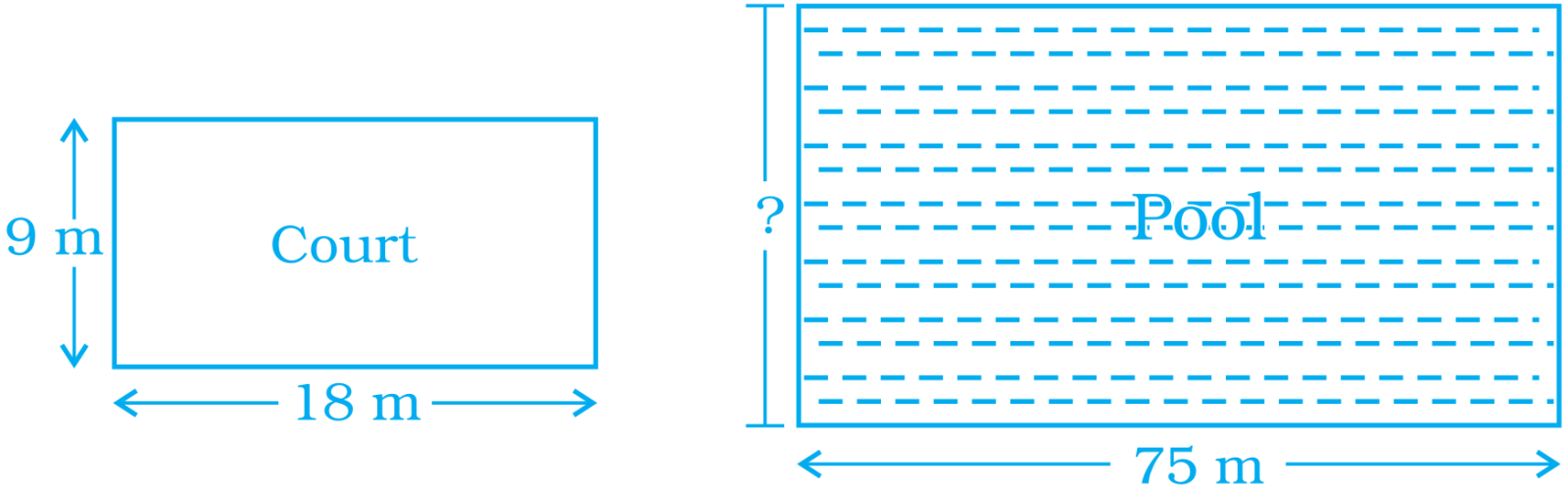
A volleyball court is in a rectangular shape and its dimensions are directly proportional to the dimensions of the swimming pool given below. Find the width of the pool.
The marks scored by $20$ students in a test are given below: $54, 42, 68, 56, 62, 71, 78, 51, 72, 53, 44, 58, 47, 64, 41, 57, 89, 53, 84, 57.$ Complete the following frequency table:
(Marks in class intervals) Tally marks Frequency (no. of children)
$40-50$    
$50-60$    
$60-70$    
$70-80$    
$80-90$    
What is the class interval in which the greatest frequency occurs$?$
Find the square root of the following by prime factorization.$1764$
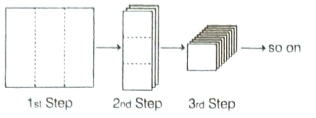
To make ballot papers cut a sheet of paper into three. Stack the three pleces and cut the stack into three. Stack all the pieces and cut the stack into three again.
Image
(i) Complete the table to show the number of ballot papers after five such steps :
Number of stepsNumber of ballot paper
13
2
3
4
5
(ii) Suppose you continue this process. How many ballot papers would you have after 15 steps? How many would you have after $n$ cuts?
(iii) How many steps would it take to make atleast one lakh ballot papers?
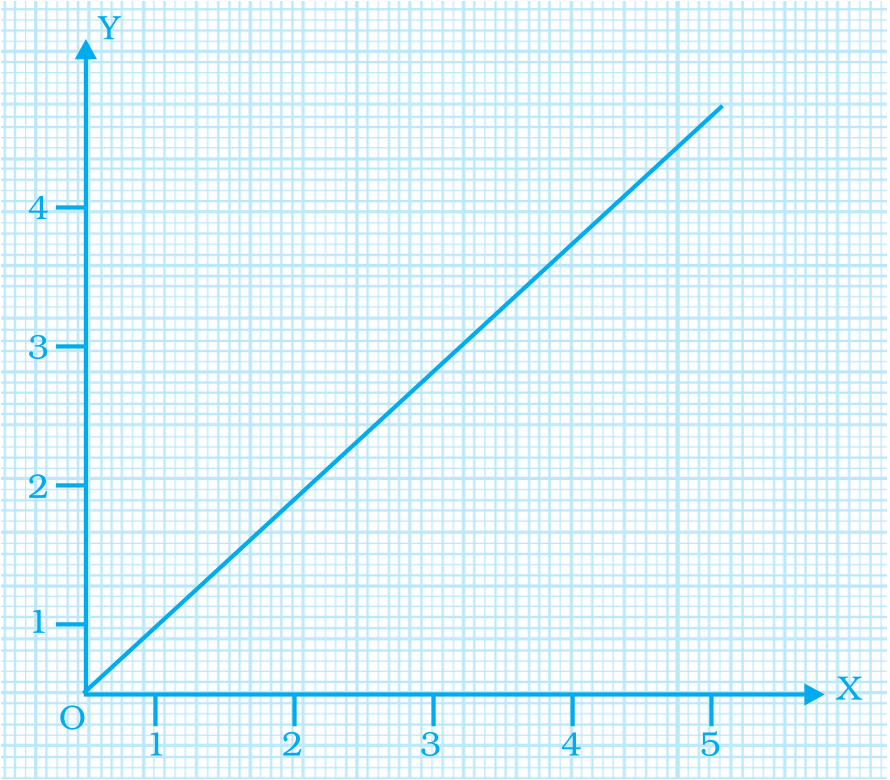
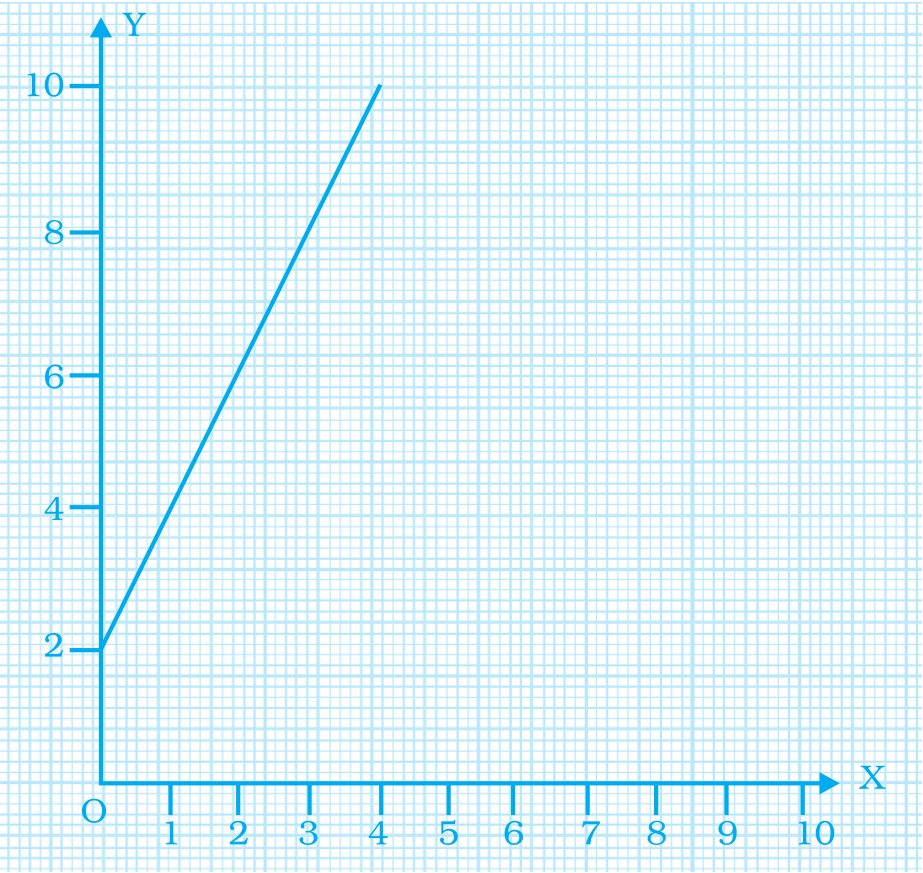
Study the given graphs $(a)$ and $(b)$ and complete the corresponding tables below.
$a.$
$x$
$0$
$1$
$2$
$3$
$y$


$b.$
$x$
$0$
$1$
$2$
$3$
$4$
$y$
 
       
Simplify: $\frac{3}{2}\text{x}^2\big(\text{x}^2−1\big)+\frac{1}{4}\text{x}^2\big(\text{x}^2+\text{x}\big)−\frac{3}{4}\text{x}\big(\text{x}^3−1\big)$