Question
Solve for x and y:
23x - 29y = 98,
29x - 23y = 110

Answer

The given equations are: 23x - 29y = 98 ...(i) 29x - 23y = 110 ...(ii) Adding (i) and (ii), we get 52x + 52y = 208 ⇒ x + y = 4 ...(iii) Subtract (i) from (ii), we get 6x - 6y = 12 ⇒ x - y = 2 ...(iv) Adding (iii) and (iv), we get 2x = 6 ⇒ x = 3 Substituting x = 3 in (iii), we get y = 1Hence, x = 3 and y = 1

Need a full question paper?

Generate a complete, print-ready paper with questions like this in minutes — across 16+ boards, with answer keys.
Start Generating Free

Similar questions

Solve for x and y:
$\frac{1}{2(\text{x}+\text{2y)}}+\frac{5}{3(3\text{x}-\text{2y)}}=\frac{-3}{2},$
$\frac{5}{4(\text{x}+\text{2y)}}-\frac{3}{5(3\text{x}-\text{2y)}}=\frac{61}{60}$
The area of a rectangle gets reduced by $8m^2$, when its length is reduced by 5m and its breadth is increased by $3m$. If we increase the length by 3m and breadth by 2m, the area is increased by $74m^2​​​​​​​$​​​​​​​. Find the length and the breadth of the rectangle.
Show graphically that each of the following given systems of equations is inconsistent, i.e., has no solutions:
2x + y = 2, 2x + y = 6
Find the area of a trapezium whose parallel sides are 11cm and 25cm long and nonparallel sides are 15cm and 13cm.
From a solid cylinder whose height is $15\ cm$ and diameter $16\ cm$, a conical cavity of the same height and same diameter is hollowed out. Find the total surface area of the remaining solid. $[$Use $\pi= 3.14]$
Solve the following quadratic equation:
$\frac{\text{x}}{\text{x}+1}+\frac{\text{x}+1}{\text{x}}=2\frac{4}{15},$ $\text{x}\neq0,-1$
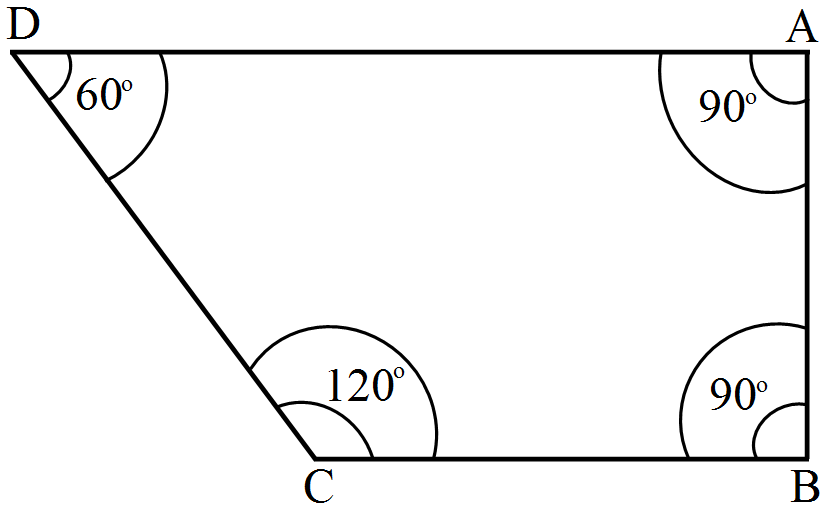
ABCD is a field in the shape of a trapezium, $\text{AD}||\text{BC},\ \angle\text{ABC}=90^\circ$ and $LADC 60^\circ .$ $\angle\text{ADC}=60^\circ.$ Four sectors are formed with centres $A, B, C$ and $D$, as shown in the figure. The radius of each sector is $14\ m$. Find the following.
  1. Total area of the four sector,
  2. Area of the remaining portion, given that $AD =55m, BC = 45m$ and $AB = 30m,$
Solve the following systems of equations by using the method of cross multiplication:
$2ax + 3by = (a + 2b),$
$3ax + 2by = (2a + b).$
An AP $8, 10, 12, ....$ has $60$ terms. Find its last term. Hence, find the sum of its last $10$ terms.
Prove the following identities:
$\frac{\sec\theta+\tan\theta}{\sec\theta-\tan\theta}=(\sec\theta+\tan\theta)^2$
$=1+2\tan^2\theta+2\sec\theta\tan\theta$