Question
Solve for x and y:
2x + 3y = 0,
3x + 4y = 5

Answer

The given equation are:
2x + 3y = 0 ...(1)
3x + 4y = 5 ...(2)
On multiplying (1) by 4 and (2) by 3, we get:
8x + 12y = 0 ...(3)
9x + 12y = 15 ...(4)
On subtracting (3) and (4), we get:
x = 15
On substituting the value of x = 15 in (1), we get:
2 × 15 + 3y = 0
⇒ 3y = 0 - 30
⇒ 3y = -30 or y = -10
$\therefore$ x = 15 and y = -10

Need a full question paper?

Generate a complete, print-ready paper with questions like this in minutes — across 16+ boards, with answer keys.
Start Generating Free

Similar questions

How many two digit numbers are divisible by 4 ?
Find the coordinates of the circumcentre of PQR if P(2, 7), $Q(-5,8)$ and $R(-6,1)$.
Find the relation between x and y, where point (x, y) is equidistant from (2, -4) and (-2, 6).
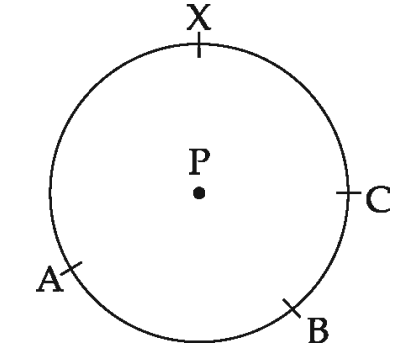
A circle with centre P. arc AB = arc BC and arc AXC = 2 arc AB. measure of arc AB, arc BC and arc AXC. Prove chord AB $\cong$ chord BC.
Image
A bucket is frustum shaped. Its height is $28 \mathrm{~cm}$. Radii of circular faces are $12 \mathrm{~cm}$ and $15 \mathrm{~cm}$. Find the capacity of the bucket. $\left(\pi=\frac{22}{7}\right.$ )
Find the zeros of the following quadratic polynomial and verify the relationship between the zeros and their coefficients:
$\text{p(x)}=\text{x}^2+2\sqrt{2\text{x}}-6$
If A + B = 90° and $\cos\text{B}=\frac{3}{5},$ what is the value of sin A?
If the $p^{th}$​​​​​​​ term of an AP is $q$ and its $q^{th}​​​​​​​$​​​​​​​ term is $p$ then show that its $(p + q)^{th}​​​​​​​$​​​​​​​ term is zero.
Two buildings are facing each other on a road of width 12 metre. From the top of the first building, which is 10 metre high, the angle of elevation of the top of the second is found to be 60°. What is the height of the second building?

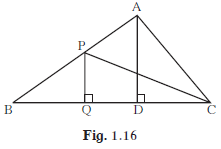
In adjoining figure PQ ⊥ BC, AD ⊥ BC then find following ratios.

(i) $\frac{ A (\Delta PQB )}{ A (\triangle PBC )}$
(ii) $\frac{ A (\Delta PBC )}{ A (\Delta ABC )}$
(iii) $\frac{ A (\Delta ABC )}{ A (\triangle ADC )}$
(iv) $\frac{ A (\Delta ADC )}{ A (\Delta PQC )}$