Question
Solve for x and y:
$\frac{35}{\text{x}+\text{y}}+\frac{14}{\text{x}-\text{y}}=19,$ $\frac{14}{\text{x}+\text{y}}+\frac{35}{\text{x}-\text{y}}=37$
Answer

We have: $\frac{35}{\text{x+y}}+\frac{14}{\text{x}-\text{y}}=19$ and $\frac{14}{\text{x+y}}+\frac{35}{\text{x}-\text{y}}=37$ Taking $\frac{1}{\text{x+y}}=\text{u}$ and $\frac{1}{\text{x}-\text{y}}=\text{v}.$
$35 u+14 v-19=0.......(i) 14 u+35 v-37=0$
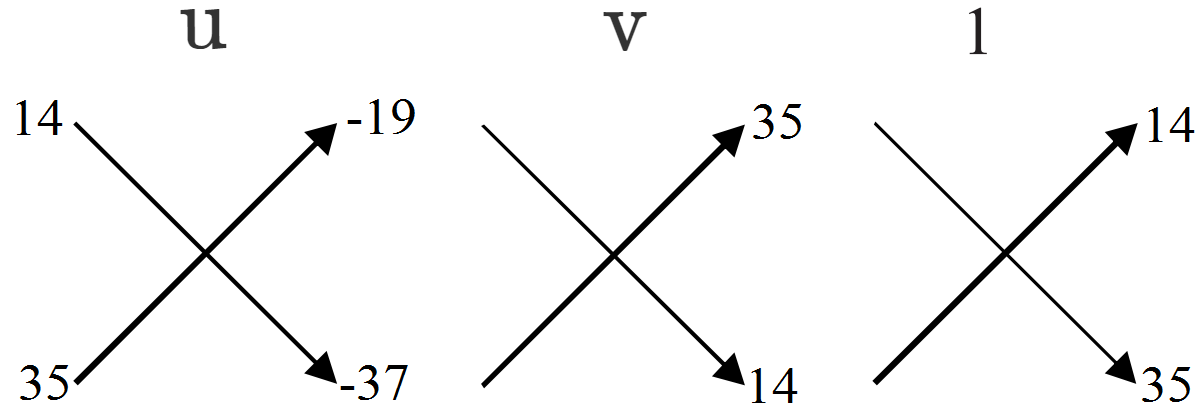
Here, $a_1=35, b_1=14, c_1=-19, a_2=14, b_2=35, c_2=-37$ By cross multiplying, we have:

$\therefore\frac{\text{u}}{[14\times(-37)-35\times(-19)]}=\frac{\text{v}}{[(-19)\times14-(-37)\times(35)]}=\frac{1}{[35\times35-14\times14]}$
$\Rightarrow\frac{\text{u}}{-518+665}=\frac{\text{v}}{-266+1295}=\frac{1}{1225-196}$
$\Rightarrow\frac{\text{u}}{147}=\frac{\text{v}}{1029}=\frac{1}{1029}$
$\Rightarrow\text{u}=\frac{147}{1029}=\frac{1}{7},\ \text{v}=\frac{1029}{1029}=1$
$\Rightarrow\frac{1}{\text{x+y}}=\frac{1}{7},\ \frac{1}{\text{x}-\text{y}}=1$
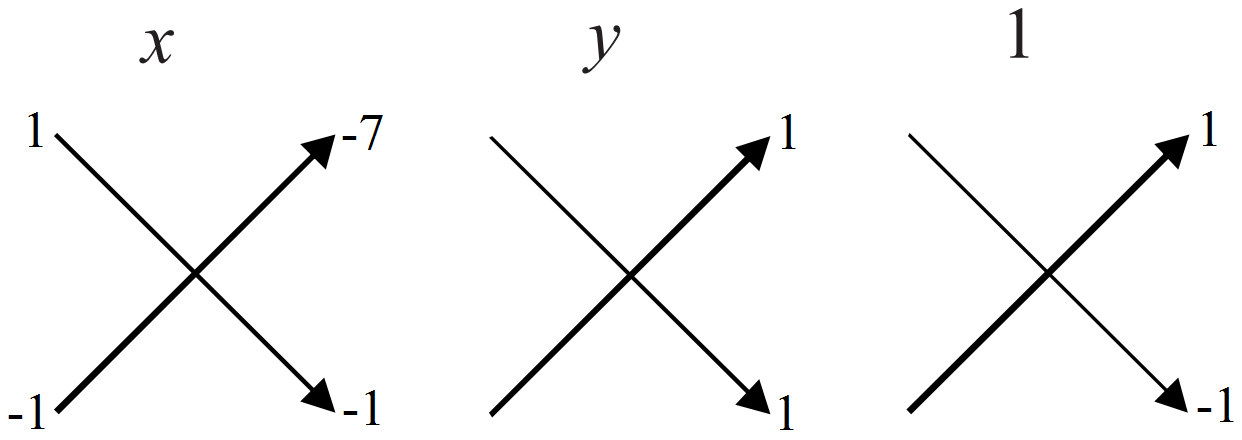
$\therefore( x + y )=7 \ldots$...iii) And, $( x - y )=1 \ldots$ (iv) Again, the equation (iii) and (iv) can be written as follows: $x + y -7=0 \ldots$ (v) x $-y-1=0 \ldots$ (vi) Here $a_1=1, b_1=1, c_1=-7, a_2=1, b_2=-1, c_2=-1$ By multiplication, we have:
$\Rightarrow\frac{\text{x}}{[1\times(-1)-(-1)\times(-7)]}=\frac{\text{y}}{[(-7)\times1-(-1)\times1]}=\frac{1}{[1\times(-1)-1\times1]}$ $\Rightarrow\frac{\text{x}}{-1-7}=\frac{\text{y}}{-7+1}=\frac{1}{-1-1}$
$\Rightarrow\frac{\text{x}}{-8}=\frac{\text{y}}{-6}=\frac{1}{-2}$
$\Rightarrow\text{x}=\frac{-8}{-2}=4,\ \text{y}=\frac{-6}{-2}=3$ Hence, x = 4 and y = 3 is the required solution.

Need a full question paper?

Generate a complete, print-ready paper with questions like this in minutes — across 16+ boards, with answer keys.

Start Generating Free

Similar questions

The boat goes 30km upstream and 44km downstream in 10 hours. In 13 hours, it can go 40km upstream and 55km downstream. Determine the speed of stream and that of the boat in still water.
Find the ratio in which the point $\text{P}\Big(\frac{3}{4},\frac{5}{12}\Big)$ divides the line segment joining the points $\text{A}\Big(\frac{1}{2},\frac{3}{2}\Big)$ and B(2, -5).
Evaluate the following:
If $3\text{x}=\text{cosec}\theta$ and $\frac{3}{\text{x}}=\cot\theta,$ find the value of $3\Big(\text{x}^2-\frac{1}{\text{x}^2}\Big).$
Solve the following pair of linear equations graphically $6 x-y+4=0$ and $2 x-5 y=8$. Shade the region bounded by the lines and $y$-axis.
A tent is in the form of a right circular cylinder surmounted by a cone. The diameter of the base of the cylinder or the cone is $24 \ m$ . The height of the cylinder is $11\ m$ . If the vertex of the cone is $16\ m$ above the ground, find the area of the canvas required for making the tent. $($Use $\pi=\frac{22}{7} )$
A lady has only 25-paisa and 50-paisa coins in her purse. If she has 50 coins in all totalling ₹ 19.50, how many coins of each kind does she have?
In a right triangle ABC in which $\angle\text{B}=90^\circ,$ a circle is drawn with AB as diameter intersecting the hypotenuse AC and P. Prove that the tangent to the circle at P bisects BC.
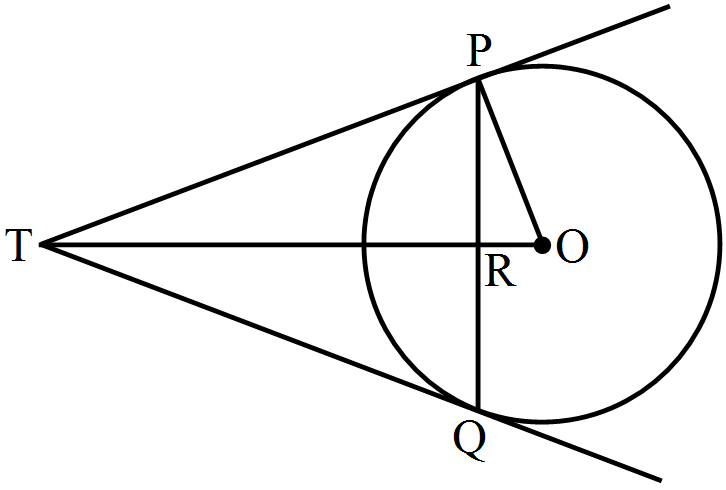
PQ is a chord of length 16cm of a circle of radius 10cm. The tangent at P and Q intersect at point T as shown in the figure.
Finf the length of TP.
The sum of the 4th and 8th terms of an AP is 24 and the sum of the 6th and 10th term is 44. Find the first three terms of the AP.
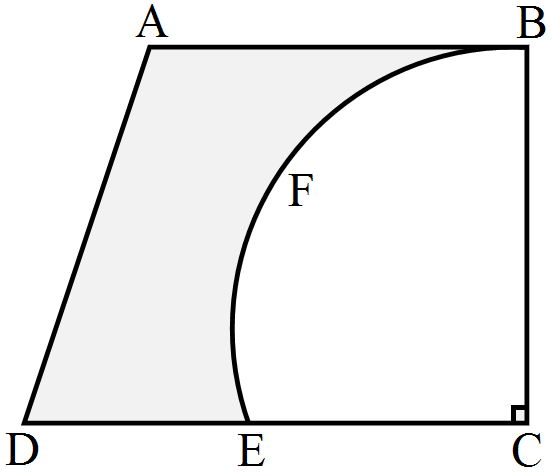
From a thin metallic piece in the shpe of a trapezium ABCD in which $\text{AB}||\text{CD}$ and $\angle\text{BCD}=90^\circ$ a quarter circle BFEC is removed. Given, AB = BC = 3.5cm and DE = 2cm, calculate the area of remaining (shaded) part of metals sheet.