Question
Solve for x and y:
$\text{2x}+\text{3y}+1=0,$
$\frac{7-\text{4x}}{3}=\text{y}$

Answer

The given equations are: 7 - 4x = 3y -4x - 3y = -7 4x + 3y = 7 ...(1) 2x + 3y = -1 ...(2)Subtracting (2) from (1), we get
2x = 8
$\therefore$ x = 4
Substitution x = 4 in (1), we get
4 × 4 + 3y = 7
⇒ 3y = 7 - 16
⇒ 3y = -9
⇒ y = -3
$\therefore$ Solution is x = 4 and y = -3

Need a full question paper?

Generate a complete, print-ready paper with questions like this in minutes — across 16+ boards, with answer keys.
Start Generating Free

Similar questions

A straight highway leads to the foot of a tower. A man standing at the top of the tower observes a car at an angle of depression of 30°, which is approaching the foot of the tower with a uniform speed. Six seconds later, the angle of depression of the car is found to be 60°. Find the further time taken by the car to reach the foot of the tower from this point.
Find the mass of a $3.5\ m$ long lead pipe, if the external diameter of the pipe is $2.4\ cm$, thickness of the metal is $2\ mm$ and the mass of $1\ cm^3$ of lead is $11$.4g.
Prove that $\sqrt{3}$ is an irrational number.
If $d_1, d_2 (d_2 > d_1)$ be the diameters of two concentric circles and c be the length of a chord of a circle which is tangent to the other circle, prove that . $\text{d}^2_2=\text{c}^2+\text{d}^2_2$
Evaluate the following:
$4\big(\sin^430^\circ+\cos^260^\circ\big)-3\big(\cos^245^\circ-\sin^290^\circ\big)-\sin^260^\circ$
The $7^{\text {th }}$ term of an $A.P$. is $32$ and its $13^{\text {th }}$ term is $62$ . Find the $A.P.$
Prove that the surface area of a sphere is equal to the curved surface area of the circumscribed cylinder.
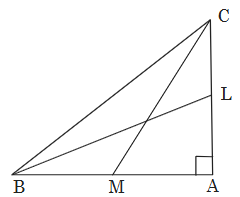
In figure $, BL$ and $CM$ are medians of a $\triangle ABC$ right $-$ angled at $A$ . Prove that $4\left( BL ^2+ CM ^2\right) =5\  BC ^2$.
Image
If the sum of the first $14$ terms of an $A.P.$ is $1050$ and its first term is $10$ find its $20^{th}$​​​​​​​ term.
The ratio of the sums of first m and first $n$ terms of an $A.P.$ is $m^2: n^2$. Show that the ratio of its $m ^{\text {th }}$ and $n ^{\text {th }}$ terms is $(2m - 1):(2n -1 ).$